Plant care card
Jewel orchid
Ludisia discolor · Orquídea joya
Also called golden lace orchid or black jewel orchid
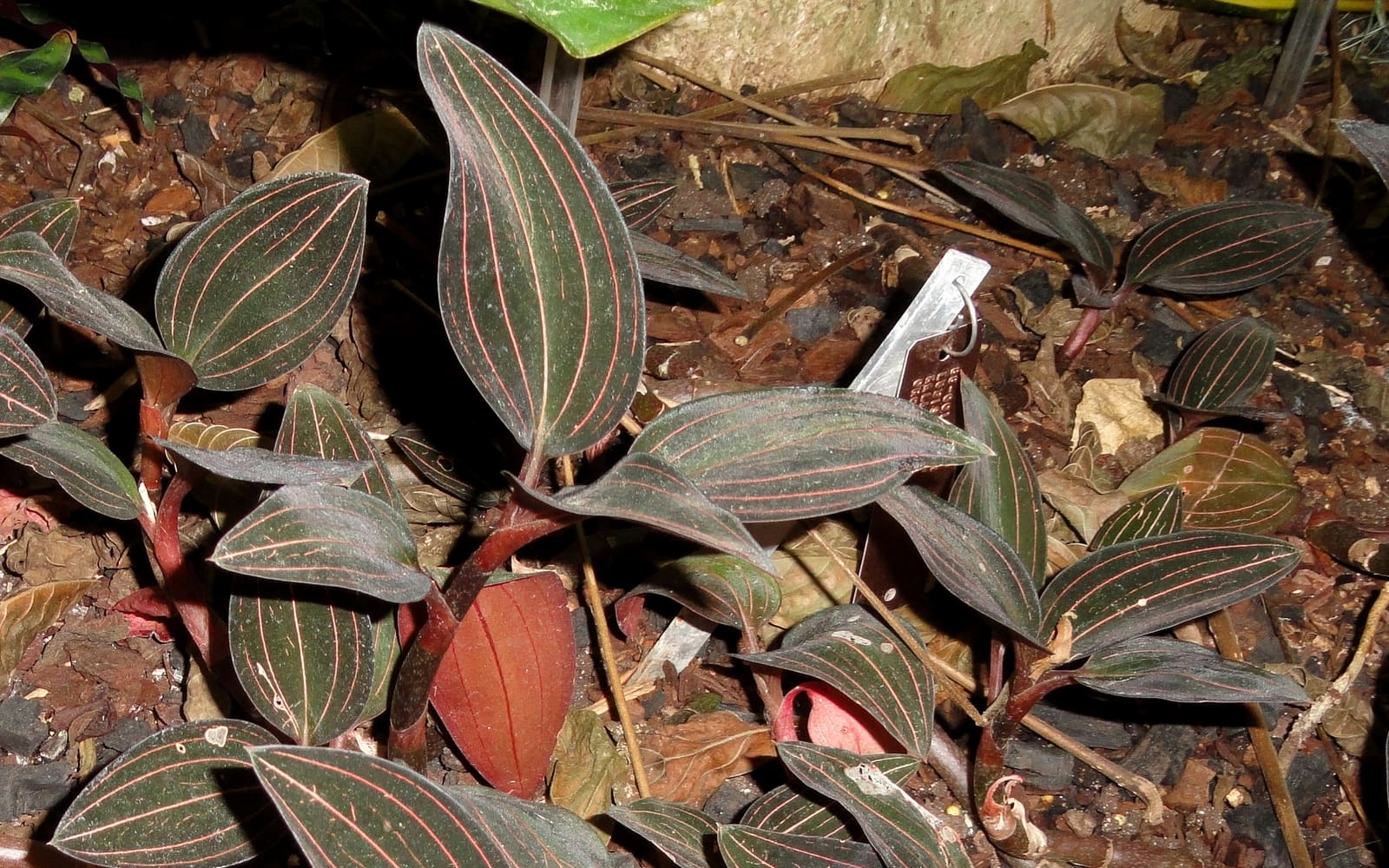
Photo by Daderot on Wikimedia Commons, CC0 1.0

The jewel orchid (Ludisia discolor) is the orchid you grow for its leaves: velvety, nearly black or deep green, with fine pink to gold veins. It grows in the ground in the wild, so it's easier than most orchids in an ordinary pot: keep its soil-like mix evenly moist, give it gentle light from a north or east window, and add some humidity. In winter, it sends up spikes of small white flowers as a bonus.
Non-toxic to cats, dogs and horses
No signs of poisoning listed. The ASPCA lists it under its old name, Haemaria discolor, and NC State agrees. Any plant can still upset a pet’s stomach if it eats enough. Children: No poison information listed for people.
Pet poison line: ASPCA (888) 426-4435
Good for: a north or east window, terrariums, people who love leaves more than flowers · Think twice if: you often forget to water for a week or more, your air is very dry and you won’t add a tray, humidifier or terrarium.
Needs at a glance
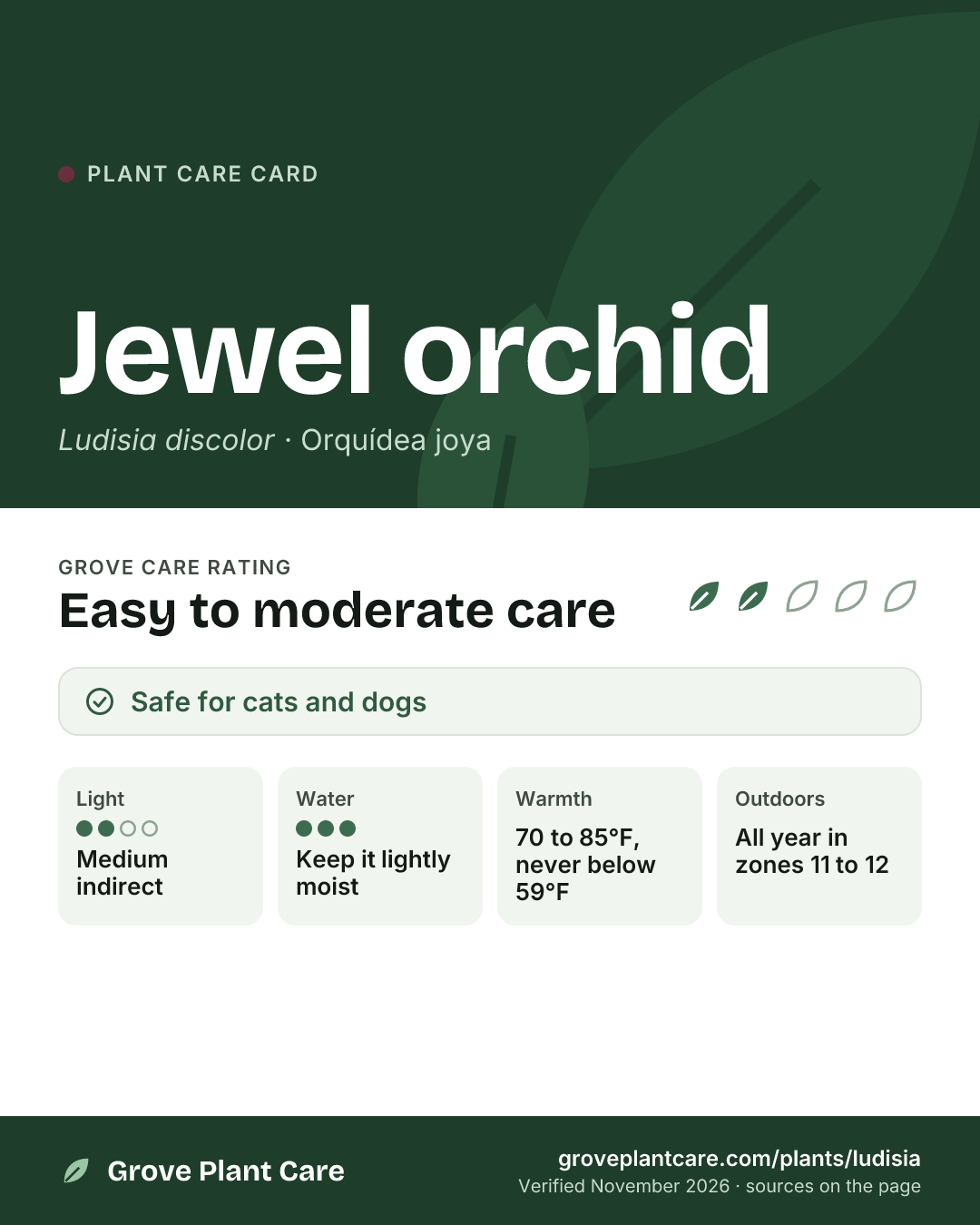
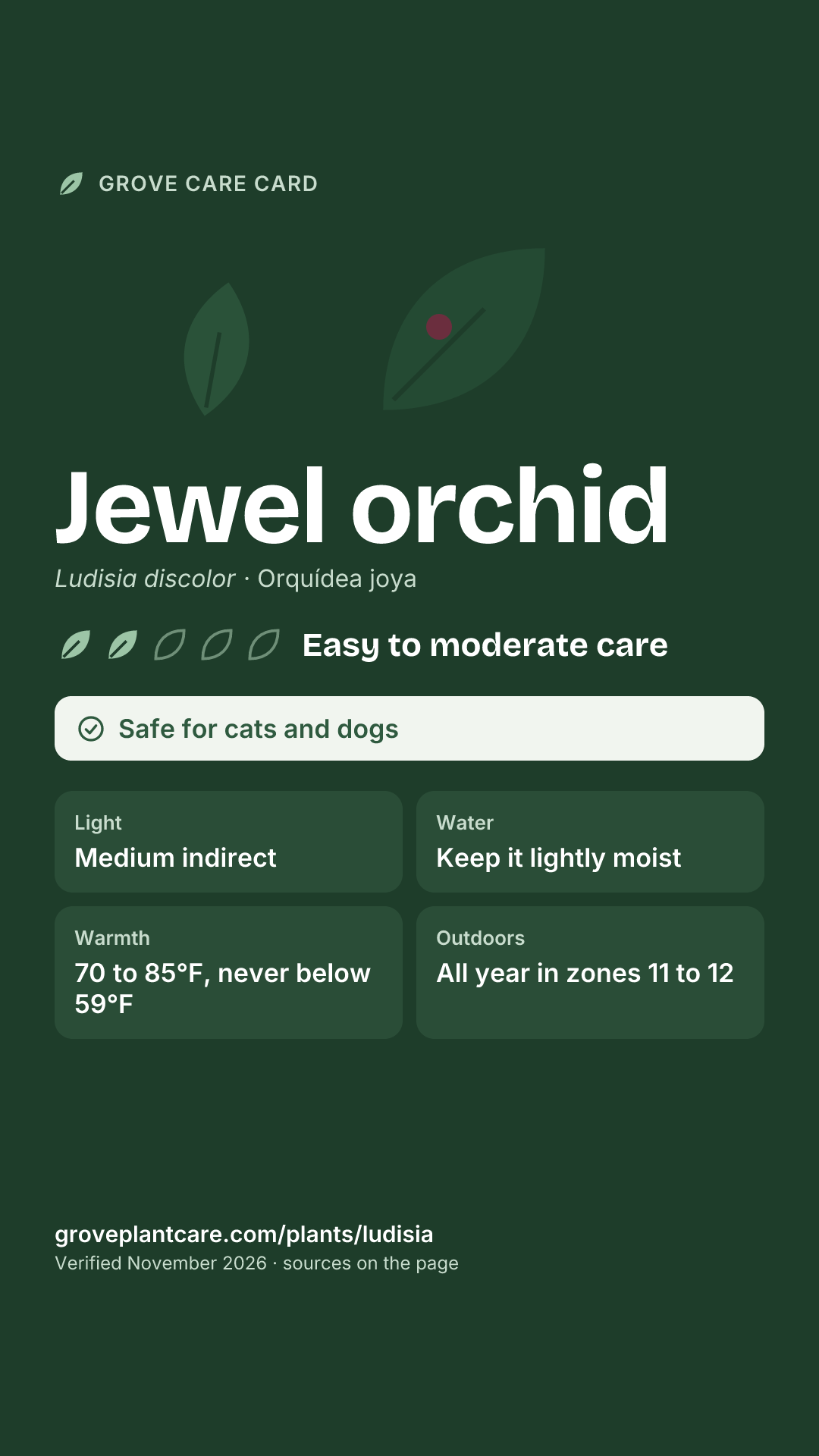
- Light2 of 4 · Medium indirectA north or east window; keep it out of direct sun
- Water3 of 3 · Keep lightly moistEvenly moist with tepid water, never soggy
- Humidity2 of 3 · Above averageA pebble tray, a humidifier or a terrarium
- Soil when pottedAfrican violet type mixOr a fine bark mix, in a shallow, wide pot
Indoors: best at 70 to 85°F (21 to 29°C). Keep it above 59°F (15°C) and away from drafts and heat vents.
How the rating adds up
0 = easiest · 1 = moderate · 2 = hardest
- Missed waterings2 of 2 · HardestKeep it evenly moist; it dislikes drying out
- Light flexibility0 of 2 · EasiestHappy in shade; direct sun is too much
- Humidity1 of 2 · ModerateLikes humid air; a tray or terrarium helps
- Pests and disease1 of 2 · ModerateMealybugs; rot if the mix stays soggy
- Sensitivity to change0 of 2 · EasiestAdapts to ordinary home conditions
Growing outdoors
All year: USDA zones 11 to 12, where the coldest winter nights average 40°F (4°C) or warmer.
Elsewhere: summer outside in shade. Bring it in before nights drop below 59°F (15°C).
- Containers
- Terrariums
Sources: NC State, American Orchid Society, UConn, NParks, RHS, ASPCA, ASPCA plant list, Kew, Smithsonian Gardens, Iowa State and USDA zone map. Full list below.
Verified · How we rate plants
How often should I water a jewel orchid?
Often enough to keep the mix evenly moist all year, never soggy. Unlike the moth orchid, which dries out between drinks in bark, the jewel orchid grows in the ground, and the American Orchid Society, NC State, UConn and Singapore's NParks all say to keep it steadily moist. Use tepid water, and let the pot drain, because a waterlogged mix rots the roots and stems fast. One source disagrees: the RHS says to let the compost dry out between waterings. If yours sulks when it stays wet, try a little longer between drinks.
How much light does a jewel orchid need?
Less than most orchids. The RHS suggests a north-facing spot, NC State lists partial shade, and NParks grows it in semi-shade to full shade. Direct sun is too much for those velvet leaves. A north window, or an east window a few feet back, suits it, and so does a terrarium under ordinary room light.
Does a jewel orchid need a terrarium?
It doesn't have to live in one, but it likes the humid air a terrarium gives. NC State says it needs warm, humid conditions, and UConn counts jewel orchids among the plants that really want high humidity. On the other side, the American Orchid Society calls it adaptable as a houseplant with no special setup. Start with a pebble tray or a humidifier nearby; if the leaf edges dry out, a terrarium or a glass dome is the next step. Smithsonian Gardens notes it's a common terrarium plant.
NC State, UConn, American Orchid Society, Smithsonian Gardens, NParks
What potting mix does a jewel orchid need?
A moist, soil-like mix, the opposite of chunky orchid bark. The American Orchid Society suggests a mix like you'd use for African violets, and NParks agrees; NC State and the RHS also allow a fine bark mix. Use a shallow, wide pot, because the stems creep sideways along the surface and can spread to about 2 feet.
Does a jewel orchid flower?
Yes, usually in winter. Each leafy stem can send up an upright spike of small white flowers with a yellow center, and the flowers open one after another, which stretches the show. Smithsonian Gardens says the lip and column twist in opposite directions. The RHS suggests cutting the flower stem back once it's done. Sources disagree on scent: Smithsonian Gardens and NParks call the flowers fragrant, while the American Orchid Society knows of no fragrance.
American Orchid Society, Smithsonian Gardens, NC State, RHS, NParks
How do I propagate a jewel orchid?
From stem cuttings, which is why a broken stem is good news. The RHS roots fleshy stems that snap off in damp sphagnum moss, which takes about six weeks. The American Orchid Society roots leafy stems in a terrestrial mix after flowering, and Smithsonian Gardens and NParks say a stem in a glass of water roots in a few weeks.
RHS, American Orchid Society, Smithsonian Gardens, NParks, NC State
Is a jewel orchid safe for cats and dogs?
Yes. The ASPCA lists the jewel orchid as non-toxic to cats, dogs and horses under its old name, Haemaria discolor, which Kew's checklist treats as the same plant as Ludisia discolor, and NC State tags it non-toxic too. Any plant can still upset a pet's stomach if it eats enough, so keep a determined chewer away from the leaves.
Can a jewel orchid live outdoors?
Only in the tropics. NC State lists USDA zones 11 to 12 and a shady spot, where the coldest nights stay around 40°F (4°C) or warmer. The RHS is more cautious and keeps it above 59°F (15°C) all year. Elsewhere, it can spend summer outside in shade if you like, and should come back in before nights drop below 59°F.
How Grove helps
Grove reminds you to check the pot before it dries out, so a busy week doesn't crisp those velvet leaves. You can assign the check to whoever is home, and add a reminder to refill the pebble tray.
Sources
- NC State Extension Gardener Plant Toolbox: Ludisia discolor
- American Orchid Society Q&A: Jewel Orchids
- UConn Home & Garden Education Center: humidity and houseplants (2026 article)
- National Parks Board Singapore, Flora & Fauna Web: Ludisia discolor
- RHS plant entry: Ludisia discolor (black jewel orchid)
- American Orchid Society: Ludisia
- ASPCA Animal Poison Control: Jewel Orchid (Haemaria discolor)
- ASPCA Animal Poison Control: Toxic and Non-Toxic Plants
- Kew: World Checklist of Vascular Plants (June 2026 release), the data behind Plants of the World Online
- Smithsonian Gardens Plant Explorer: Ludisia discolor
- Iowa State University Extension: Growing Orchids Indoors
- USDA ARS Plant Hardiness Zone Map (2023)
- Orchids of the Philippines (Naturalis Biodiversity Center): Ludisia