Plant care card
Cattleya
Cattleya · Orquídea cattleya
Also called corsage orchid or queen of orchids
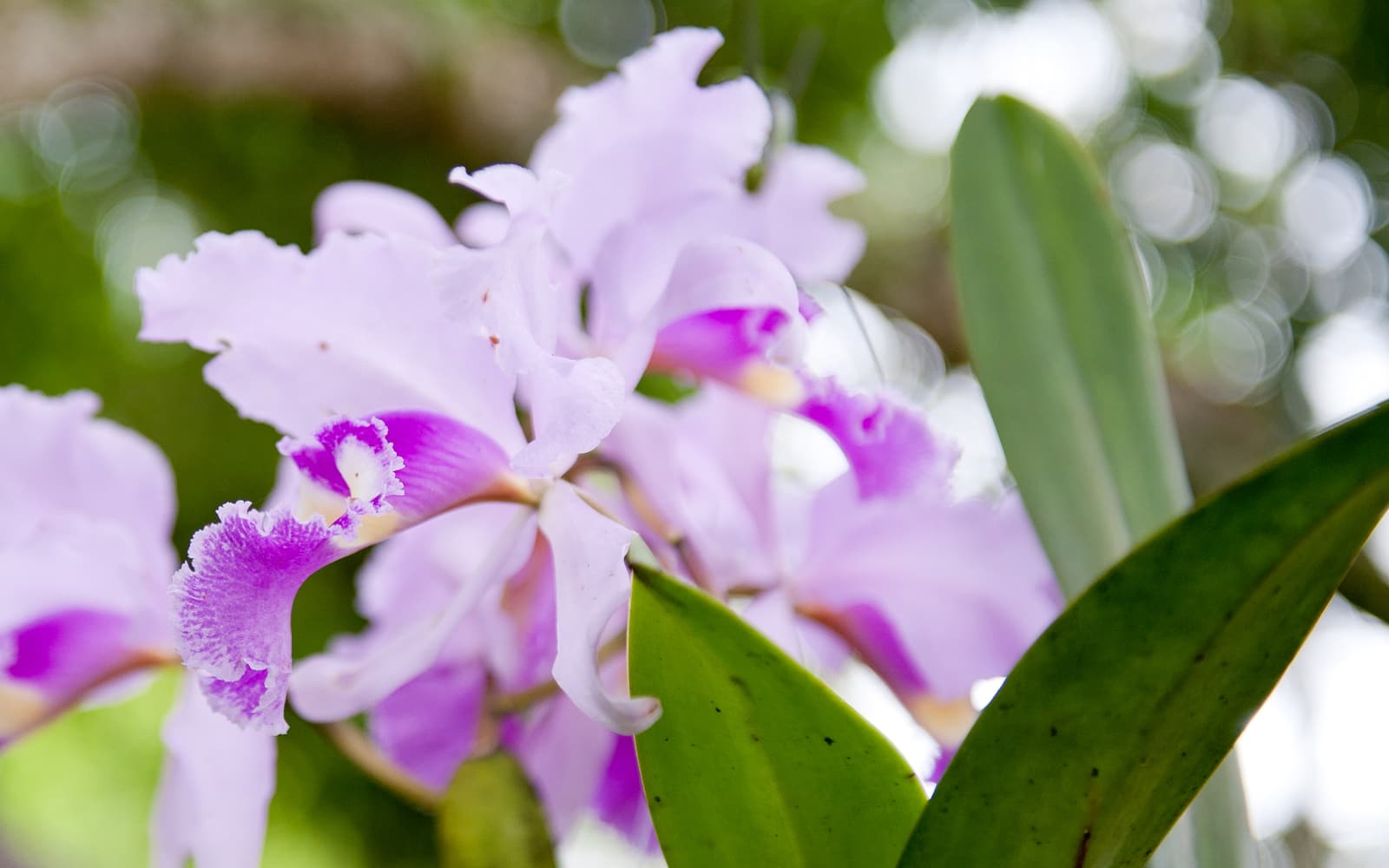
Photo by Mario Carvajal on Wikimedia Commons, CC BY 2.0

Cattleyas, the big, often fragrant corsage orchids, are happy in a home if you give them your brightest window. Let the bark dry out completely between waterings, keep the air at about 50% humidity, and give it cooler nights than days. Light is the deal breaker: in a dim spot a cattleya grows leaves and never blooms.
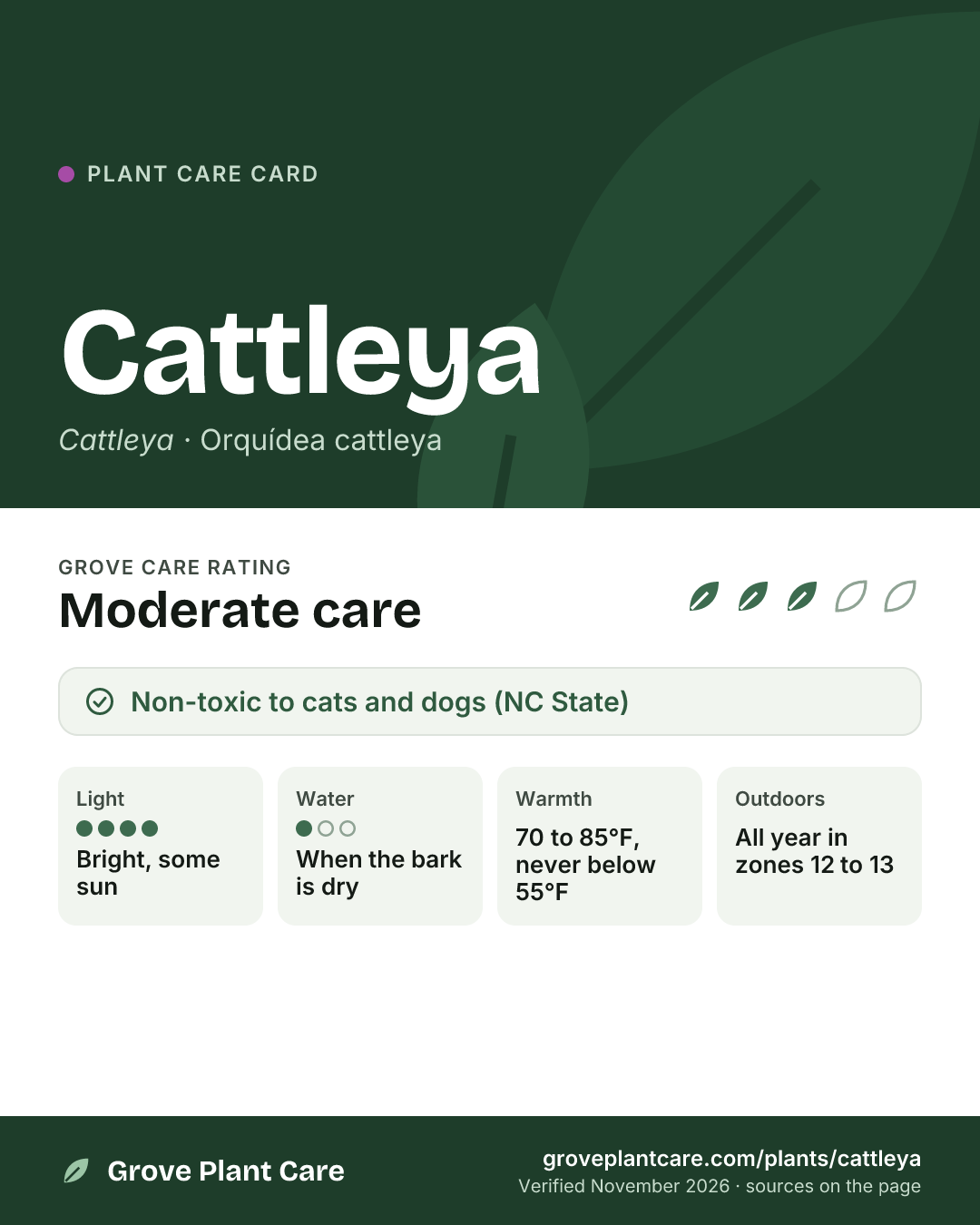
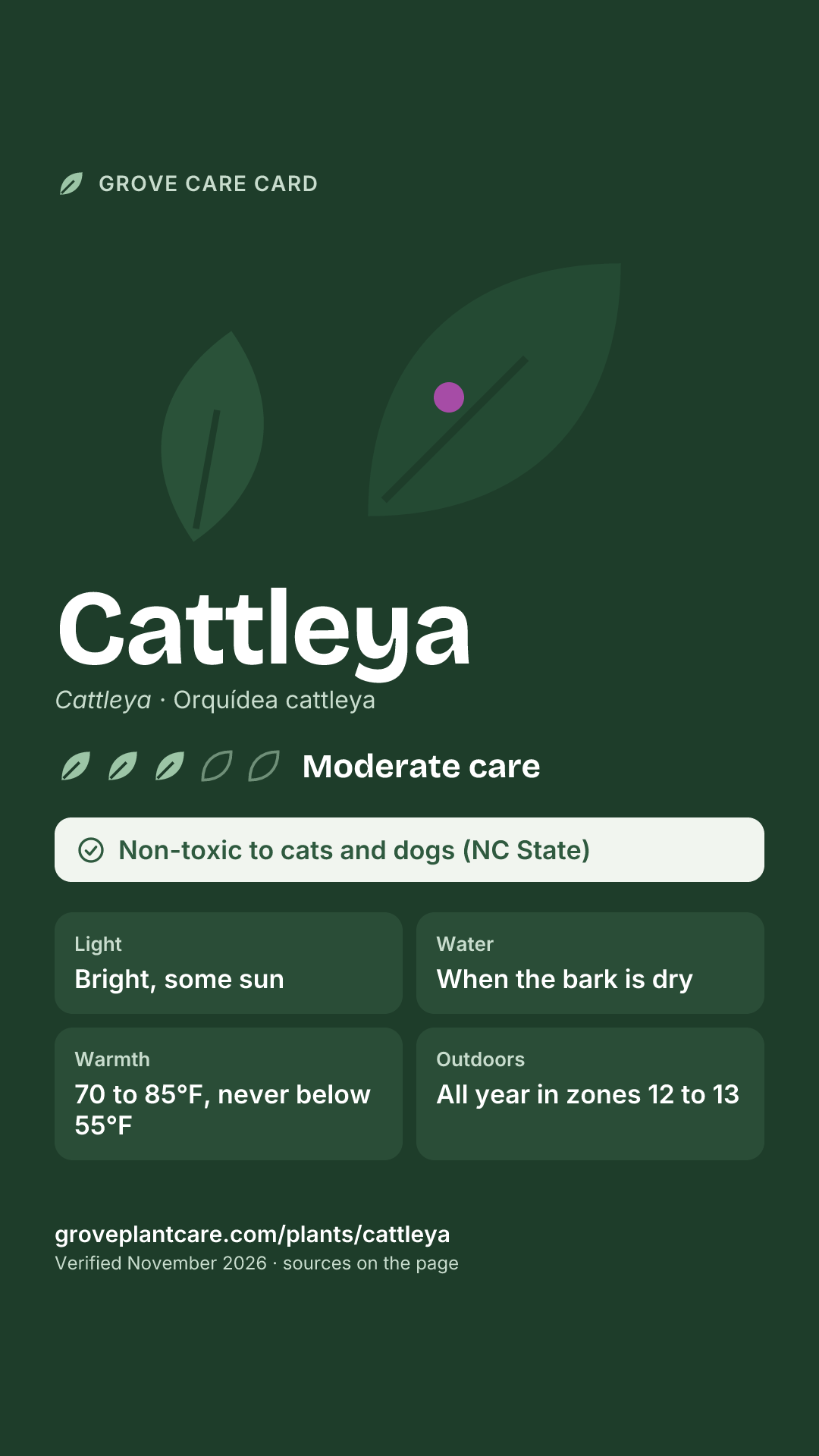
Non-toxic to cats and dogs (NC State)
No signs of poisoning listed. The ASPCA lists four species as non-toxic: C. trianae (as C. trianaei), C. mossiae, C. forbesii and C. labiata. Any plant can still upset a pet’s stomach if it eats enough. Children: No poison risk listed.
Pet poison line: ASPCA (888) 426-4435
Good for: your brightest window, people who tend to underwater, homes with cats and dogs · Think twice if: your only window faces north or sits in shade, you water every plant on the same day.
Needs at a glance
- Light4 of 4 · Bright, some sunAn east or west window, or south behind a sheer curtain
- Water1 of 3 · Let it dry outWater when the bark is dry and the pot feels light; minis need it more often
- Humidity2 of 3 · Above average50% or more; a pebble tray helps
- Soil when pottedCoarse orchid barkWith the rhizome sitting on top, never buried
Indoors: best at 70 to 85°F (21 to 29°C). Keep it above 55°F (13°C) and away from drafts and heat vents.
How the rating adds up
0 = easiest · 1 = moderate · 2 = hardest
- Missed waterings0 of 2 · EasiestShould dry out completely between waterings
- Light flexibility2 of 2 · HardestNeeds high light; it won’t bloom without it
- Humidity1 of 2 · ModeratePrefers 50% humidity or more
- Pests and disease1 of 2 · ModerateScale, mealybugs and thrips; rot if water sits on it
- Sensitivity to change1 of 2 · ModerateDislikes softened or cold water; repot only as new roots start
Growing outdoors
All year: USDA zones 12 to 13, where the coldest winter nights average 50°F (10°C) or warmer.
Elsewhere: summer outside in filtered sun. Bring it in when nights reach 55 to 60°F (13 to 16°C).
- Containers
- Hanging baskets
Sources: NC State, Iowa State, American Orchid Society, Clemson, NYBG, ASPCA, ASPCA plant list and USDA zone map. Full list below.
Verified · How we rate plants
How often should I water a cattleya?
When the bark is dry, which for a big plant is usually every 7 to 10 days, according to the American Orchid Society. Minis and young plants hold less water, so they need it every 5 to 7 days. Cattleyas store water in their thick pseudobulbs, and NC State and Iowa State both say to let the mix dry completely before you water again. Run lukewarm water through the pot for about a minute, then let it drain fully. You’ll soon tell by the weight of the pot when it’s time, and if in doubt, wait a day. Skip softened water, water colder than 50°F (10°C) and ice cubes.
How much light does a cattleya need?
A lot. Cattleyas are in the high-light group of orchids: Clemson says about twice what a moth orchid wants. An east or west window works well, or a south window behind a sheer curtain, so hot midday sun doesn’t burn the leaves. The leaves tell you if it’s right: medium green is good, and dark green means it needs more light. The American Orchid Society says some direct sun, around four hours a day, helps it bloom indoors.
Why won’t my cattleya bloom?
Almost always too little light. Every source we checked says a cattleya in a dim spot won’t flower, and dark green leaves or floppy pseudobulbs are the clue. Move it to your brightest window first. It also blooms better when nights are clearly cooler than days: the American Orchid Society suggests a drop of 10 to 15°F (5 to 8°C) in one sheet and 15 to 20°F (8 to 11°C) for mature plants in another, and NYBG says about 10°F. Most cattleyas bloom once a year, in spring or fall, and some hybrids bloom more often.
What do I do when the flowers fade?
Cut off the spent flowers, and cut the flower stem at its base once it turns brown. Then keep watering and feeding it as usual. The American Orchid Society says it will start its next bloom cycle within a year. Each flower lasts about 2 to 6 weeks, according to Clemson.
When should I repot a cattleya?
Every two to three years, when the rhizome, the creeping stem the pseudobulbs grow from, hangs over the pot edge, or when the bark breaks down and stays wet. The best moment is when new roots or shoots are just starting, often in spring or right after flowering. Use coarse orchid bark and set the rhizome on top, never buried, because a buried rhizome can rot. If you divide it, keep at least three plump pseudobulbs in each piece.
How warm should I keep a cattleya?
Days of 70 to 85°F (21 to 29°C) and nights of about 55 to 60°F (13 to 16°C), according to NC State and the American Orchid Society. Clemson puts the night minimum a little higher, at 60°F (16°C). Remember that a windowsill can get much colder or hotter than the rest of the room.
Is a cattleya safe for cats and dogs?
NC State lists the whole Cattleya genus as non-toxic to cats, dogs and horses. The ASPCA doesn’t rate the genus, but it lists four species as non-toxic: Cattleya trianae (spelled trianaei on its page), C. mossiae, C. forbesii and C. labiata. We found no trusted source that calls any cattleya toxic. Any plant can still upset a pet’s stomach if it eats enough.
Can a cattleya live outdoors?
In summer, yes, almost anywhere: NC State says it can go outside, and NYBG suggests filtered light in summer. Bring it in before nights drop below about 55 to 60°F (13 to 16°C), the night range NC State and the American Orchid Society give; the AOS adds that cattleyas need protection below 50°F, especially in bud or flower. All year, sources differ: NC State lists USDA zones 10 to 12, but only zones 12 and 13, where the coldest winter nights stay above 50°F, are that warm, so those are the zones on the card. In zones 10 and 11, cover it or bring it in on cold nights.
How Grove helps
Grove turns watering into a check of the bark instead of a fixed day, so the pot gets to dry out first. You can add a fall reminder to move it to your brightest window, and assign it to whoever is home.
Sources
- NC State Extension Gardener Plant Toolbox: Cattleya
- Iowa State University Extension: Growing Orchids Indoors
- American Orchid Society: Novice Culture Sheet, Cattleya
- American Orchid Society: Cattleya culture sheet
- Clemson Cooperative Extension HGIC: Orchids
- New York Botanical Garden LibGuides: Cattleya
- ASPCA Animal Poison Control: Christmas Orchid (Cattleya trianaei)
- ASPCA Animal Poison Control: Toxic and Non-Toxic Plants
- American Orchid Society: Orchid Parts and Why They Matter (2024)
- American Orchid Society: Cold Tolerance of Warm Growing Orchids (2024)
- USDA ARS Plant Hardiness Zone Map (2023)
- Kew Plants of the World Online: Cattleya
- International Plant Names Index: Cattleya trianae Linden & Rchb.f.
- Ministerio de Ambiente de Colombia: Resolución 0956 de 2010 (Año Nacional de las Orquídeas)
- Aldana-Jauregui, Cárdenas-Henao y Toro-Perea (2026), diversidad genética y conservación de Cattleya trianae, Revista de Biología Tropical 74(1)
- ColPlanta (Kew y Universidad Nacional de Colombia): Cattleya trianae, nombres comunes
- Kew: World Checklist of Vascular Plants (June 2026 release), the data behind Plants of the World Online