Plant care card
Spider orchid
Brassia · Orquídea araña
Also called brassia
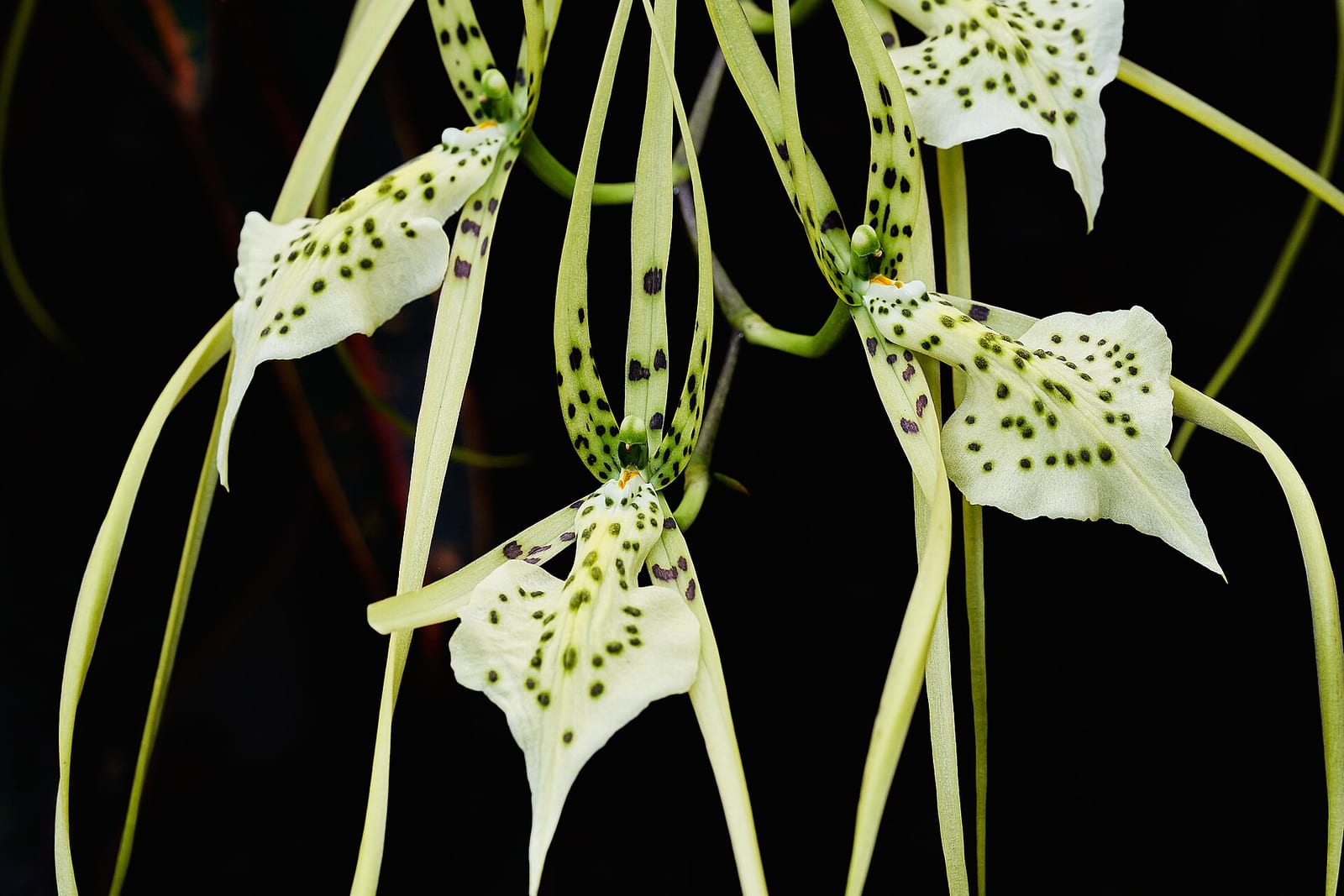
Photo by geoff mckay on Wikimedia Commons, CC BY 2.0

The spider orchid (Brassia) wants bright, filtered light, nights no colder than about 59°F (15°C), and water whenever the pot feels light. It grows on trees in the wild, so give it an open bark mix in a snug pot and repot only every two to three years. Its long, thin petals make the flowers look like spiders, and that look is how it gets pollinated.
Not rated for pets
Neither the ASPCA nor NC State rates Brassia orchids. The “Brassia actinophylla” on the ASPCA’s toxic list is the umbrella tree (Schefflera), a different plant. No reputable source lists a Brassia orchid as toxic, but none rates it either. Children: No poisoning information found.
Pet poison line: ASPCA (888) 426-4435
Good for: a bright room with filtered light, a sunroom or greenhouse, fans of big, spidery flowers · Think twice if: you like to repot often, your home drops below about 59°F (15°C) at night.
Needs at a glance
- Light3 of 4 · Bright indirectBright, filtered light out of direct sun; an east or west window
- Water2 of 3 · Let it dry a littleWater when the pot feels light; less in winter
- Humidity2 of 3 · Above averageMoist air with a gentle breeze
- Soil when pottedOpen orchid bark mixBark with grit, sphagnum or coir, in a pot or basket that drains
Indoors: best at 65 to 77°F (18 to 25°C). Keep it above 59°F (15°C) and away from drafts and heat vents.
How the rating adds up
0 = easiest · 1 = moderate · 2 = hardest
- Missed waterings1 of 2 · ModerateSteady water all year, drying a little in between
- Light flexibility1 of 2 · ModerateBright, filtered light; sources disagree on direct sun
- Humidity1 of 2 · ModerateLikes moist, moving air
- Pests and disease1 of 2 · ModerateMealybugs, aphids and scale; rarely gets sick
- Sensitivity to change1 of 2 · ModeratePrefers a snug pot and repotting only every 2 to 3 years
Growing outdoors
All year: USDA zone 13, where the coldest winter nights average 59°F (15°C) or warmer.
Elsewhere: summer outside in shade. Bring it in before nights drop below 59°F (15°C).
- Containers
- Baskets
- Sunrooms and greenhouses
Sources: American Orchid Society, RHS, U.S. Botanic Garden, ASPCA plant list, NC State and USDA zone map. Full list below.
Verified · How we rate plants
Why is it called a spider orchid?
Its sepals and petals are long and narrow, so each flower looks like a spider. The look has a job: Cornell's conservatory and the RHS explain that female spider-hunting wasps mistake the flower for prey, sting the lip, and leave carrying pollen to the next flower. Other plants share the name, though. In Australia, spider orchids are Caladenia, which grow in the ground, and in Europe the early spider-orchid is Ophrys sphegodes. Check the botanical name on the tag before you look up care.
Cornell, American Orchid Society, RHS, RBG Victoria, NBN Atlas
How often should I water a spider orchid?
Whenever the pot feels light, and a little less in winter. The American Orchid Society says to water steadily all year and let the roots dry out somewhat between waterings, and the RHS says to water when the pot feels light and let the water drain away freely. Since the American Orchid Society asks for water all year, don't leave it bone dry for weeks.
How much light does a spider orchid need?
Bright light, and sources disagree on how much sun. The RHS says bright, filtered light out of direct sun, in an east, west or even north window. The American Orchid Society calls it medium to bright. The U.S. Botanic Garden puts it with its high-light orchids, which do best in a south or west window. Start with a bright east or west window, and keep it out of hot midday sun, as the RHS advises.
How warm does it need to be?
Warm rooms suit it. The RHS gives about 59°F (15°C) as the lowest night temperature for the wild species and up to 77°F (25°C) by day, and the American Orchid Society calls it an intermediate grower. The award-winning hybrid Eternal Wind takes nights down to 55°F (13°C) and days up to 84°F (29°C). Keep it away from radiators and heat vents, which the RHS warns against.
When should I repot it?
Only when it outgrows its pot or the bark breaks down, about every two to three years. The RHS says it grows best slightly pot-bound, and the American Orchid Society says to wait until new roots start growing, after new shoots appear. Use an open bark mix in a pot or basket that drains well.
What are the roots growing out of the pot?
Aerial roots, and they're normal. The RHS notes that spider orchids make them, the same way they reach into the air on tree branches in the wild.
Is a spider orchid safe for cats and dogs?
We can't say yet. Neither the ASPCA nor NC State rates Brassia orchids, and we found no reputable source that lists one as toxic. One thing to watch for: the ASPCA's toxic list includes an octopus tree written as "Schefflera or Brassia actinophylla". That's the umbrella tree, whose old name was Brassaia, a different plant that NC State lists as poisonous. If your pet chewed a plant and seems unwell, call your vet or the ASPCA Animal Poison Control Center at (888) 426-4435.
Can a spider orchid live outdoors?
Only all year where nights stay at about 59°F (15°C) or warmer. No source gives USDA zones for Brassia, but only zone 13 stays that warm, so that's the zone on the card. Elsewhere, the RHS says it can spend summer outside in a sheltered, shady spot. Bring it in before nights cool to about 59°F (15°C).
How Grove helps
Grove turns watering into a quick check of how heavy the pot feels, so the bark never stays soggy. Add a reminder to bring it in when nights cool down in fall, and assign it to whoever is home.
Sources
- American Orchid Society: Brassia
- Royal Horticultural Society: Brassia caudata plant details
- U.S. Botanic Garden: Orchid Home Care
- Royal Horticultural Society: Brassia Eternal Wind gx plant details
- Royal Horticultural Society: Brassia verrucosa (spider orchid) plant details
- ASPCA Animal Poison Control: Toxic and Non-Toxic Plants
- NC State Extension Gardener Plant Toolbox: Schefflera actinophylla (formerly Brassaia actinophylla)
- USDA ARS Plant Hardiness Zone Map (2023)
- Kew Plants of the World Online: Brassia
- Kew: World Checklist of Vascular Plants (June 2026 release), the data behind Plants of the World Online
- Cornell University Liberty Hyde Bailey Conservatory: Brassia spp. (spider orchid)
- Royal Botanic Gardens Victoria: Terrestrial Orchid Collection
- NBN Atlas: Ophrys sphegodes (early spider-orchid)
- UF/IFAS Gardening Solutions: Florida's Native Orchids
- Atlas of Florida Plants, USF Institute for Systematic Botany: Brassia caudata
- New York Botanical Garden Mertz Library: Oncidium Intergeneric Hybrid Orchids
- Royal Botanic Gardens Victoria, Horticultural Flora of South-eastern Australia: Brassia