Plant care card
Zebra plant
Aphelandra squarrosa · Planta cebra
Also called saffron spike or aphelandra
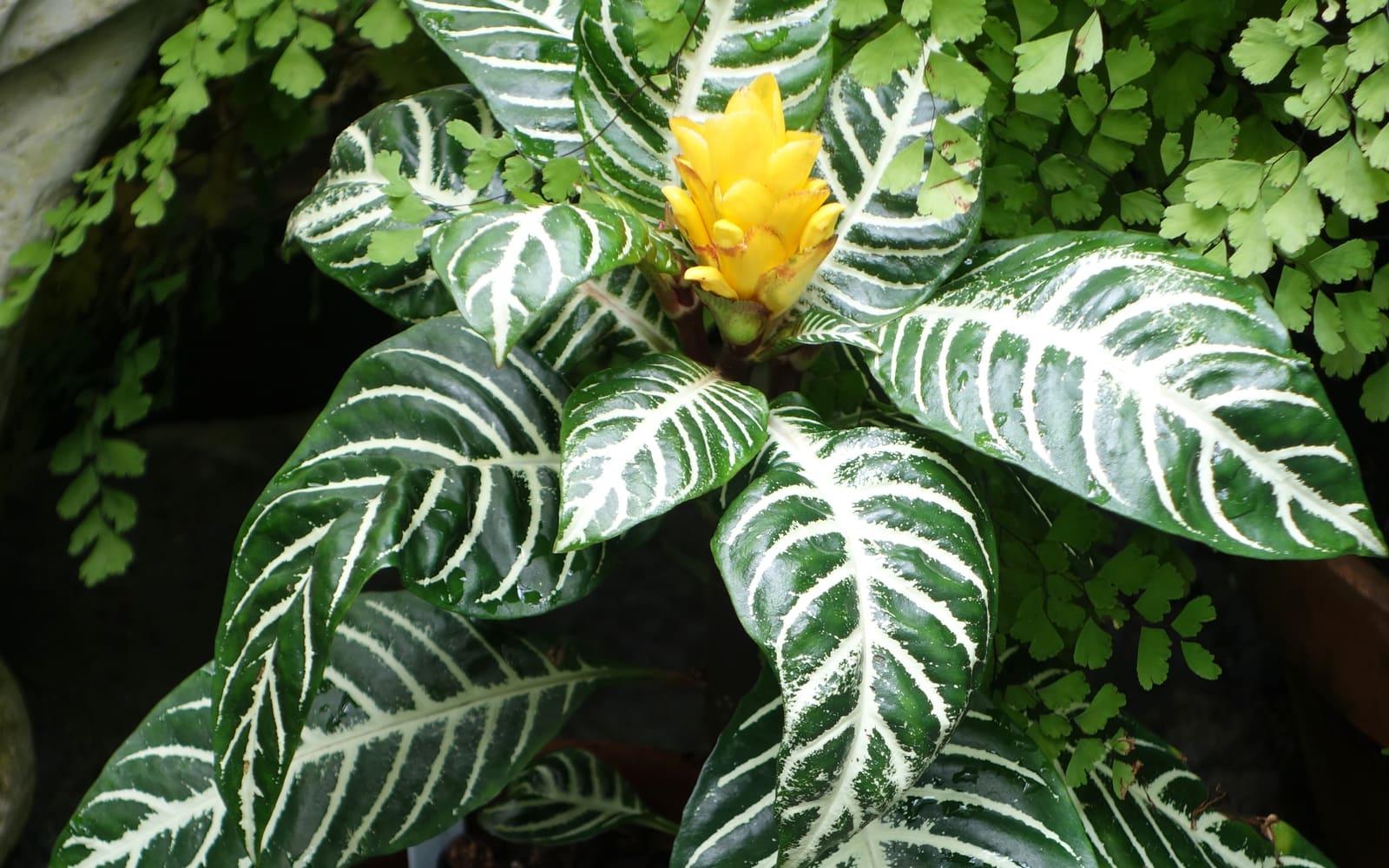
Photo by Daderot on Wikimedia Commons, CC0 1.0

The zebra plant (Aphelandra squarrosa) is a Brazilian shrub with glossy, white-striped leaves and a spike of yellow bracts on top. It's fussier than most houseplants: give it bright indirect light, keep the soil evenly moist, keep it warm, above 65°F (18°C), and give it humid air, or the leaves brown and drop. The ASPCA lists it as non-toxic to cats, dogs and horses. Two other plants share its name, the zebra haworthia succulent and the zebra prayer plant, and their care is very different.
Non-toxic to cats, dogs and horses
No signs of poisoning listed. The ASPCA lists it as non-toxic under the name saffron spike zebra; NC State agrees. Children: low severity. Not listed as poisonous; NParks Singapore lists the sap as an irritant.
Pet poison line: ASPCA (888) 426-4435
Good for: bright, humid rooms such as a bathroom, bold striped leaves, yellow flower spikes that last weeks · Think twice if: your home has dry air in winter, you often forget to water, your rooms run cool in winter.
Needs at a glance
- Light3 of 4 · Bright indirectLots of bright light, out of hot direct sun
- Water3 of 3 · Keep lightly moistMoist while it grows; a little less in winter, never bone dry
- Humidity3 of 3 · HighA tray of wet pebbles or a bright bathroom helps
- Soil when pottedRich mix that drains fastHigh in organic matter and slightly acidic, with added grit
Indoors: best at 65°F (18°C) or warmer. Keep it above 59°F (15°C) and away from drafts and heat vents.
How the rating adds up
0 = easiest · 1 = moderate · 2 = hardest
- Missed waterings2 of 2 · HardestNever let the mix dry out; dry soil drops the lower leaves
- Light flexibility1 of 2 · ModerateBright, indirect light; too much sun scorches the leaves
- Humidity2 of 2 · HardestNeeds high humidity; dry air browns the leaf tips
- Pests and disease1 of 2 · ModerateSometimes aphids, scale, mealybugs, whiteflies or spider mites
- Sensitivity to change1 of 2 · ModerateCool rooms and dry spells make it drop leaves
Growing outdoors
All year: USDA zones 11 to 12, where the coldest winter nights average 50°F (10°C) or warmer.
Elsewhere: summer outside in bright shade, such as a covered patio. Bring it in when nights reach 60 to 65°F (16 to 18°C).
- Houseplant
- Pot on a shaded patio in summer
- Shrub in frost-free tropical gardens
Sources: NC State, University of Arkansas, RHS, NParks Singapore, ASPCA, ASPCA plant list, USDA zone map, Clemson, FISC, Hawaii noxious weed list and Rojas-Sandoval and Acevedo-Rodríguez. Full list below.
Verified · How we rate plants
Is the zebra plant toxic to cats and dogs?
No. The ASPCA lists Aphelandra squarrosa as non-toxic to dogs, cats and horses, under the name saffron spike zebra, and NC State also lists it as non-toxic. NParks Singapore notes that the sap can irritate skin, so wash your hands after pruning. The zebra haworthia succulent is on the ASPCA non-toxic list too. If your pet seems unwell after chewing it, call your vet or the ASPCA Animal Poison Control Center at (888) 426-4435.
Which zebra plant do I have?
Three different houseplants go by zebra plant, and NC State uses the name for all of them. This one, Aphelandra squarrosa, is a leafy shrub with glossy dark green leaves striped along the veins with white and a yellow flower spike on top. The zebra haworthia (Haworthiopsis fasciata or H. attenuata, often sold as Haworthia) is a small, slow-growing succulent from South Africa that NC State rates low maintenance. The zebra prayer plant (Goeppertia zebrina, formerly Calathea zebrina) is a calathea from the rainforests of Brazil that grows from rhizomes; our calathea card covers it. If your plant has yellow bracts or white veins on shiny leaves, you're in the right place.
How much light does a zebra plant need?
Bright, indirect light, and plenty of it. NC State says it does best with warm, bright, indirect light and blooms more after long stretches of it. The RHS and NParks Singapore also call for bright, indirect light indoors. Too much sun scorches the leaves (NC State), so keep hot direct sun off it. Arkansas Extension says it needs strong light, about 650 foot-candles for 12 weeks, to set flowers.
How often should I water a zebra plant?
Often enough that the mix never dries out. Arkansas Extension says the potting mix must never dry out completely, and NC State says to keep it moist while the plant grows and to water often rather than heavily. The RHS says to water freely in summer. In winter, water a little less but don't stop. It also hates wet feet (NC State): drooping stems mean too much water, while dry soil makes the lower leaves fall. A rich mix that drains fast (NC State, Arkansas) keeps the roots from sitting wet.
How do I give a zebra plant enough humidity?
NC State says it needs high humidity: set the pot on a tray of wet pebbles or grow it in a bright bathroom. Brown leaf tips are the sign the air is too dry (NC State). Arkansas Extension adds that it comes from the hot, humid tropics and suffers in the cool, dry air of many homes in winter,. Winter is when it needs the pebble tray most.
Why is my zebra plant dropping leaves?
Usually it got too dry, too cold or too much sun. NC State lists all three as causes of dropping or scorched leaves, and says lower leaves that brown and fall can also mean too much water or extreme dryness. Arkansas Extension says the lower leaves fall whenever the plant wilts or dries out, which can leave a bare stem with a tuft of leaves on top. Check the soil first, then the temperature: keep it above 65°F (18°C). A leggy plant can be cut back after it flowers.
What do I do after my zebra plant flowers?
Cut it back. The yellow part is a stack of bracts; Arkansas Extension says the small flowers last only a few days but the bracts stay showy for six to eight weeks. When they fade, remove the spike. The RHS says to cut the main stem back to a strong pair of leaves to make side shoots grow, and NC State suggests leaving two rows of leaves on each stem so it doesn't get leggy. NC State also says to repot it each year, one pot size up. The side shoots make good cuttings: the RHS roots them once they're 3 to 4 inches (8 to 10 cm) long.
How do I get a zebra plant to bloom again?
Give it light and warmth for a few months. Arkansas Extension says it needs nights averaging above 65°F (18°C) and about 650 foot-candles of light for roughly 12 weeks before flowers form, and that it usually blooms in fall. After the last bloom, move it to a warm, bright spot; in summer it can go out to a shaded patio. NC State says more bright, indirect light means more blooms, and suggests a weak fertilizer every few weeks once new growth starts in late winter. The RHS feeds every 2 weeks in summer.
Can a zebra plant grow outdoors?
Only where it never gets cold. NC State lists USDA zones 11 and 12, and the RHS rates it for summers outside only, with a minimum of 10 to 15°C (50 to 59°F). In cooler places, Arkansas Extension suggests summering it on a shaded patio. Clemson says to wait until nights stay above 60°F (16°C) before moving tropical plants out; bring it back in before nights fall below that, and NC State's 65°F (18°C) is safer still. Florida's invasive plant list, Hawaii's noxious weed list and a Puerto Rico invasive plant study don't name it (checked November 2026).
NC State, RHS, University of Arkansas, Clemson, USDA zone map, FISC, Hawaii noxious weed list, Rojas-Sandoval and Acevedo-Rodríguez
How Grove helps
Grove sets a watering check based on how dry the soil is, and for a zebra plant it can come around often so the mix never dries out. You can add cutting back after it blooms as a task and assign it to whoever is home that week.
Sources
- NC State Extension Gardener Plant Toolbox: Aphelandra squarrosa (zebra plant)
- University of Arkansas Extension, Plant of the Week: Zebra Plant, Aphelandra squarrosa 'Louisae' (G. Klingaman, 2001-02-09)
- Royal Horticultural Society: Aphelandra squarrosa (zebra plant)
- National Parks Board Singapore, Flora & Fauna Web: Aphelandra squarrosa
- ASPCA Animal Poison Control: Saffron Spike Zebra (Aphelandra squarrosa), non-toxic
- ASPCA Animal Poison Control: Toxic and Non-Toxic Plants
- USDA ARS Plant Hardiness Zone Map (2023)
- Clemson Cooperative Extension HGIC 1454: Moving Houseplants Indoors and Outdoors
- Florida Invasive Species Council: Plant List, Category I (April 2026)
- Hawaii Administrative Rules 4-68: plant species designated as noxious weeds (Hawaii Department of Agriculture)
- J. Rojas-Sandoval and P. Acevedo-Rodríguez (2015), Naturalization and invasion of alien plants in Puerto Rico and the Virgin Islands, Biological Invasions 17 (supplementary list)
- Kew WCVP data release (2026-06-04 file), plant_name_id 2643715: Aphelandra squarrosa (status unplaced)
- ASPCA Animal Poison Control: Zebra Haworthia (Haworthia fasciata), non-toxic
- NC State Extension Gardener Plant Toolbox: Haworthiopsis fasciata (zebra haworthia, zebra plant)
- NC State Extension Gardener Plant Toolbox: Haworthiopsis attenuata (zebra haworthia, zebra plant)
- Kew WCVP data release (2026-06-04 file), plant_name_id 490810: Haworthiopsis fasciata
- NC State Extension Gardener Plant Toolbox: Goeppertia zebrina (zebra plant, formerly Calathea zebrina)
- Kew WCVP data release (2026-06-04 file), plant_name_id 247245: Goeppertia zebrina
- UF/IFAS Florida Master Gardener Volunteer Program, Plant ID: Zebra plant (Aphelandra squarrosa)