Plant care card
Arrowhead plant
Syngonium podophyllum · Singonio
Also called arrowhead vine, nephthytis or American evergreen
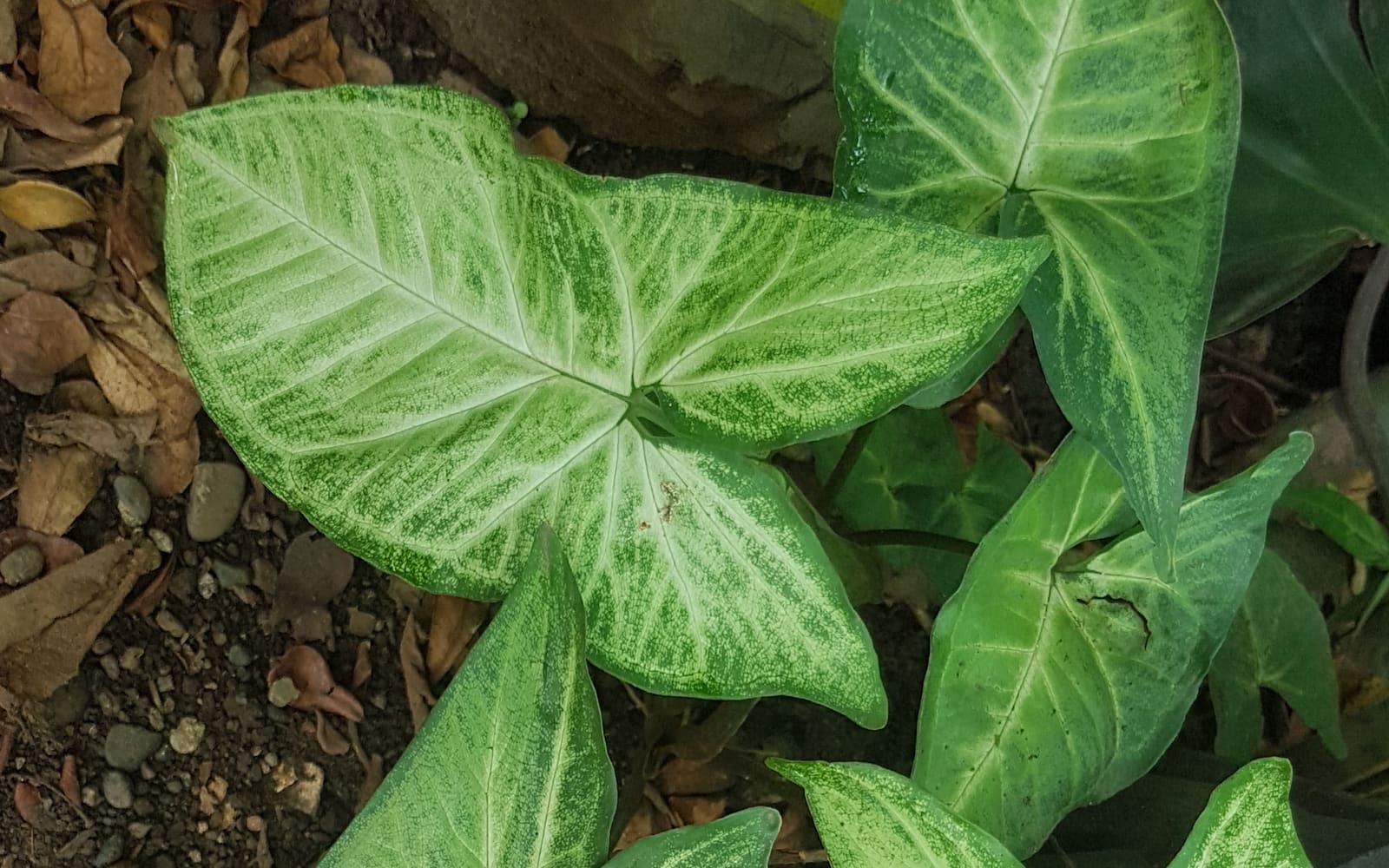
Photo by Obsidian Soul on Wikimedia Commons, CC0 1.0

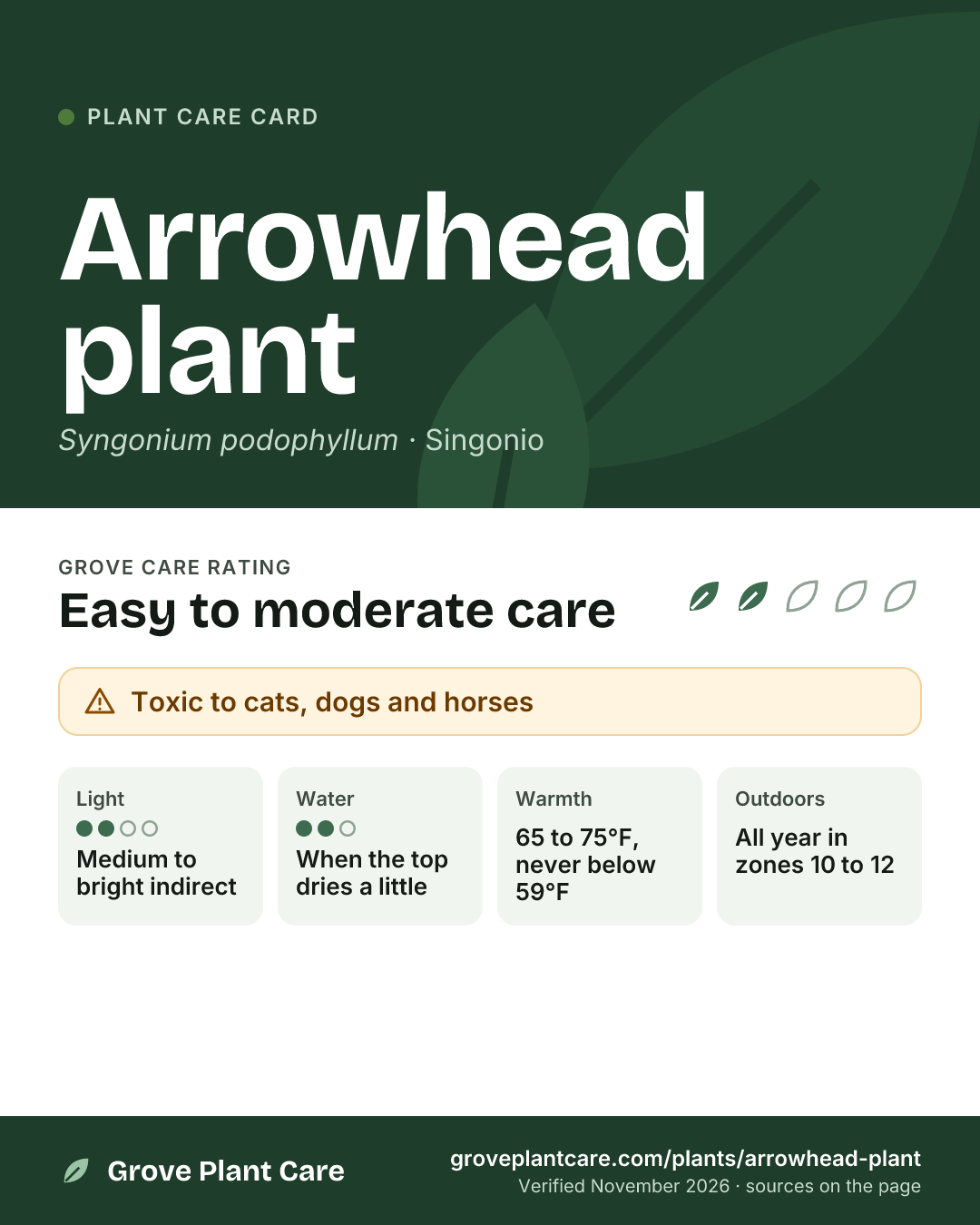
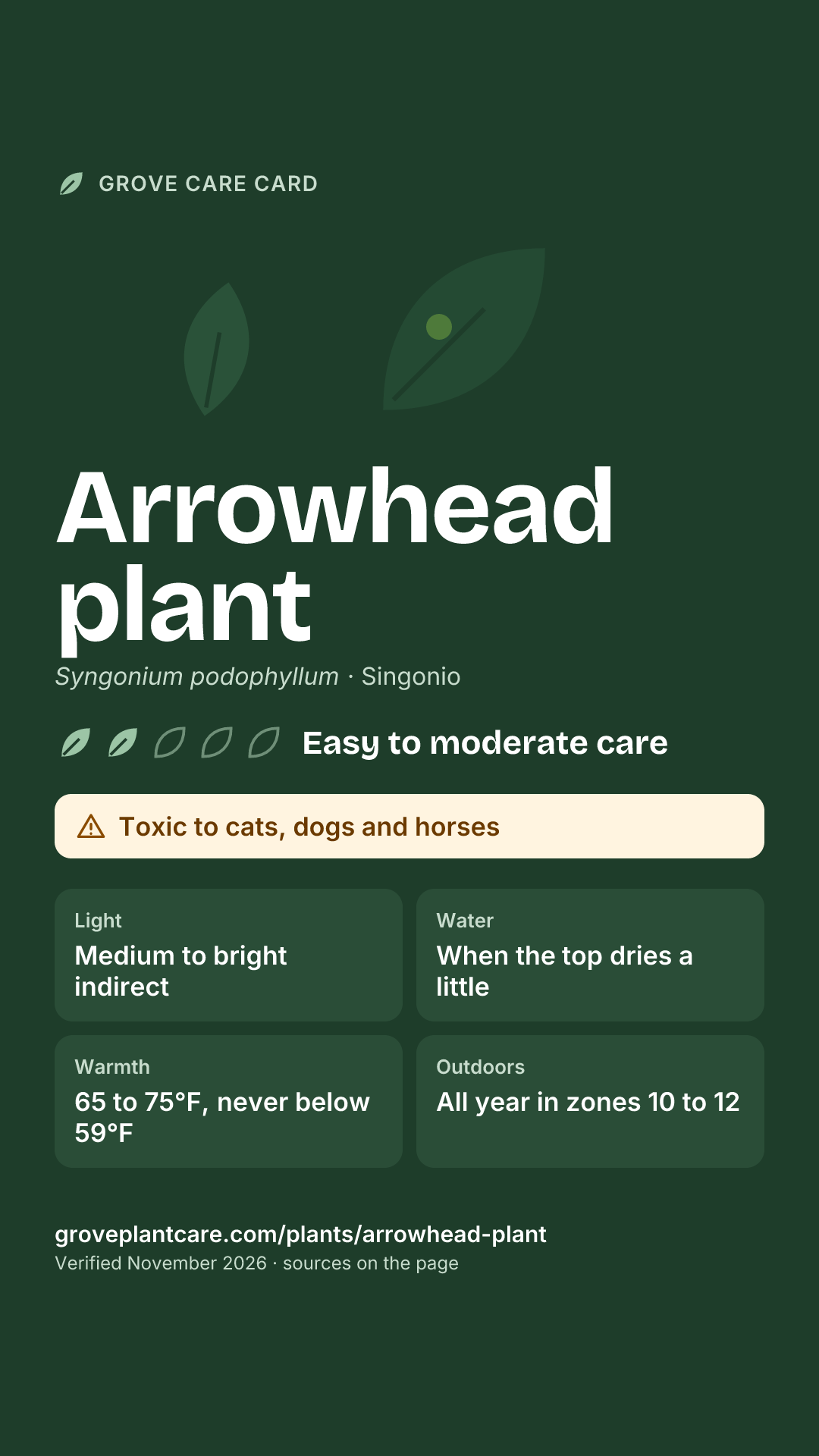
The arrowhead plant (syngonium) is an easy, fast-growing houseplant: give it medium to bright indirect light, water when the top of the soil dries a little, and keep it warm. Colorful kinds need more light to keep their pink or white. It's toxic to cats, dogs and horses. Where winters are frost-free it can escape and smother wild plants, so Florida lists it as invasive: keep it in a pot and toss cuttings in the trash.
Toxic to cats, dogs and horses · Moderate
Mouth pain and swelling, drooling, vomiting and trouble swallowing. Its sap holds needle-like calcium oxalate crystals; NC State rates the severity as medium. Children: moderate severity. NC State rates it medium severity; chewing causes mouth pain and swelling, and the sap irritates skin and eyes.
Pet poison line: ASPCA (888) 426-4435
Good for: rooms with medium light, shelves and hanging baskets, colorful leaves · Think twice if: pets or small children chew plants, you garden where it can escape, such as Florida, Hawaii or Queensland.
Needs at a glance
- Light2 of 4 · Medium to bright indirectSurvives low light; colorful kinds need brighter light to keep their color
- Water2 of 3 · Let the top dryWater when the surface dries a little; less in winter
- Humidity2 of 3 · Above averagePrefers 50% or more; normal home air is usually fine
- Soil when pottedAiry, well-drained potting mixPeat or coir, vermiculite and perlite in equal parts
Indoors: best at 65 to 75°F (18 to 24°C). Keep it above 59°F (15°C) and away from drafts and heat vents.
How the rating adds up
0 = easiest · 1 = moderate · 2 = hardest
- Missed waterings1 of 2 · ModerateWater once the top dries a little; keep it barely moist
- Light flexibility0 of 2 · EasiestLow to bright indirect light; colorful kinds fade in low light
- Humidity1 of 2 · ModeratePrefers 50% or more, but copes with less
- Pests and disease1 of 2 · ModerateAphids, mealybugs, spider mites; bacterial leaf spot
- Sensitivity to change0 of 2 · EasiestEasygoing; repot every few years and trim the roots
Growing outdoors
All year: USDA zones 10 to 12, where the coldest winter nights average 30°F (−1°C) or warmer.
Elsewhere: summer outside in shade or part shade; full sun burns the leaves. Bring it in before nights drop below 60°F (16°C).
Invasive in: Florida, Queensland (Australia), Puerto Rico. A Category I invasive in Florida, where UF/IFAS advises against planting it. Keep it in a pot and never dump cuttings outdoors. Lists checked .
- Containers and hanging baskets
- On a moss pole or trellis
Sources: NC State, Clemson, Texas Tech, Illinois Extension, RHS, Arkansas Extension, ASPCA, ASPCA plant list, USDA, UF/IFAS, FISC, UF/IFAS Assessment, Queensland Government, Global Invasive Species Database, Hawaii weed risk assessment and Biological Invasions. Full list below.
Verified · How we rate plants
Is the arrowhead plant toxic to cats and dogs?
Yes. The ASPCA lists it as toxic to cats, dogs and horses. Its sap holds insoluble calcium oxalate crystals, tiny needles that hurt the mouth. A pet that chews it may get mouth pain and swelling, drool, vomit (horses don't vomit) and have trouble swallowing. NC State rates the severity as medium for people and pets, and the sap can irritate skin and eyes, so wear gloves when you prune it. Keep it out of reach. If a pet eats some, call your vet or the ASPCA Animal Poison Control Center at (888) 426-4435. If a child eats some, call Poison Help at 1-800-222-1222.
How much light does an arrowhead plant need?
Medium to bright indirect light. Clemson suggests an east window, or a few feet back from a west window. It also copes with low light; Arkansas Extension says it handles dim winter rooms surprisingly well, as long as it can see a window. Keep it out of direct sun, which can burn or bleach the leaves. The catch is color: in low light, pink and white kinds turn plain green, so give those the brightest spot you have without direct sun.
How often should I water an arrowhead plant?
When the top of the soil has dried a little. Clemson and Texas Tech both say to let the mix dry slightly between waterings, and Illinois Extension says to keep it barely moist. Water until it drains, then empty the saucer. The RHS says to water freely while it grows and sparingly in winter. A mix of peat or coir, vermiculite and perlite drains well, which helps prevent stem rot.
Why is my arrowhead plant turning plain green?
Usually too little light. Clemson says leaves that lose their pink, cream or white pattern and go solid green are a sign the plant needs a brighter spot. Move it closer to a window, out of direct sun, and the new leaves should come in with their color. The old leaves won't change back. Feeding less, as Clemson suggests for plants in low light, also helps.
What temperature and humidity does an arrowhead plant like?
Warm rooms, about 65 to 75°F (18 to 24°C), per Clemson. The RHS says to keep it above 15°C (59°F) in winter. Arkansas Extension is more relaxed and says it takes 35°F (2°C) without chilling injury, but the warmer figure is the safer one for a houseplant. Clemson says it prefers humidity of 50% or more and tolerates less, so a normal home is usually fine. If the air is very dry in winter, a humidifier nearby helps.
What pests and diseases bother an arrowhead plant?
Clemson lists aphids, mealybugs and spider mites, and NC State adds thrips. Check under the leaves and along the stems now and then. For diseases, Clemson names bacterial blight, bacterial leaf spot and stem rot, and NC State adds soft rot. Wet leaves and soggy soil help these along, so water the soil and let it dry a little in between. The RHS says it is generally free of disease under glass.
Why are my arrowhead plant's leaves changing shape?
It's growing up. Young plants are bushy, with single arrow-shaped leaves. As the plant matures and starts to climb, the stalks get longer and each leaf splits into 3 leaflets, then 5 to 11. Clemson says you can train an older plant up a moss pole, trellis or stake. To keep it bushy and young-looking instead, NC State suggests cutting the long stems as they develop, and the RHS says spring is the time to cut it back. Use the cuttings to start new plants.
How do I propagate an arrowhead plant?
With stem cuttings. Arkansas Extension cuts a stem into pieces with one leaf and a bit of stem each, sets them in moist mix and covers the pot with a plastic bag to keep the moisture even until roots form. The RHS suggests summer, with some warmth from below. NC State also lists division and layering. Throw extra stems in the trash: in Florida and other warm places, discarded cuttings are how it escapes into the wild.
Arkansas Extension, RHS, NC State, Illinois Extension, UF/IFAS
Can an arrowhead plant grow outdoors, and is it invasive?
It can live outdoors all year in USDA zones 10 to 12, in shade or part shade. That's exactly why it causes trouble. The Florida Invasive Species Council lists it as a Category I invasive across the state, and UF/IFAS advises against planting it there: it covers the ground, climbs trees to about 33 ft (10 m) and crowds out native plants, mostly after people dump houseplants or cuttings. Queensland lists it as an environmental weed, the Hawaii weed risk assessment rates it high risk, and the Global Invasive Species Database records it in Puerto Rico, American Samoa and other islands. In cold places, it can spend summer outside in the shade; bring it in before nights drop to 60°F (16°C). Wherever you live, keep it in a pot and bag your trimmings.
NC State, FISC, UF/IFAS Assessment, UF/IFAS, Queensland Government, Hawaii weed risk assessment, Global Invasive Species Database, Biological Invasions, RHS, Clemson
How Grove helps
Grove sets a watering check based on how dry the soil is, so the arrowhead plant gets water once the top has dried. You can add pruning as a repeating task and assign it, and the reminder can say to bag the cuttings for the trash.
Sources
- NC State Extension Gardener Plant Toolbox: Syngonium podophyllum
- Clemson Cooperative Extension HGIC 1573: Arrowhead Vine (Syngonium spp.) (J. Jordan, 2026)
- Texas Tech University Plant Database: Butterfly Nephthytis (Syngonium podophyllum)
- University of Illinois Extension, Houseplants: Nephthytis (Syngonium)
- Royal Horticultural Society: Syngonium podophyllum (arrowhead vine)
- University of Arkansas Extension, Plant of the Week: 'Trileaf Wonder' (Arrowhead Philodendron, Nephthytis) (G. Klingaman, 2000)
- ASPCA Animal Poison Control: Arrow-Head Vine
- ASPCA Animal Poison Control: Toxic and Non-Toxic Plants
- USDA ARS Plant Hardiness Zone Map (2023)
- UF/IFAS Plant Directory: Syngonium podophyllum (arrowhead vine)
- Clemson Cooperative Extension HGIC 1454: Moving Houseplants Indoors and Outdoors
- Florida Invasive Species Council: Plant List, Category I (April 2026)
- UF/IFAS Assessment of Non-Native Plants: Syngonium podophyllum (Invasive, no uses)
- Business Queensland (Queensland Government): Arrowhead vine, invasive plant
- IUCN Global Invasive Species Database: Syngonium podophyllum
- Hawaii-Pacific Weed Risk Assessment (Plant Pono): Syngonium podophyllum, high risk, score 15
- Rojas-Sandoval and Acevedo-Rodríguez (2015), Naturalization and invasion of alien plants in Puerto Rico and the Virgin Islands, Biological Invasions 17
- Kew WCVP data release (2026-06-04 file), plant_name_id 199060: Syngonium podophyllum
- Kew WCVP data release (2026-06-04 file), plant_name_id 135137: Nephthytis afzelii (the African genus Nephthytis)
- NC State Extension Gardener Plant Toolbox: Sagittaria latifolia (arrowhead, a marsh plant)