Plant care card
Autograph tree
Clusia rosea · Clusia
Also called pitch apple, Florida clusia, copey or balsam apple
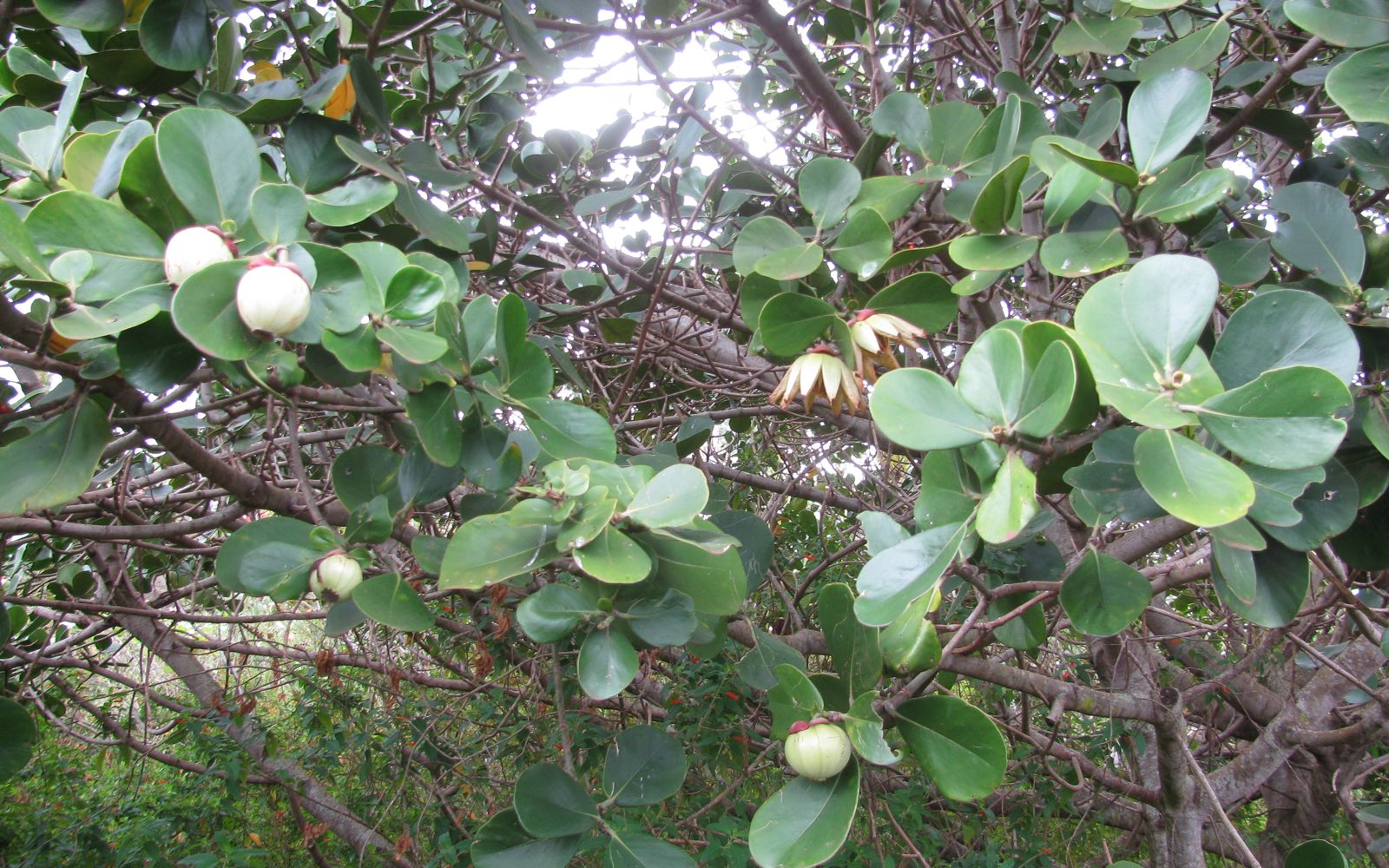
Photo by Forest and Kim Starr on Wikimedia Commons, CC BY 3.0 US

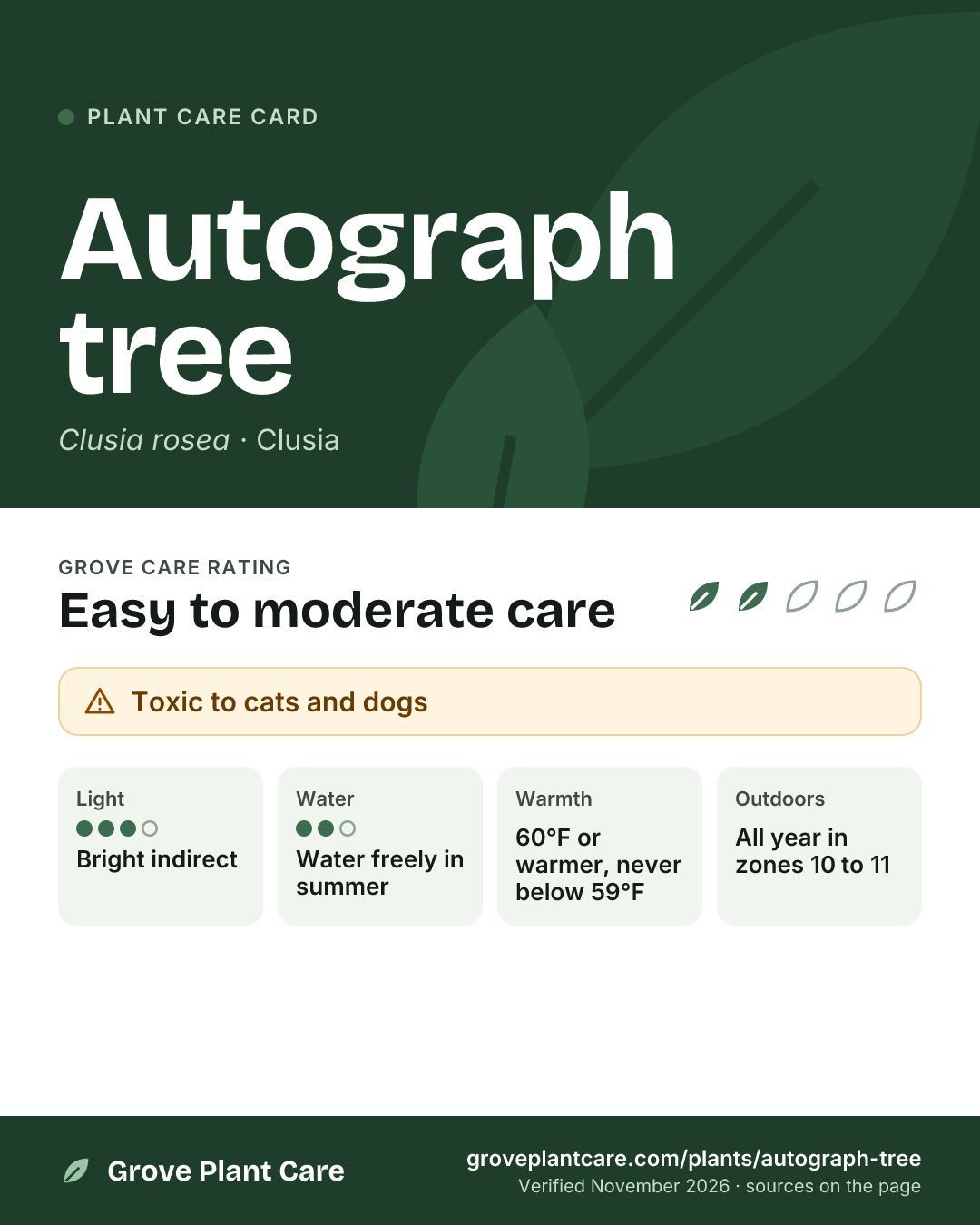
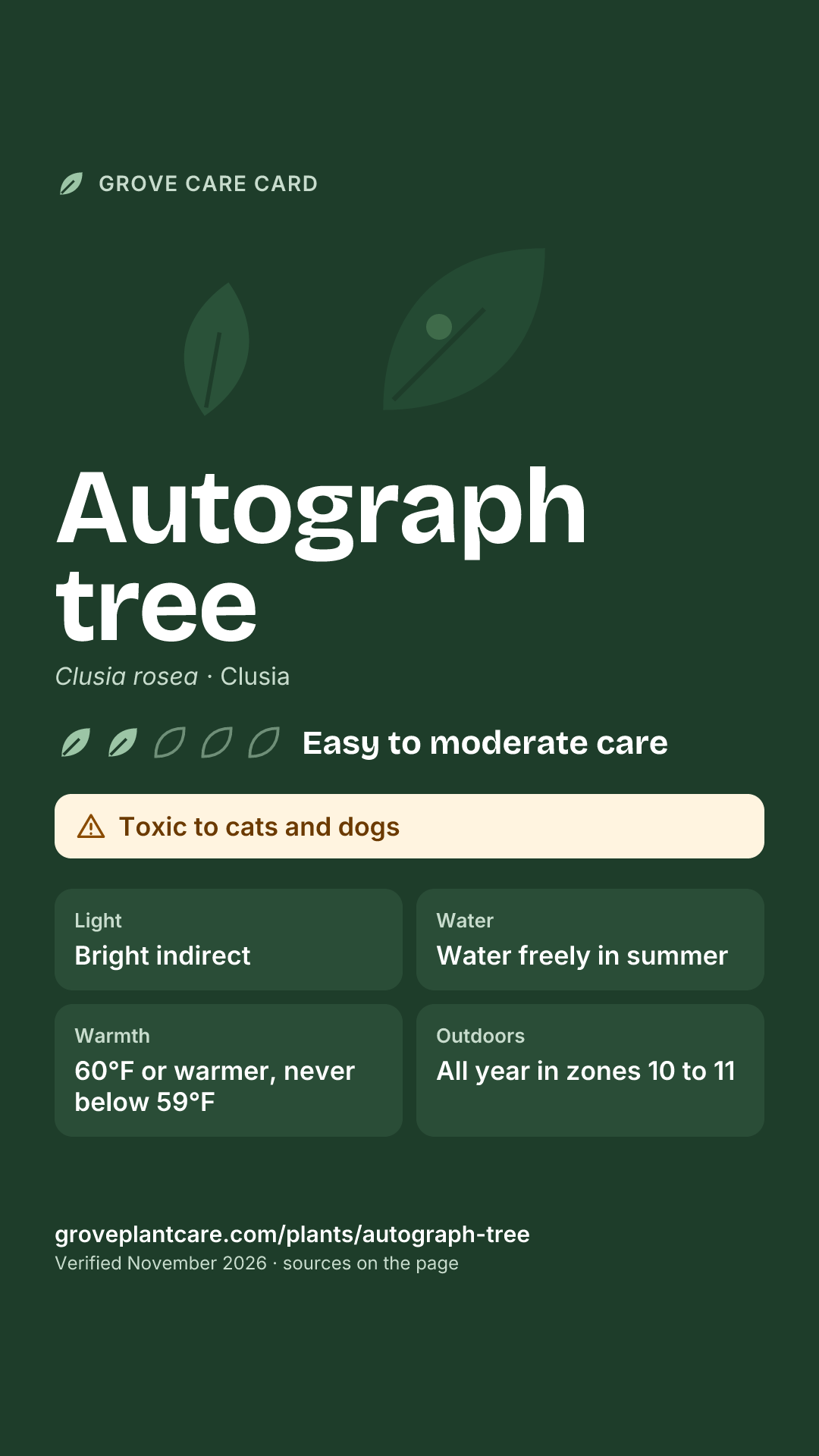
The autograph tree (Clusia rosea) has thick, rounded, leathery leaves you can scratch words into, which is how it got its name. As a houseplant it wants bright filtered light, a good drink in summer and a drier winter, and warmth above 59°F (15°C) all year. It forgives a missed watering. Outdoors it grows into a big tree in USDA zones 10 to 11 and drops its leaves below about 30°F (−1°C). The ASPCA lists it as toxic to cats, dogs and horses, the fruit most of all. It is native to South Florida and the Caribbean, but it runs wild in Hawaii.
Toxic to cats, dogs and horses (fruit most of all)
Upset stomach and vomiting. The ASPCA says the fruit is the most toxic part, though the leaves hold some toxins too. Children: low severity. The fruit is poisonous if eaten, and the sap can irritate skin.
Pet poison line: ASPCA (888) 426-4435
Good for: bright rooms and sunrooms, people who forget to water, salty, windy coastal gardens without frost · Think twice if: pets or small children might eat the fruit, you garden in Hawaii or another frost-free place where birds spread it.
Needs at a glance
- Light3 of 4 · Bright indirectBright filtered light indoors, out of hot midday sun; full sun to part shade outdoors
- Water2 of 3 · Water freely in summerWater well in summer and keep it barely moist in winter; it shrugs off a dry spell
- Humidity1 of 3 · AverageNo special humidity needed
- Soil when pottedGritty, well-drained mixLoam-based potting mix with leaf mold and grit; in the ground it takes sand, clay or limestone
Indoors: best at 60°F (16°C) or warmer. Keep it above 59°F (15°C) and away from drafts and heat vents.
How the rating adds up
0 = easiest · 1 = moderate · 2 = hardest
- Missed waterings0 of 2 · EasiestHighly drought tolerant once settled; dry spells in a pot do no harm
- Light flexibility1 of 2 · ModerateBright filtered light indoors; full sun to part shade outdoors
- Humidity0 of 2 · EasiestNo source asks for extra humidity
- Pests and disease1 of 2 · ModerateScale now and then; mealybugs or spider mites indoors
- Sensitivity to change1 of 2 · ModerateDislikes repotting; needs warmth all winter
Growing outdoors
All year: USDA zones 10 to 11, where the coldest winter nights average 30°F (−1°C) or warmer.
Elsewhere: summer outside in part shade at first, then brighter; shade from harsh midday sun. Bring it in before nights drop below 60°F (16°C).
- Houseplant or sunroom plant in a pot
- Shade tree, screen or hedge in frost-free gardens
- Coastal plant that handles salt spray
Sources: UF/IFAS, USDA Forest Service, Florida Native Plant Society, RHS, ASPCA, NParks Singapore, Hawaii weed risk assessment, Clemson, UF/IFAS Sarasota County, USDA zone map, FISC, Hawaii noxious weed list, Global Invasive Species Database, Queensland Government, Cal-IPC and University of Hawaiʻi. Full list below.
Verified · How we rate plants
Is the autograph tree toxic to cats and dogs?
Yes. The ASPCA lists Clusia rosea as toxic to cats, dogs and horses. Eating it can cause an upset stomach and vomiting, and the ASPCA says the fruit is the most toxic part, though the leaves hold some toxins too. The ASPCA files it under the name Clusia major, which the RHS says is misapplied to this plant. Potted plants rarely fruit, but pick up any fallen fruit from a garden tree. If your pet chewed it and seems unwell, call your vet or the ASPCA Animal Poison Control Center at (888) 426-4435. UF/IFAS calls the fruit poisonous to people too, so if a child eats some, call Poison Help at 1-800-222-1222.
How much light does an autograph tree need?
Indoors, bright filtered light. The RHS grows it in bright light with shade from hot sun, near an east, south or west window. Outdoors it is more flexible: UF/IFAS says it grows well in full sun to dappled shade, and the USDA Forest Service calls it moderately shade tolerant. If you move a pot outside for summer, start it in shade and ease it into brighter light over a week or so, as Clemson suggests for houseplants, so the leaves don't scorch.
How often should I water an autograph tree?
Water freely in summer and keep it barely moist in winter, as the RHS advises. It handles a missed watering well: UF/IFAS rates its drought tolerance as high, and the USDA Forest Service found that an occasional dry spell does no harm to young plants in containers. Those thick leaves store water, and the tree can switch to a water-saving way of making food during droughts. Never let the pot sit in water.
RHS, UF/IFAS, USDA Forest Service, Florida Native Plant Society
How cold can an autograph tree get, and what do I do in winter?
Keep a potted plant above 59°F (15°C). The RHS rates it H1A, a plant that needs heated shelter all year above 15°C. Bring it in before nights drop below 60°F (16°C); Clemson notes that 50°F (10°C) or lower damages many tropical plants. In the ground it grows in USDA zones 10 to 11, per UF/IFAS and the Florida Native Plant Society. UF/IFAS Sarasota County says it drops its leaves below 30°F (−1°C), and the USDA Forest Service notes that frost never happens in its native range.
RHS, Clemson, UF/IFAS, Florida Native Plant Society, UF/IFAS Sarasota County, USDA Forest Service
What pests bother an autograph tree?
Not many. UF/IFAS lists scale and no diseases of major concern, and the RHS says it may get red spider mite, scale insects and mealybugs under glass. Check the undersides of the leaves and the stems now and then, especially indoors in winter. Wipe off scale and mealybugs early, before they spread.
Should I repot my autograph tree, and why won't it flower?
Repot only when you must. The RHS says it dislikes having its roots disturbed and needs a snug pot to flower. Even so, the RHS adds that flowers are unlikely on potted plants; they come on mature trees. Outdoors, UF/IFAS says the pink and white flowers open at night, mostly in summer, and sometimes stay open into the morning on cloudy days. Indoors, enjoy it for the leaves.
How do I propagate an autograph tree?
From cuttings, by air layering or from seed. The RHS takes softwood cuttings in summer with bottom heat, or air layers in spring or summer, and UF/IFAS lists seeds or cuttings. Be patient: in a USDA Forest Service trial only about a quarter of untreated cuttings rooted, and they took about six months.
Which clusia is which?
The big-leaved tree on this card is Clusia rosea, the pitch apple or autograph tree. UF/IFAS Sarasota County says the hedge plant often sold as Clusia rosea in Florida is usually a smaller-leaved plant sold as Clusia guttifera, which rarely flowers or fruits. That name doesn't show up in the Kew checklist, so it may be a hybrid. The compact houseplant sold as 'Princess' is a Clusia rosea variety, per the RHS, as is the yellow-marbled 'Variegata'. If your clusia has small leaves and never flowers, it may be the hedge plant.
Can I plant an autograph tree outdoors, and is it invasive?
It grows outdoors in USDA zones 10 to 11. No official invasive list names it: it isn't on the Florida Invasive Species Council list, Hawaii's noxious weed list, Queensland's restricted plants or the Global Invasive Species Database. UF/IFAS lists it as native to Florida, the West Indies and from Mexico to northern South America. Hawaii is a different story. Its weed risk assessment rates it high risk, and the University of Hawaiʻi says it has gone wild on Kauaʻi, Oʻahu and Hawaiʻi Island, where birds spread the seeds and seedlings even sprout on other trees. The Florida Native Plant Society notes it can escape near plantings in Florida too. Give it room: UF/IFAS says it reaches 25 to 30 ft, and its aerial roots need trimming or it can take over an area.
UF/IFAS, FISC, Hawaii noxious weed list, Queensland Government, Global Invasive Species Database, Hawaii weed risk assessment, University of Hawaiʻi, Florida Native Plant Society
How Grove helps
Grove sets a watering check based on how dry the soil is, so the autograph tree gets a good drink in summer and less in winter. You can add a pest check and a move indoors before cold nights as tasks you can assign to whoever cares for the plant.
Sources
- UF/IFAS Extension EDIS ENH331 (ST172): Clusia rosea, Pitch Apple (Gilman et al., rev. December 2018)
- USDA Forest Service, International Institute of Tropical Forestry: Clusia rosea Jacq., Cupey (J. K. Francis; Spanish edition, Bioecología de árboles nativos y exóticos de Puerto Rico y las Indias Occidentales)
- Florida Native Plant Society plant database: Clusia rosea (pitch-apple, autograph tree)
- Royal Horticultural Society: Clusia rosea (pitch apple), H1A
- Royal Horticultural Society: Clusia rosea 'Princess' (autograph tree 'Princess')
- ASPCA Animal Poison Control: Clusia Rosea (listed under Clusia major)
- National Parks Board Singapore, Flora & Fauna Web: Clusia rosea
- Hawaii-Pacific Weed Risk Assessment (Plant Pono): Clusia rosea, high risk, score 9
- Clemson Cooperative Extension HGIC 1454: Moving Houseplants Indoors and Outdoors
- UF/IFAS Extension EDIS ENH332 (ST173): Clusia rosea 'Variegata', 'Variegata' Pitch Apple (rev. December 2023)
- UF/IFAS Extension Sarasota County: Flora-da Friendly Features: Imposter Pitch Apple? (F. Hecker, 2024)
- USDA ARS Plant Hardiness Zone Map (2023)
- Florida Invasive Species Council: Plant List, Category I and II and Watch List (April 2026)
- Hawaii Administrative Rules 4-68: plant species designated as noxious weeds (Hawaii Department of Agriculture)
- IUCN Global Invasive Species Database: search for Clusia rosea (no record)
- Business Queensland: Restricted invasive plants (Biosecurity Act 2014)
- California Invasive Plant Council (Cal-IPC): plant search, "clusia" (no listing)
- University of Hawaiʻi CTAHR, Weeds of Hawaiʻi's Pastures and Natural Areas (Motooka et al. 2003): Clusia rosea, autograph tree, copey
- Kew WCVP data release (2026-06-04 file), plant_name_id 2728591: Clusia rosea