Plant care card
Bamboo palm
Chamaedorea seifrizii · Palma bambú
Also called reed palm
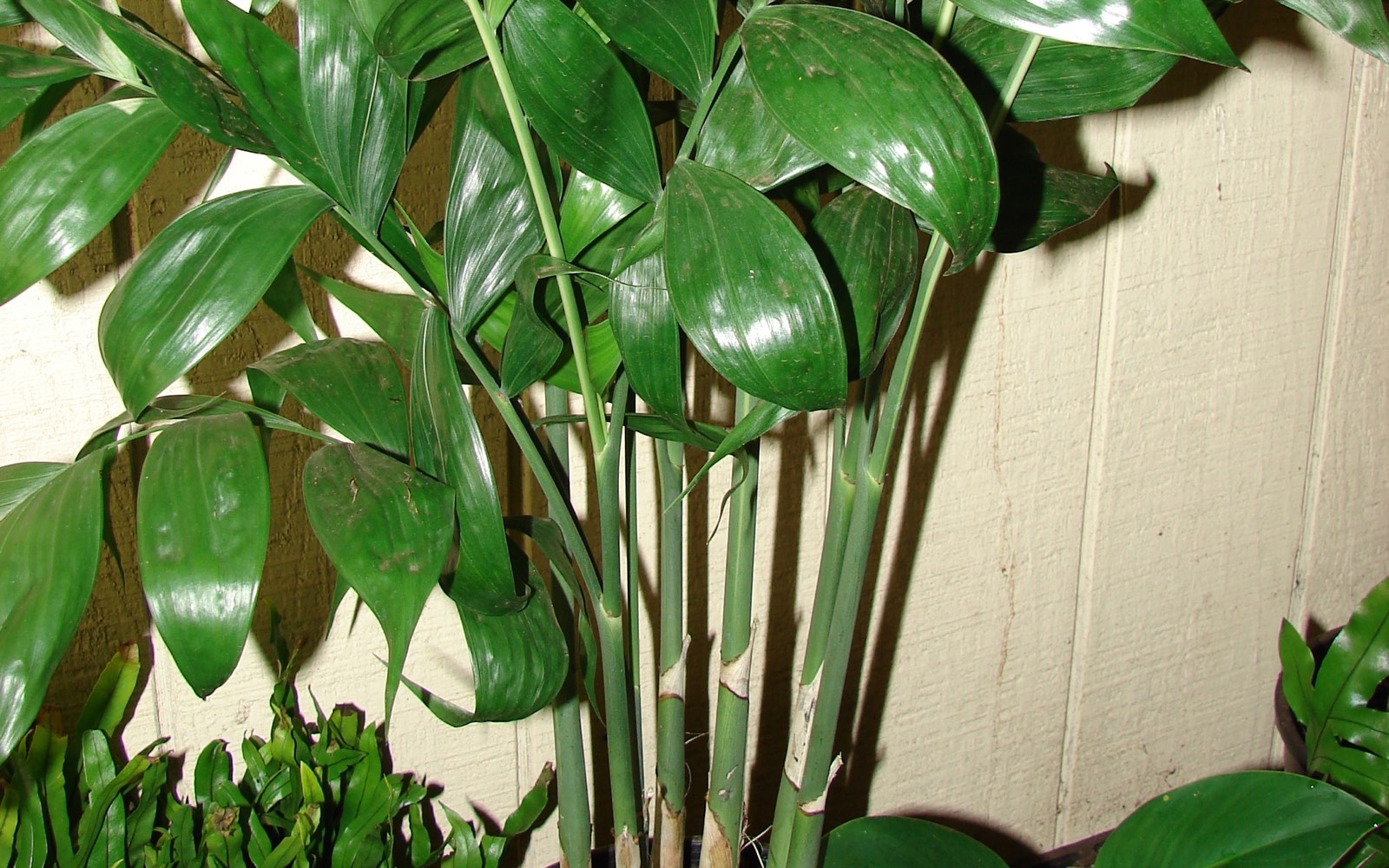
Photo by Forest and Kim Starr on Wikimedia Commons, CC BY 3.0 US

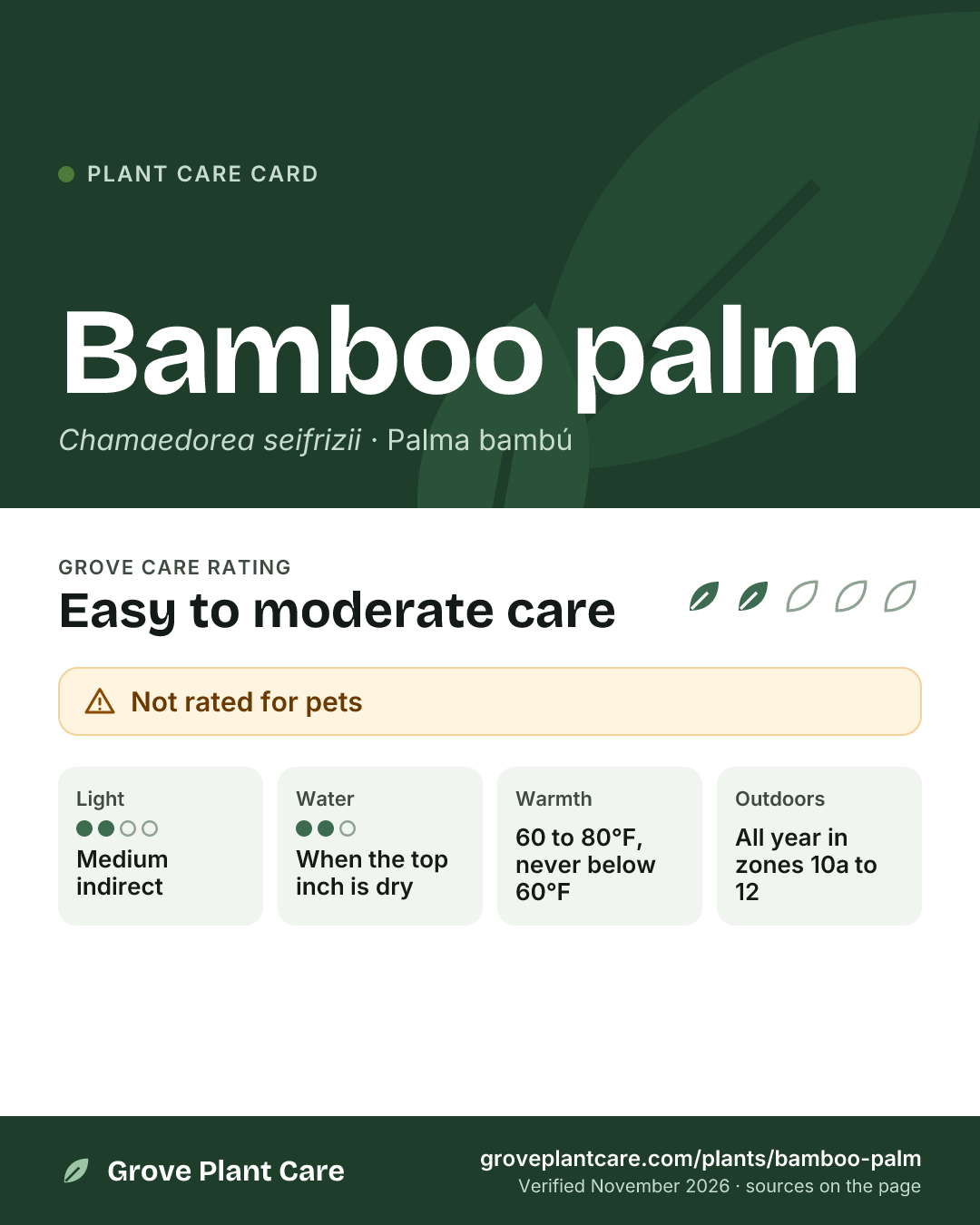
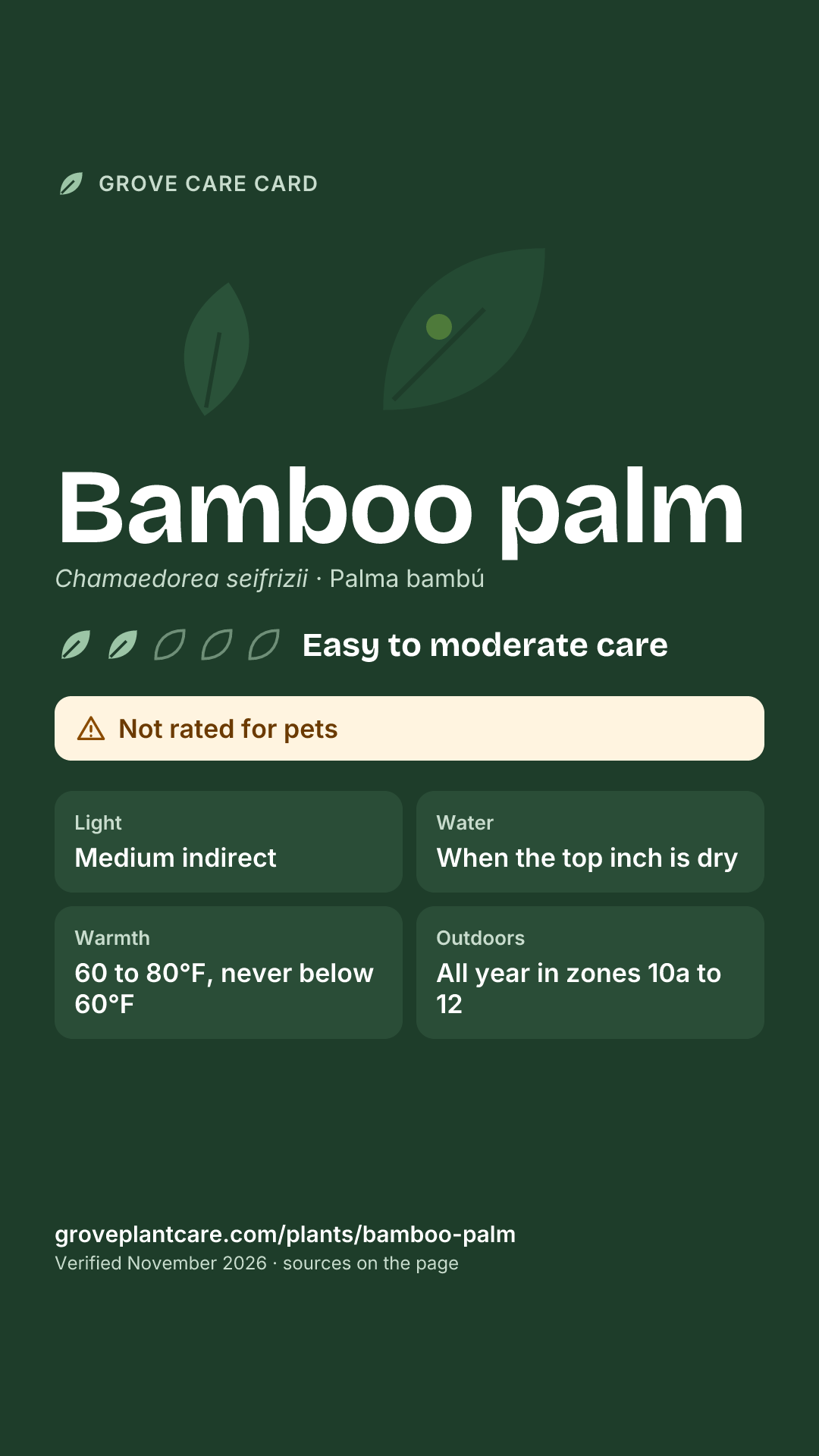
A bamboo palm is one of the easier palms to keep indoors. It survives low light, grows best in medium light, and likes soil that stays slightly moist but never soggy. Watch for spider mites and scale under the leaves. The ASPCA hasn’t rated this palm for pets; its “bamboo palm” entry is a different plant. In a pot it grows 3 to 7 feet tall.
Not rated for pets
Neither the ASPCA nor NC State rates this palm. The ASPCA’s “bamboo palm” is a different plant, the parlor palm, which it lists as non-toxic. Children: low severity. NC State rates it low severity: the flesh of the fruit can irritate skin.
Pet poison line: ASPCA (888) 426-4435
Good for: rooms with medium or low light, a tall, narrow palm for corners, beginners · Think twice if: you tend to overwater, you won’t check under the leaves for spider mites, you want it planted out in South or Central Florida.
Needs at a glance
- Light2 of 4 · Medium indirectLow light is fine; keep it out of hot sun
- Water2 of 3 · When the top inch is dryWater until it drains; less in winter
- Humidity1 of 3 · AverageMedium humidity; tips may brown in very dry air
- Soil when pottedWell-drained potting mixPorous, with plenty of organic matter
Indoors: best at 60 to 80°F (16 to 27°C). Keep it above 60°F (16°C) and away from drafts and heat vents.
How the rating adds up
0 = easiest · 1 = moderate · 2 = hardest
- Missed waterings1 of 2 · ModerateKeep it slightly moist; water when the top inch dries
- Light flexibility0 of 2 · EasiestSurvives low light, grows best in medium light
- Humidity0 of 2 · EasiestMedium humidity suits it
- Pests and disease1 of 2 · ModerateWatch for spider mites, scale and mealybugs indoors
- Sensitivity to change1 of 2 · ModerateDislikes drafts, sudden changes and fertilizer buildup
Growing outdoors
All year: USDA zones 10a to 12, where the coldest winter nights average 30°F (−1°C) or warmer.
Elsewhere: summer outside in shade, out of direct sun and wind. Bring it in before nights drop below 60°F (16°C).
Invasive in: Florida. A Category II invasive in Central and South Florida on the FISC list, though the UF/IFAS Assessment still rates it “not a problem species”. Keep it in your garden and never dump seeds or clumps in wild areas. Lists checked .
- Screen, border or accent in shade
- Containers and planters
- Poor salt tolerance
Sources: NC State, Penn State, Clemson, NYBG, RHS, UF/IFAS, ASPCA plant list, ASPCA, NTBG, USDA zone map, FISC, UF/IFAS Assessment, Hawaii weed risk assessment, Hawaii noxious weed list, Rojas-Sandoval and Acevedo-Rodríguez, Queensland Government, Cal-IPC and GISD. Full list below.
Verified · How we rate plants
Is a bamboo palm safe for cats and dogs?
We can’t say for sure, because the name trips people up. The ASPCA lists “bamboo palm” and “reed palm” as non-toxic, but both of those entries are the parlor palm, Chamaedorea elegans. Neither the ASPCA nor NC State rates this palm, Chamaedorea seifrizii, and we found no reputable source that lists it as toxic to pets. For people, NC State rates it low severity: the flesh of its small black fruit can irritate skin, though potted plants rarely fruit. Keep it away from pets that chew plants. If your pet chewed it and seems unwell, call your vet or the ASPCA Animal Poison Control Center at (888) 426-4435. If a child eats some and seems unwell, call Poison Help at 1-800-222-1222.
Bamboo palm, areca palm or parlor palm: which is which?
Several palms share the name, so look at the plant. This bamboo palm grows a clump of thin green canes with rings like bamboo, and the last pair of leaflets at each frond tip is wider than the rest. NC State and UF/IFAS also call the areca palm a bamboo palm; the areca has yellow leaf stalks. The ASPCA’s bamboo palm is the parlor palm, which Clemson says grows as a few single stems that don’t form clumps. NC State gives the name to the lady palm too, a fan palm with stems wrapped in brown fiber. And the “hardy bamboo palm” sold for cooler gardens is another species, Chamaedorea microspadix. Old tags may say Chamaedorea erumpens: Kew counts it as this same plant.
Can a bamboo palm grow in low light?
Yes. NC State calls it an excellent houseplant for low-light spots, and Penn State and NYBG agree it tolerates lower light. It grows best in medium light, though, so a spot a few feet from a bright window is ideal. Keep it out of hot, direct sun: the RHS shades it from strong sun, and UF/IFAS plants it in shade outdoors. In a dim corner it grows slowly, so it will need water less often there.
NC State, Penn State, NYBG, RHS, UF/IFAS
How often should I water a bamboo palm?
When the top inch of soil is dry. Water until it runs out the bottom, then empty the saucer. NC State and Penn State both say to keep the mix slightly moist, and NC State warns that overwatering causes root and stem rot, so the pot needs good drainage. Clemson says palms should never dry out completely or stand in water. In winter, when it grows slowly, NYBG keeps the soil barely moist.
Why are my bamboo palm leaves turning brown or yellow?
Some of it is normal. NYBG says the lower leaves turn yellow and drop as the plant grows, and UF/IFAS notes old leaves die and hang on the cane, so cut them off. Brown tips usually mean dry air or too much fertilizer: Clemson says extra fertilizer burns the tips, and feeds palms only two or three times while they grow. Brown or yellow spots can mean too much water or a sudden temperature change. Reddish-brown dead patches that show up a few days after a cold spell are chill damage, which Clemson says starts at 45°F (7°C).
What pests attack a bamboo palm?
Spider mites, scale and mealybugs. NC State lists all three for plants grown indoors, and UF/IFAS says scale and spider mites can become a serious problem indoors. Mites like warm, dry rooms. Check under the leaves and along the canes every week or two. Rinse mites off with a strong spray of water, and repeat it. Clemson notes that a summer outside lets rain and natural predators help.
Can a bamboo palm grow outdoors? Is it invasive?
It grows outside all year in USDA zones 10a to 12, where winter nights stay above about 30°F (−1°C). No source gives a tested cold limit, and its leaves can show chill damage below 45°F (7°C). UF/IFAS plants it in shade with shelter from wind, as a screen, border or accent, and it handles salt poorly. In Florida it is on the official invasive list: the Florida Invasive Species Council lists it as Category II in Central and South Florida, meaning it is spreading into natural areas. The UF/IFAS Assessment still rates it as no problem there, so the two sources disagree. Hawaii’s weed risk assessment says to evaluate it further, since birds spread its seeds. If you live in South or Central Florida, think twice before planting it out.
UF/IFAS, NC State, USDA zone map, Clemson, FISC, UF/IFAS Assessment, Hawaii weed risk assessment
When should I bring a bamboo palm inside?
Before nights drop to 60°F (16°C). Clemson says Chamaedorea palms need at least 60°F in winter, and to move houseplants out only once nights stay above 60°F. Outside, keep it in shade out of direct sun and ease it into brighter light over about a week. Before you bring it back in, check under the leaves for mites and scale, so you don’t carry pests indoors.
How do I repot or divide a bamboo palm?
Repot only when roots fill the pot, about every 2 to 3 years, in spring or early summer. Palm roots are fragile, so move it gently into a pot just one size up with a porous, well-drained mix. The clump grows wider slowly as new canes come up from the base. To make new plants, divide a crowded clump into pieces with roots attached, or sow seed; the RHS sows it warm, at 77°F (25°C) or more.
How Grove helps
Grove sets a watering check based on how dry the soil is, so the bamboo palm gets water once the top inch has dried, and not before. You can add a spider mite check every two weeks as a task you can assign, so whoever is home takes a look under the leaves.
Sources
- NC State Extension Gardener Plant Toolbox: Chamaedorea seifrizii
- Penn State Extension: Palms as Houseplants (M. L. Smith, 2023)
- Clemson Cooperative Extension HGIC 1508: Indoor Palms
- NYBG Mertz Library: Guide to Palm Plants Indoors
- RHS: Chamaedorea seifrizii (bamboo palm)
- UF/IFAS EDIS FPS120: Chamaedorea seifrizii, Bamboo Palm (Graves et al.; rev. September 2026)
- ASPCA Animal Poison Control: Toxic and Non-Toxic Plants
- ASPCA Animal Poison Control: Bamboo Palm (Chamaedorea elegans)
- National Tropical Botanical Garden, Tropical Plant Database: Chamaedorea seifrizii
- USDA ARS Plant Hardiness Zone Map (2023)
- Clemson Cooperative Extension HGIC 1454: Moving Houseplants Indoors and Outdoors
- Florida Invasive Species Council: Plant List, Category I and II (April 2026); bamboo palm in Category II
- UF/IFAS Assessment of Non-Native Plants: Chamaedorea seifrizii
- Hawaii-Pacific Weed Risk Assessment (Plant Pono): Chamaedorea seifrizii, evaluate, score 6
- Hawaii Administrative Rules 4-68: plant species designated as noxious weeds (Hawaii Department of Agriculture)
- J. Rojas-Sandoval and P. Acevedo-Rodríguez (2015), Naturalization and invasion of alien plants in Puerto Rico and the Virgin Islands, Biological Invasions 17 (supplementary list)
- Business Queensland: Restricted invasive plants (Biosecurity Act 2014)
- California Invasive Plant Council (Cal-IPC): plant search, "chamaedorea" (no listing)
- IUCN Global Invasive Species Database: Chamaedorea seifrizii (no entry)
- Kew WCVP data release (2026-06-04 file), plant_name_id 37655: Chamaedorea seifrizii
- NC State Extension Gardener Plant Toolbox: Chamaedorea elegans (parlor palm)
- NC State Extension Gardener Plant Toolbox: Rhapis excelsa (lady palm)
- UF/IFAS EDIS FPS121: Chamaedorea microspadix, Microspadix Palm, Hardy Bamboo Palm