Plant care card
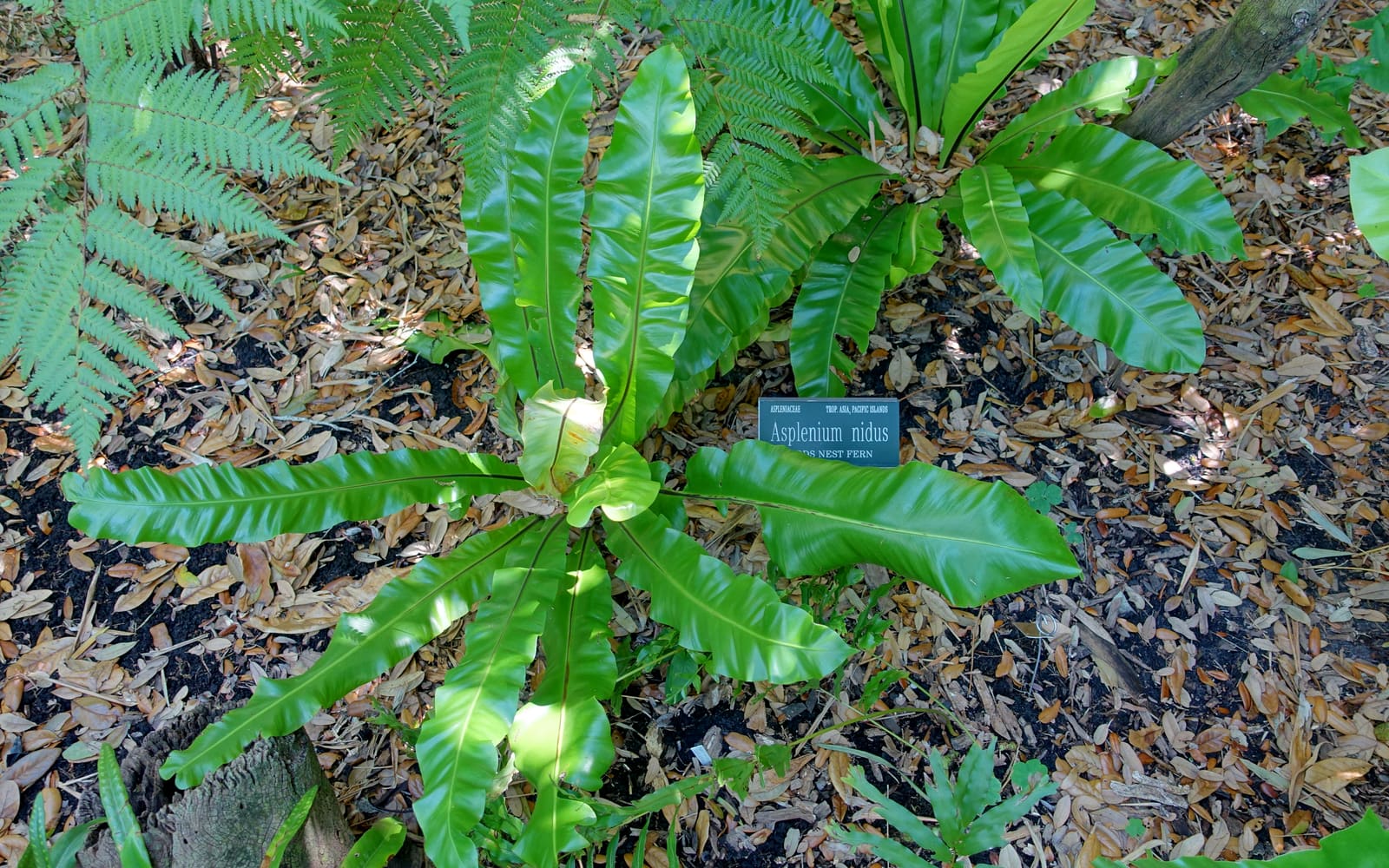
Bird's nest fern
Asplenium nidus · Helecho nido de ave
Also called nest fern
Photo by Daderot on Wikimedia Commons, CC0 1.0

The bird's nest fern grows on rainforest trees, with its fronds unrolling from a tight center like a nest. Give it medium to bright indirect light, keep the soil moist but never soggy, and water around the edge of the pot instead of into the center. Keep it away from heat vents and insecticide sprays. Neither the ASPCA nor NC State rates it for pets.
Not rated for pets
Neither the ASPCA nor NC State rates this fern. The ASPCA lists a close relative, mother fern (Asplenium bulbiferum), as non-toxic. Children: No poisoning information found.
Pet poison line: ASPCA (888) 426-4435
Good for: bright bathrooms, shady spots outdoors in frost-free gardens, a bold single plant · Think twice if: your pots often dry out, you reach for insecticide sprays.
Needs at a glance
- Light2 of 4 · Medium to bright indirectA north or east window works; direct sun yellows the fronds
- Water3 of 3 · Keep lightly moistWater around the edge when the top inch is dry, never into the center
- Humidity2 of 3 · Above averageA pebble tray or a humidifier helps in winter
- Soil when pottedRich, airy fern or tropical potting mixHigh in organic matter and well drained
Indoors: best at 60 to 70°F (16 to 21°C). Keep it above 50°F (10°C) and away from drafts and heat vents.
How the rating adds up
0 = easiest · 1 = moderate · 2 = hardest
- Missed waterings2 of 2 · HardestNeeds steady moisture; keep the soil moist
- Light flexibility1 of 2 · ModerateMedium to bright indirect light; sun yellows the fronds
- Humidity1 of 2 · ModerateLikes humid air; a pebble tray or humidifier helps
- Pests and disease0 of 2 · EasiestFew pests; watch for scale and, outdoors, slugs
- Sensitivity to change1 of 2 · ModerateFragile fronds; dislikes drafts, heat vents and insecticide sprays
Growing outdoors
All year: USDA zones 11 to 12, where the coldest winter nights average 40°F (4°C) or warmer.
Elsewhere: summer outside in shade. Bring it in before nights drop below 50°F (10°C).
- Pots and hanging baskets
- Shady beds in frost-free gardens
- Wired to a tree trunk or slab
Sources: NC State, UF/IFAS, Clemson, RHS, ASPCA plant list, ASPCA, USDA zone map, FISC, Hawaii noxious weed list, Rojas-Sandoval and Acevedo-Rodríguez, Queensland Government, Cal-IPC, Texas Invasives, South Africa NEMBA list and GISD. Full list below.
Verified · How we rate plants
How do I water a bird's nest fern?
Around the edge, never into the center. Clemson Extension says to water along the outer edge of the pot, keep water off the leaves and out of the middle, and water when the top inch of soil feels dry. Don't let it dry out completely: NC State and UF/IFAS both say it doesn't tolerate drying out. Don't leave the pot sitting in a saucer of water either, since soggy roots rot, per Clemson. Check the soil every few days.
Why are my bird's nest fern's tips turning brown?
Check four things. Dry air: NC State and Clemson suggest a pebble tray or a humidifier, especially in winter. Heat and drafts: NC State and Clemson say keep it away from heat vents, fireplaces and drafts. Dry soil: NC State and UF/IFAS say it doesn't tolerate drying out. Chemicals: NC State and UF/IFAS warn that insecticides damage this fern. Fronds that turn pale or yellow usually mean too much sun, per NC State and UF/IFAS. You can trim old brown or yellow fronds at the base, and new ones will unroll from the center.
How much light does a bird's nest fern need?
Medium to bright light without direct sun. NC State says bright light or light shade, such as a north-facing window, works, and Clemson suggests an east- or north-facing room. Too much sun turns the fronds yellow and can stop growth, per NC State and UF/IFAS.
Is a bird's nest fern safe for cats and dogs?
It isn't rated. The ASPCA has no entry for Asplenium nidus, and NC State gives no toxicity information, so this card can't call it safe. The ASPCA does list a close relative, mother fern (Asplenium bulbiferum), as non-toxic to dogs, cats and horses, and no source we found lists the bird's nest fern as toxic. Any plant can upset a pet's stomach if it eats enough. If a pet eats some and seems unwell, call your vet or the ASPCA Animal Poison Control Center at (888) 426-4435. If a child eats any plant, Poison Help is at 1-800-222-1222.
Which bird's nest fern do I have?
Possibly not Asplenium nidus. UF/IFAS says a second species, Asplenium antiquum from East Asia, is smaller and more often sold as a houseplant. Clemson names one cultivar of each: Asplenium antiquum 'Leslie', with forked frond tips, and Asplenium nidus 'Osaka', with frilly edges. UF/IFAS adds that there are dozens of crested, wavy and dwarf cultivars and that their names aren't used consistently. These sources give no separate care for them, so this card covers both.
Can a bird's nest fern grow outdoors?
All year only where it stays warm. NC State and Clemson list USDA zones 11 to 12, and NC State says it won't survive below 40°F (4°C) or any frost. UF/IFAS grows it outside in zones 9B to 11B but says plants in zone 9 need protection from freezes. Elsewhere it can spend summer outside in shade once frost is past, and Clemson says to bring it in before nights drop below 50°F (10°C). In frost-free gardens it suits shady beds and pots, or it can be wired to a tree trunk the way it grows in the wild. No official invasive list we checked names it, and UF/IFAS says it isn't known to be invasive.
How do I feed and repot a bird's nest fern?
Lightly and rarely. Clemson suggests feeding monthly from late spring through summer at half the label rate for ferns, and NC State says a dilute liquid feed monthly while it grows. It grows slowly, so it only needs a new pot every few years, in spring when new growth appears, per Clemson and UF/IFAS. Use a rich, well-drained mix high in organic matter, such as a fern or tropical potting mix.
Can I propagate a bird's nest fern?
Mostly from spores. UF/IFAS says it is grown from spores or by tissue culture, and NC State and UF/IFAS both describe spores on the undersides of the fronds as the way it reproduces. The brown lines you may see under older fronds are those spores, which is normal.
How Grove helps
Grove can remind you to check the soil on a schedule you set, so the bird's nest fern never dries out. You can add a monthly feeding task for late spring and summer and assign it to anyone who helps.
Sources
- NC State Extension Gardener Plant Toolbox: Asplenium nidus
- UF/IFAS Extension EDIS FPS54: Asplenium nidus, Bird's Nest Fern (revised 2025)
- UF/IFAS Gardening Solutions: Bird's Nest Fern
- Clemson Cooperative Extension HGIC: How To Grow and Care for Bird's Nest Fern (2026)
- Royal Horticultural Society: Best bathroom plants
- ASPCA Animal Poison Control: Toxic and Non-Toxic Plants
- ASPCA Animal Poison Control: Mother Fern (Asplenium bulbiferum)
- Clemson Cooperative Extension HGIC 1454: Moving Houseplants Indoors and Outdoors
- USDA ARS Plant Hardiness Zone Map (2023)
- Florida Invasive Species Council: Plant List, Category I and II and Watch List (April 2026)
- Hawaii Administrative Rules 4-68: plant species designated as noxious weeds (Hawaii Department of Agriculture)
- J. Rojas-Sandoval and P. Acevedo-Rodríguez (2015), Naturalization and invasion of alien plants in Puerto Rico and the Virgin Islands, Biological Invasions 17 (supplementary list)
- Business Queensland: Restricted invasive plants (Biosecurity Act 2014)
- Cal-IPC (California Invasive Plant Council): site search, "asplenium" (no listing)
- Texas Invasives: plant database (no Asplenium)
- South Africa, National Environmental Management: Biodiversity Act, Alien and Invasive Species Lists 2020 (no Asplenium listed)
- IUCN Global Invasive Species Database: Asplenium nidus (no profile)
- Kew WCVP data release (2026-06-04 file), plant_name_id 3147603: Asplenium nidus
- Kew WCVP data release (2026-06-04 file), plant_name_id 3145693: Asplenium antiquum