Plant care card
Boston fern
Nephrolepis exaltata · Helecho de Boston
Also called sword fern or wild Boston fern
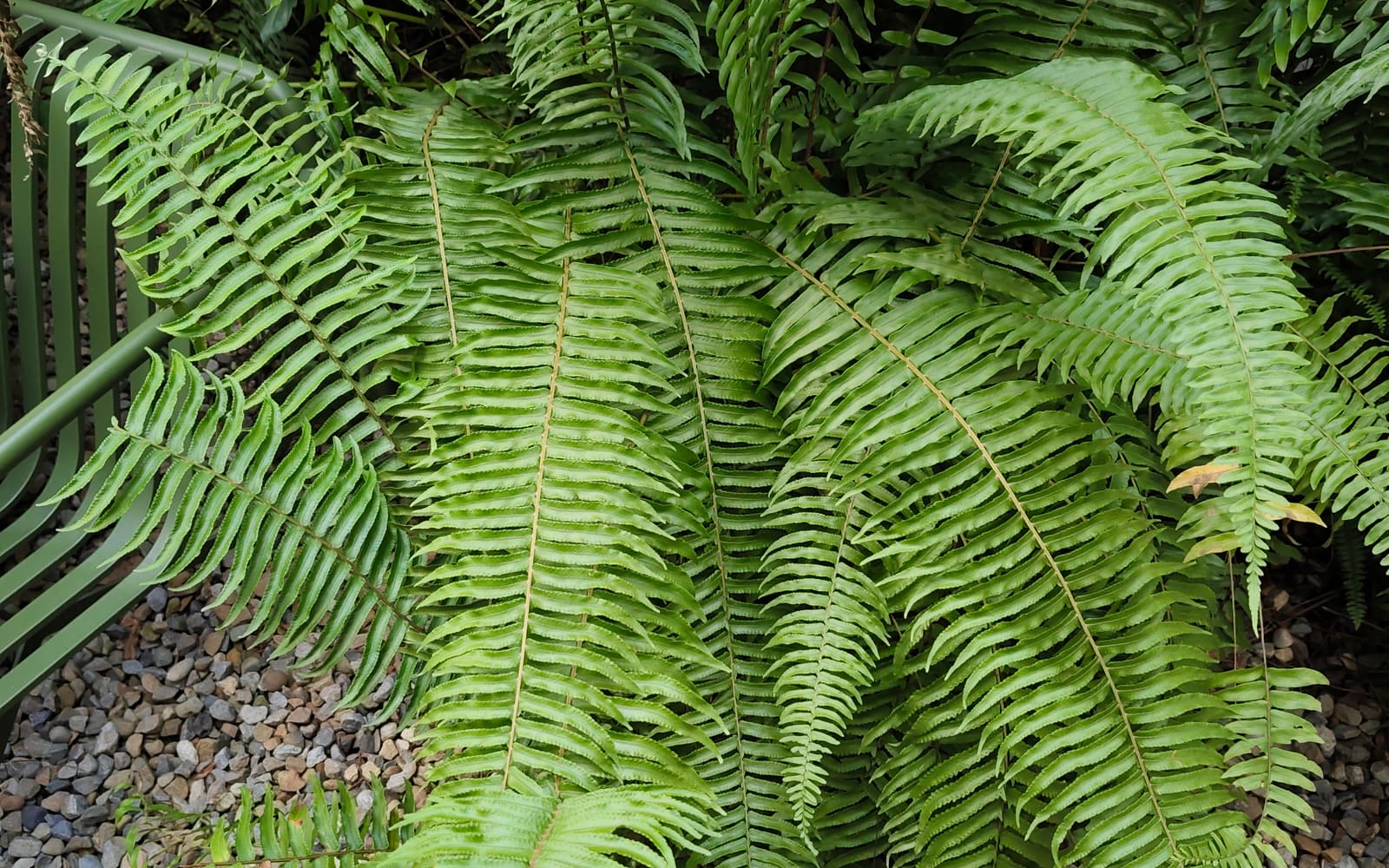
Photo by 丘崈 on Wikimedia Commons, CC0 1.0

The Boston fern wants three things: soil that never dries out, bright indirect light and humid air. Water when the surface just starts to feel dry, give it an east window or a sheer curtain, and keep it out of dry heated air, which browns its leaflets. Water less in winter. The ASPCA lists it as non-toxic to cats and dogs.
Non-toxic to cats, dogs and horses
No signs of poisoning listed. Any plant can still upset a pet’s stomach if it eats enough. Children: No poison warnings from NC State or the RHS.
Pet poison line: ASPCA (888) 426-4435
Good for: hanging baskets, bright bathrooms, pet-friendly homes · Think twice if: you often forget to water, your home gets very dry in winter.
Needs at a glance
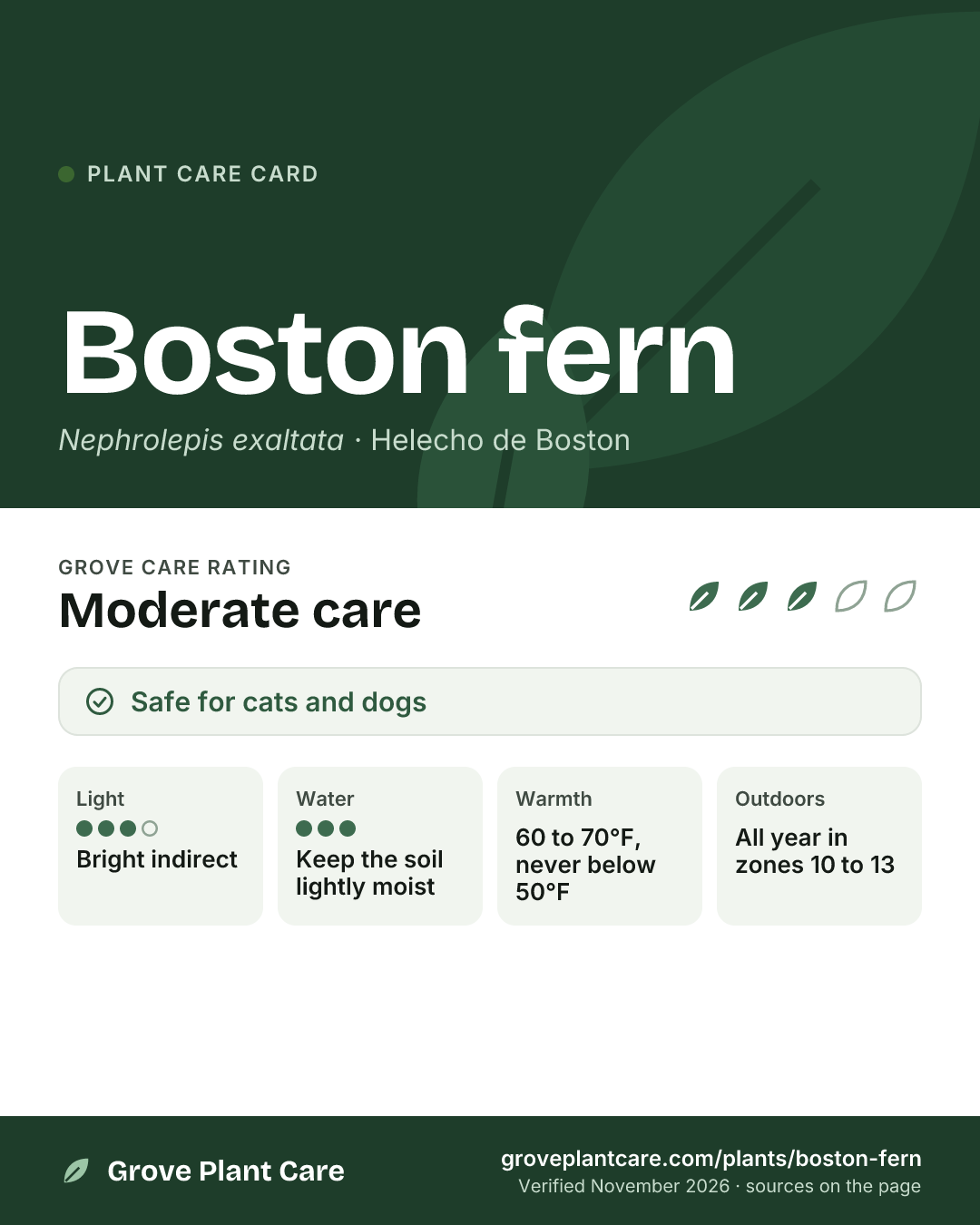
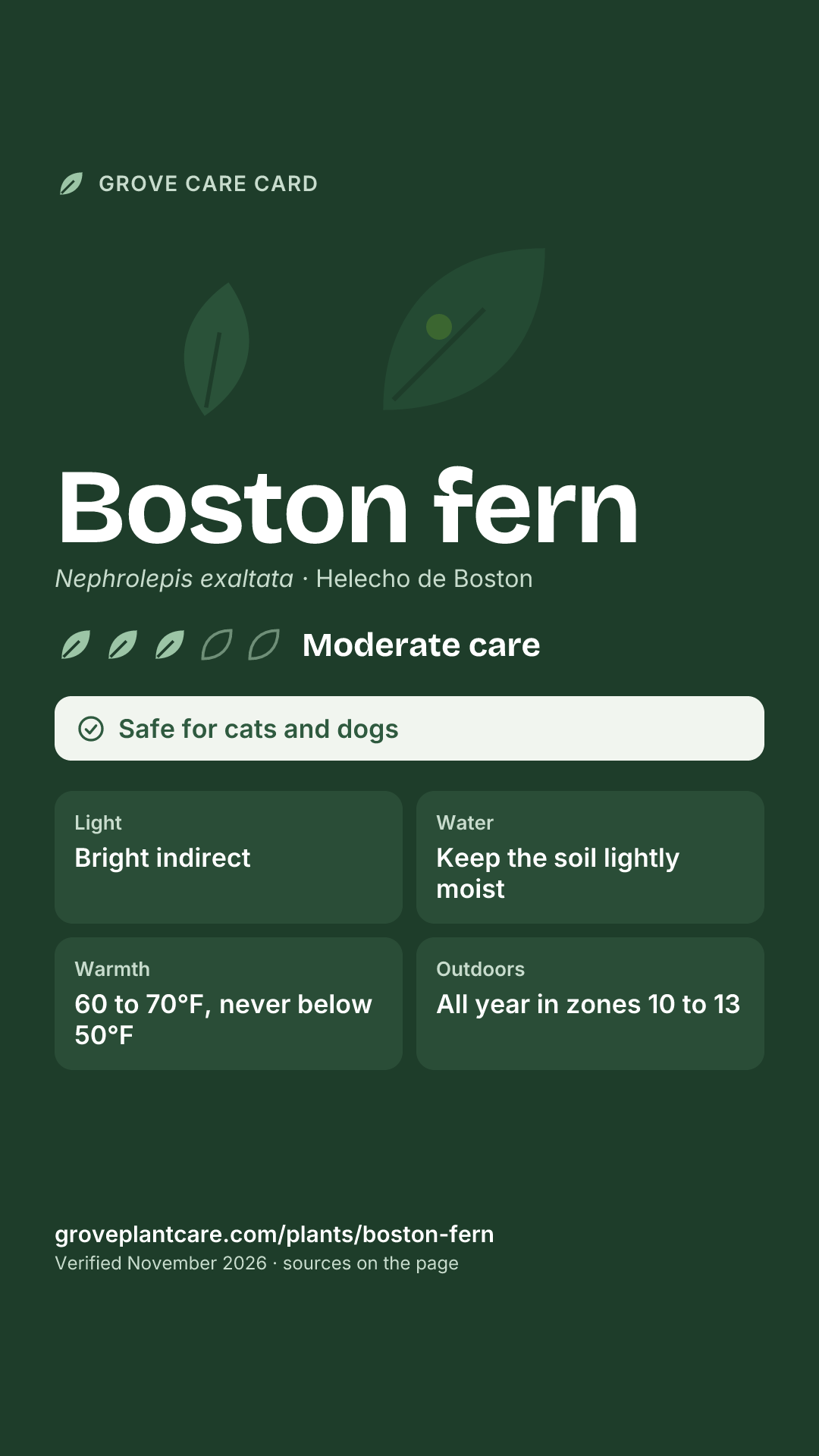
- Light3 of 4 · Bright indirectAn east window, or a sunny window behind a sheer curtain
- Water3 of 3 · Keep lightly moistNever let it dry out; water less in winter
- Humidity3 of 3 · HighA bathroom, a kitchen or a pebble tray helps
- Soil when pottedMoist but well-drained potting mixPeat-free multipurpose mix, or peat with vermiculite
Indoors: best at 60 to 70°F (16 to 21°C). Keep it above 50°F (10°C) and away from drafts and heat vents.
How the rating adds up
0 = easiest · 1 = moderate · 2 = hardest
- Missed waterings2 of 2 · HardestKeep the soil evenly moist; it sulks when it dries out
- Light flexibility1 of 2 · ModerateBright indirect or filtered light; no hot sun
- Humidity1 of 2 · ModerateLikes humid air; dry winter air browns the leaflets
- Pests and disease1 of 2 · ModerateScale, mealybugs and, in dry air, spider mites
- Sensitivity to change0 of 2 · EasiestNo trouble after moves reported; prefers soft water
Growing outdoors
All year: USDA zones 10 to 13, where the coldest winter nights average 30°F (−1°C) or warmer.
Elsewhere: summer outside in part to full shade. Bring it in before nights drop below 50°F (10°C).
Invasive in: South Africa. South Africa lists the wild species as invasive in five provinces, though sterile cultivars are exempt. Florida lists its cousins tuberous and Asian sword fern; Boston fern itself is native there. Lists checked .
- Hanging baskets and pots
- A groundcover in frost-free shade
Sources: NC State, Wisconsin Extension, RHS, UF/IFAS, ASPCA, ASPCA plant list, Clemson, USDA zone map, South Africa NEMBA list, FISC, UF/IFAS Assessment, GISD, Hawaii noxious weed list, Rojas-Sandoval and Acevedo-Rodríguez, Queensland Government, Cal-IPC and Texas Invasives. Full list below.
Verified · How we rate plants
How often should I water a Boston fern?
Often enough that the soil stays evenly moist. NC State says never let it dry out, and Wisconsin Extension says keep the mix moist but not soggy. Check it every few days, and water when the surface starts to feel dry. Wisconsin adds that small pots dry fast in hot weather. In winter the fern rests, so NC State says to water less then, since soggy soil in winter rots the roots. The RHS likes soft water, such as rainwater, and suggests watering sparingly in winter.
Why is my Boston fern turning brown and crispy?
Usually dry air or dry soil. Wisconsin Extension says dry indoor air, especially in winter, browns the tips and edges of the leaflets, and NC State notes that spider mites and scale move in when the air is too dry. Soil that dries out does the same, so check how often you water. Too much fertilizer browns the frond tips too, per Wisconsin. Fixes: water on time, raise the humidity with a pebble tray or a spot near a bathroom or kitchen, and feed at half strength. You can cut old brown fronds off at the soil line; Wisconsin says that encourages new growth. The small brown dots under healthy fronds are spores, and NC State says they're normal.
Does a Boston fern need sun or shade?
Bright light without hot sun. NC State says bright, indirect light indoors, and Wisconsin Extension suggests an east window, or a south or west window behind a sheer curtain. The RHS calls for bright, filtered light. Outdoors it's a shade plant: NC State and UF/IFAS say part to full shade, and NC State notes it copes with deep shade.
Is a Boston fern safe for cats and dogs?
Yes. The ASPCA lists the Boston fern as non-toxic to dogs and cats, and NC State marks it non-toxic for cats, dogs and horses. Any plant can still upset a pet's stomach if it eats enough. If a pet eats some and seems unwell, call your vet or the ASPCA Animal Poison Control Center at (888) 426-4435. No source lists it as poisonous to people, but if a child eats any plant, Poison Help is at 1-800-222-1222.
How do I care for a Boston fern in winter?
Bring it in, water a little less and fight the dry air. If it spent summer outside, bring it in before nights drop to 50°F (10°C): that's the RHS minimum, and Clemson Extension says 50°F or lower hurts many tropical plants. Wisconsin Extension lets it stay out until the low 40s°F, but there's no need to cut it that close. Indoors, NC State says it rests in winter, so water less, and Wisconsin says feed much less. Heated air is the big problem: set the pot on a tray of wet pebbles or near a bathroom or kitchen.
Can a Boston fern grow outdoors?
Yes, in summer almost anywhere, and all year where winters stay mild. NC State lists USDA zones 10 to 13, Wisconsin Extension says 9 to 11 and UF/IFAS starts at 8B, where it may lose some fronds in cold snaps. This card uses zone 10, whose coldest nights average 30°F (−1°C); no source gives a tested limit. In shady, frost-free gardens it spreads by thin runners into a groundcover, and UF/IFAS suggests an edging to keep it in bounds. Boston fern is native to Florida, so the Florida list doesn't name it. South Africa does: its national list names the wild species as invasive in five provinces, though sterile cultivars and hybrids are exempt.
NC State, Wisconsin Extension, UF/IFAS, USDA zone map, South Africa NEMBA list, FISC
How do I propagate a Boston fern?
Divide it or root a runner. Wisconsin Extension says division is the easiest way: in spring, cut the root ball into halves or quarters and pot each piece, keeping as many fronds as you can. The fern also sends out thin runners that root where they touch soil; the RHS suggests separating rooted runners in late winter or early spring. Spores work, but named cultivars such as 'Bostoniensis' don't come true from them, per Wisconsin.
Is a Boston fern the same as a sword fern?
Close. Boston fern is a cultivar, 'Bostoniensis', of the sword fern, Nephrolepis exaltata. Wisconsin Extension says it was found in 1894 in a shipment of sword ferns sent from Philadelphia to Boston. UF/IFAS and the RHS still call the species sword fern. Two cousins share the name: tuberous sword fern (Nephrolepis cordifolia) and Asian sword fern (Nephrolepis brownii). The Florida Invasive Species Council lists both as Category I invasives, and UF/IFAS rates tuberous sword fern invasive with no recommended uses anywhere in the state. Boston fern itself is native to Florida. Check the botanical name on the tag before you plant a sword fern in the ground there.
Wisconsin Extension, UF/IFAS, RHS, FISC, UF/IFAS Assessment, Kew
How Grove helps
Grove can remind you to check the soil on a schedule you set, so the Boston fern never dries out, and you can ease the schedule off for winter. Feeding can be a repeating task for spring and summer that you assign to anyone who helps.
Sources
- NC State Extension Gardener Plant Toolbox: Nephrolepis exaltata
- UW-Madison Extension, Wisconsin Horticulture: Boston Fern, Nephrolepis exaltata (revised 2025)
- Royal Horticultural Society: Nephrolepis exaltata (sword fern)
- Royal Horticultural Society: Best bathroom plants
- UF/IFAS Extension EDIS FPS427: Nephrolepis exaltata, Boston Fern, Sword Fern (revised 2023)
- ASPCA Animal Poison Control: Boston Fern
- ASPCA Animal Poison Control: Toxic and Non-Toxic Plants
- Clemson Cooperative Extension HGIC 1454: Moving Houseplants Indoors and Outdoors
- USDA ARS Plant Hardiness Zone Map (2023)
- South Africa, National Environmental Management: Biodiversity Act, Alien and Invasive Species Lists 2020 (Government Gazette 43726): Nephrolepis exaltata, Category 1b in five provinces
- Florida Invasive Species Council: Plant List, Category I and II (April 2026); Nephrolepis cordifolia and N. brownii Category I, N. exaltata not listed
- UF/IFAS Assessment of Non-Native Plants: Nephrolepis cordifolia
- IUCN Global Invasive Species Database: Nephrolepis exaltata (no profile)
- Hawaii Administrative Rules 4-68: plant species designated as noxious weeds (Hawaii Department of Agriculture)
- J. Rojas-Sandoval and P. Acevedo-Rodríguez (2015), Naturalization and invasion of alien plants in Puerto Rico and the Virgin Islands, Biological Invasions 17 (supplementary list)
- Business Queensland: Restricted invasive plants (Biosecurity Act 2014)
- Cal-IPC (California Invasive Plant Council): site search, "nephrolepis" (no listing)
- Texas Invasives: plant database (no Nephrolepis)
- Kew WCVP data release (2026-06-04 file), plant_name_id 3152952: Nephrolepis exaltata
- Kew WCVP data release (2026-06-04 file), plant_name_id 3152850: Nephrolepis cordifolia