Plant care card
Dwarf umbrella tree
Heptapleurum arboricola (formerly Schefflera arboricola) · Cheflera enana
Also called dwarf schefflera, Hawaiian schefflera or parasol plant
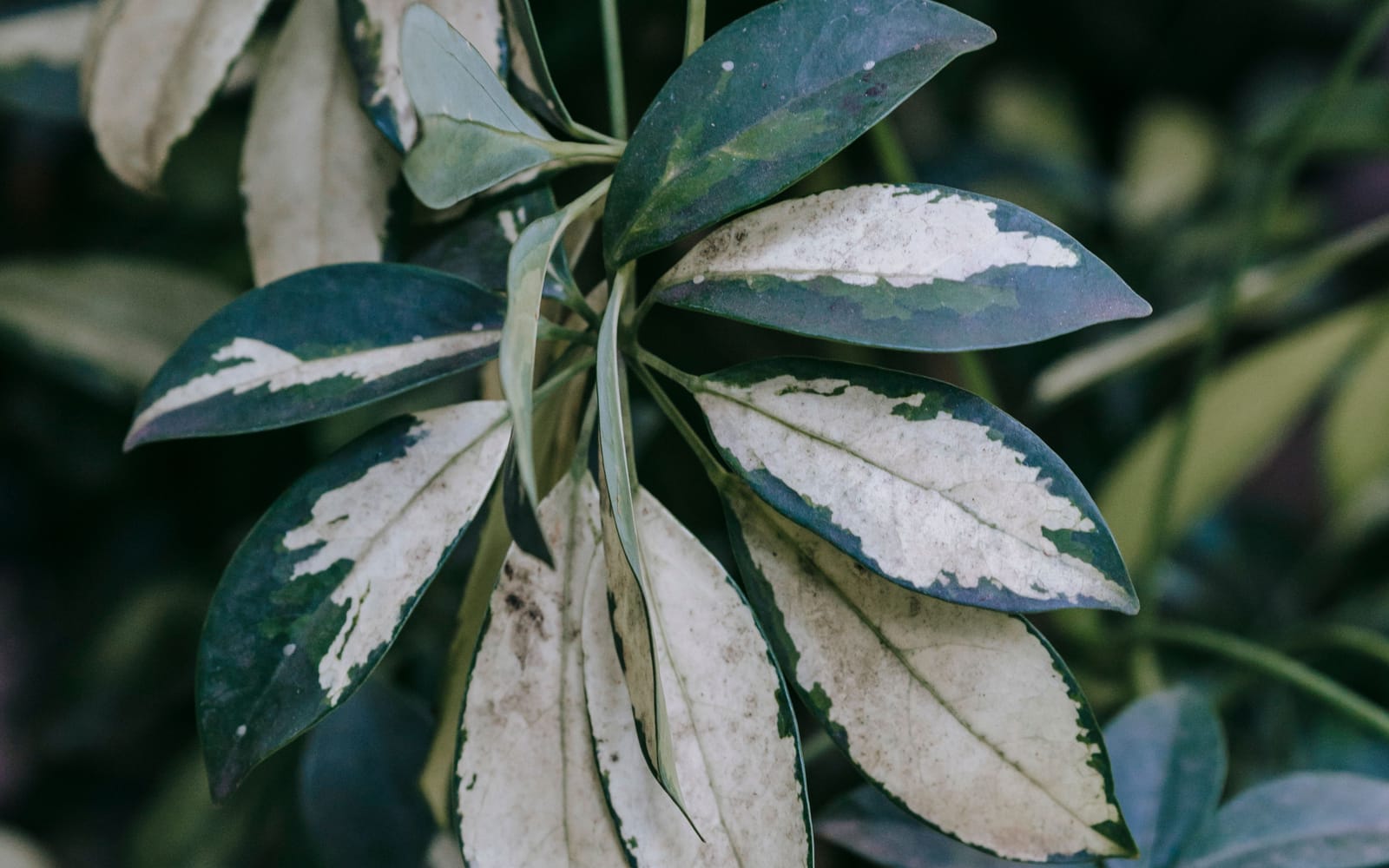
Photo by Teona Swift on Pexels
The dwarf umbrella tree is a sturdy, compact schefflera that wants bright, filtered light, a drink once the top of the soil dries, and a spot away from drafts and heat vents. Get those right and it grows into a bushy little tree you can even train as a bonsai. Get them wrong and it tells you fast by dropping leaves. It's toxic to cats and dogs. It's also a different plant from the much bigger umbrella tree, which is invasive in Florida.
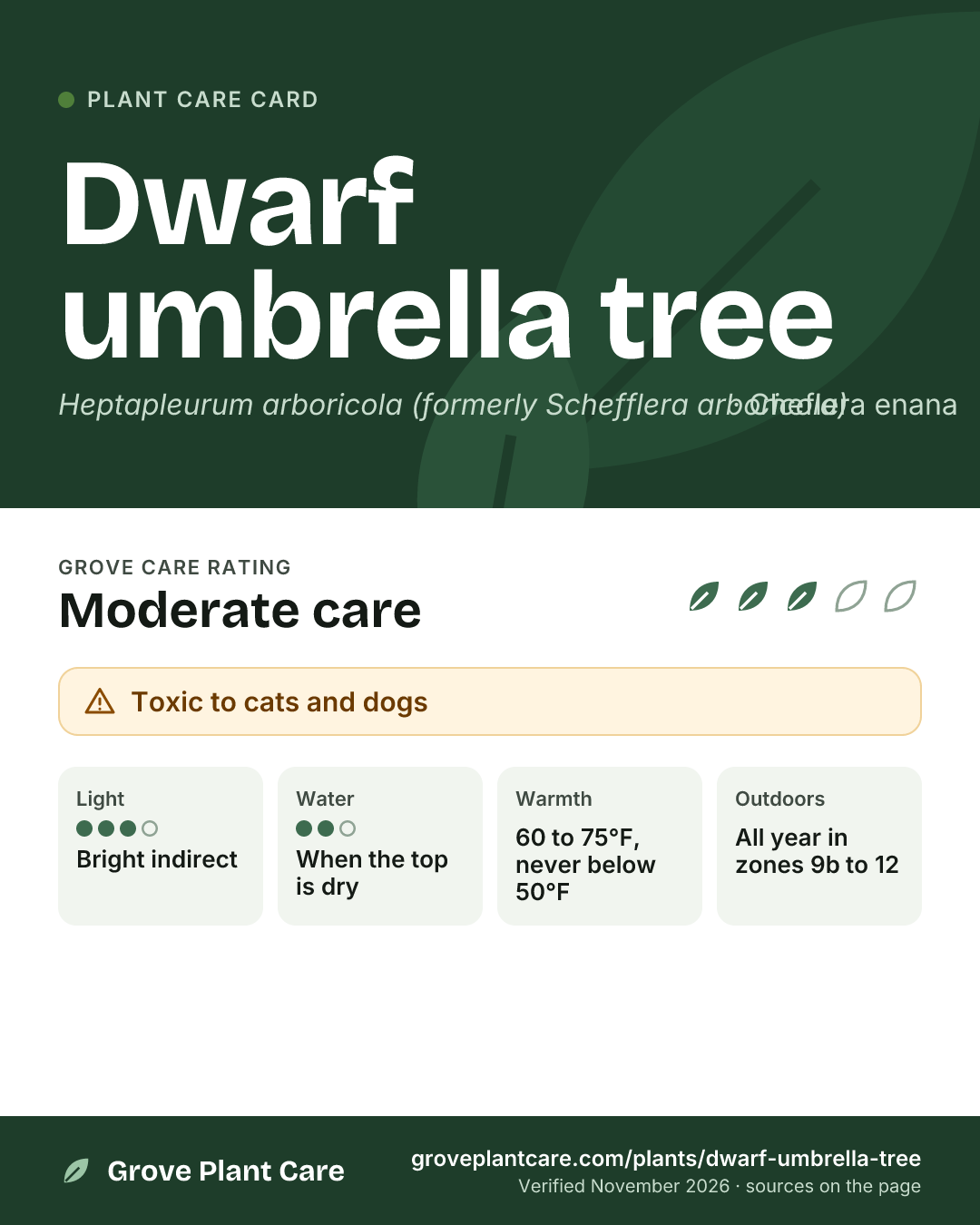
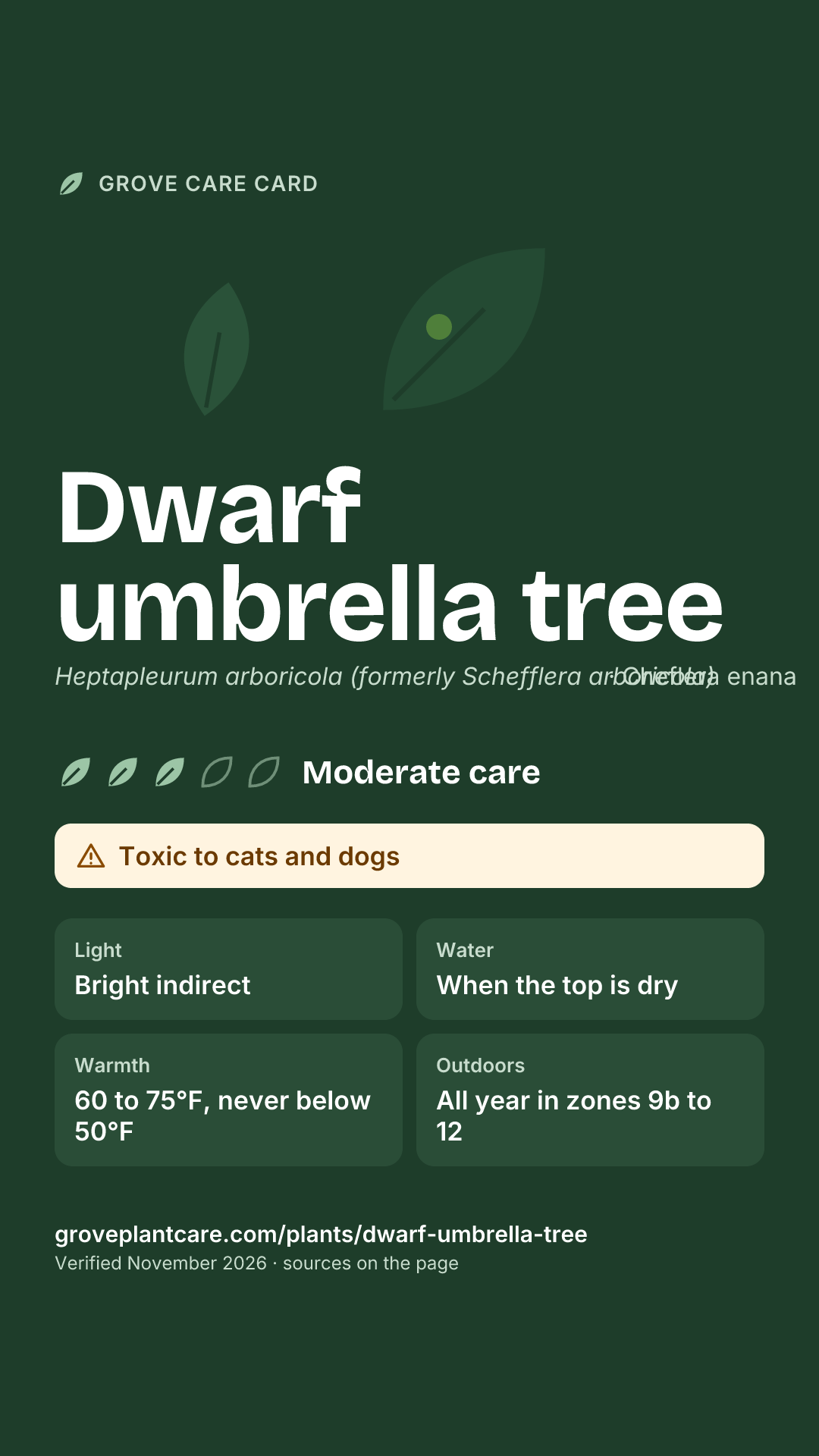
Toxic to cats and dogs · Mild
Burning mouth, drooling, vomiting and trouble swallowing. Calcium oxalate crystals in the leaves and sap; the ASPCA lists every Schefflera as toxic, and NC State rates this one low severity. Children: low severity. NC State rates it low severity; chewing irritates the mouth and throat, and the sap can irritate skin.
Pet poison line: ASPCA (888) 426-4435
Good for: bright rooms out of hot sun, training as a bonsai or small tree, patios and hedges in warm climates · Think twice if: pets or small children chew plants, you garden in Hawaii, where birds spread it into forests.
Needs at a glance
- Light3 of 4 · Bright indirectFiltered light from an east, south or west window; no hot sun through the glass
- Water2 of 3 · Let the top dryWater when the top half inch is dry; never leave it in a full saucer
- Humidity2 of 3 · Above averageLikes humid air; a pebble tray helps if the pot sits above the water
- Soil when pottedWell-drained potting mixA general houseplant mix that drains quickly
Indoors: best at 60 to 75°F (16 to 24°C). Keep it above 50°F (10°C) and away from drafts and heat vents.
How the rating adds up
0 = easiest · 1 = moderate · 2 = hardest
- Missed waterings1 of 2 · ModerateLet the top dry; soil left too dry or too wet makes it drop leaves
- Light flexibility1 of 2 · ModerateMedium to bright indirect light; leggy in dim rooms, scorched by hot sun through glass
- Humidity1 of 2 · ModeratePrefers humid air; dry air can cause leaf drop
- Pests and disease1 of 2 · ModerateSpider mites, mealybugs and scale; disease is rare
- Sensitivity to change1 of 2 · ModerateDrops leaves after drafts, chills or big swings in watering
Growing outdoors
All year: USDA zones 9b to 12, where the coldest winter nights average 25°F (−4°C) or warmer.
Elsewhere: summer outside in partial shade or filtered sun; ease it into brighter light. Bring it in when nights reach 50 to 60°F (10 to 16°C).
- Containers and patios
- Hedges, espaliers and small trees in warm climates
- Bonsai
- Drought and salt tolerant once planted out
Sources: NC State, Clemson, RHS, Illinois Extension, ASPCA, ASPCA plant list, USDA zone map, UF/IFAS Extension, FISC, Hawaii noxious weed list, GISD, UF/IFAS and Hawaii weed risk assessment. Full list below.
Verified · How we rate plants
Is a dwarf umbrella tree toxic to cats and dogs?
Yes. The ASPCA lists Schefflera as toxic to cats and dogs, and NC State lists this species as a problem for both. The leaves and sap hold calcium oxalate crystals, tiny needle-shaped crystals that irritate the mouth. A pet that chews it can get intense burning in the mouth, lips and tongue, drool a lot, vomit or have trouble swallowing. NC State rates the severity low, yet its own description calls the plant seriously toxic to dogs and cats, so keep it out of reach either way. The sap can also irritate sensitive skin, so wear gloves when you prune. If a pet eats some, call your vet or the ASPCA Animal Poison Control Center at (888) 426-4435. If a child eats some, call Poison Help at 1-800-222-1222.
Is a dwarf umbrella tree the same as an umbrella tree?
No. They're two different plants that share a lot of names, including schefflera and octopus tree. The dwarf umbrella tree has glossy leaflets up to about 4 inches long, set like umbrella spokes, and it stays compact enough to train into a small tree. The umbrella tree, also sold as Queensland umbrella tree, has leathery leaflets up to 12 inches long and grows much bigger, 8 to 10 feet even indoors (Clemson). Its botanical name is Heptapleurum actinophyllum, once Schefflera or Brassaia actinophylla. That bigger plant is on Florida's Category I invasive plant list and in the Global Invasive Species Database, and Hawaii's weed risk assessment rates it high risk. Florida's list and that database leave the dwarf umbrella tree off (we checked in November 2026), though Hawaii's assessment flags it as high risk too; the outdoors answer below explains why. The ASPCA lists both as toxic to pets.
Clemson, NC State, Kew, FISC, GISD, Hawaii weed risk assessment, ASPCA, ASPCA plant list
What is the dwarf umbrella tree's botanical name?
Heptapleurum arboricola. Kew's World Checklist of Vascular Plants now accepts that name and lists Schefflera arboricola, the name on most plant tags, as a synonym. It's the same plant with a new genus. NC State gives Schefflera arboricola as its previous name, and UF/IFAS Extension uses the new one too. You may also see the spelling Heptapleurum arboricolum on UF/IFAS pages. Stores will likely keep selling it as schefflera for a while, and the common names stay the same.
How often should I water a dwarf umbrella tree?
Water it thoroughly, then wait for the top of the soil to dry before you water again. Clemson says to wait until the soil is dry about half an inch down; NC State says to let it dry out, then water well. Empty the saucer so the pot never sits in water. Too much water causes most of the trouble, and NC State notes that soil kept too wet or too dry both make it drop leaves. The RHS suggests watering moderately while it grows and sparingly in winter.
How much light does a dwarf umbrella tree need?
Bright, filtered light. NC State suggests an east, south or west window that gives it 3 to 4 hours of filtered light a day, and warns that strong direct sun through glass can scorch the leaves. Clemson says medium to bright light; in low light the leaves yellow and the stems grow thin and weak. Illinois Extension puts it in the medium light group, and the RHS says bright indirect light. Plants in dimmer spots also need less fertilizer, Clemson adds.
Why is my dwarf umbrella tree dropping leaves?
Usually water, cold or dry air. Clemson names too much water, low humidity and chilling as the main causes, and NC State adds soil that stays too wet or too dry. Keep it above 50°F (10°C), with nights above 60°F (16°C) and days around 65 to 75°F (18 to 24°C), away from heat vents, radiators, open windows and air conditioners. Cold damage can show up as dead patches on the leaves several days later. NC State says it likes humid air: a tray of pebbles and water under the pot helps, as long as the pot sits above the water line.
What pests bother a dwarf umbrella tree?
Spider mites, mealybugs and scale, according to NC State, the RHS and Clemson. Illinois Extension notes that spider mites go after it less often than the bigger umbrella tree. Check under the leaves and along the stems now and then so you catch them early. Disease is rarely a problem indoors (Clemson), and the RHS calls it generally disease-free.
Can a dwarf umbrella tree grow outdoors?
Yes, in warm places. NC State lists USDA zones 9b to 12b, where it works as a hedge, accent, small tree or patio plant and handles drought and salt. UF/IFAS Extension in Charlotte County, Florida, says it grows in full sun to part shade, calls it one of the best shrubs for shady spots, and notes it bounces back well from frost damage. Planted out, it usually reaches 10 to 15 feet. Where winters are colder, NC State says it can go outside to a sheltered spot once temperatures stay above 60°F (16°C); bring it back in before nights drop to 50 to 60°F (10 to 16°C). Outdoors, birds eat its orange fruit and spread the seeds. UF/IFAS finds it is no problem in Florida, and no official invasive list names it. Even so, Hawaii's weed risk assessment rates it high risk: it has gone wild in moist forests on Kauai, Oahu, Maui and Hawaii Island, where it can even grow on other trees. A European plant protection report also calls it invasive in Fiji, Singapore and Brazil.
NC State, UF/IFAS Extension, Clemson, UF/IFAS, FISC, Hawaii noxious weed list, GISD, Hawaii weed risk assessment, EPPO
How do I prune and propagate a dwarf umbrella tree?
Pinch out the growing tips to keep it bushy (Illinois Extension), or cut just above a leaf to keep it shorter (Clemson). Older plants can be trained into small trees, and it is often grown as a bonsai. To make new plants, root stem cuttings; NC State, Clemson and the RHS also list seed, and Clemson and the RHS list air layering. Wear gloves, since the sap can irritate skin.
How Grove helps
Grove sets a watering check based on how dry the soil is, so a dwarf umbrella tree gets water only once the top has dried. You can add a pinch-back or a pest check under the leaves as a repeating task and assign it to whoever is home that week.
Sources
- NC State Extension Gardener Plant Toolbox: Heptapleurum arboricola (previously Schefflera arboricola)
- Clemson Cooperative Extension HGIC 1511: Schefflera (revised 2015)
- Royal Horticultural Society: Schefflera arboricola (umbrella tree)
- University of Illinois Extension, Houseplants: Umbrella Tree (Schefflera arboricola, Hawaiian schefflera)
- ASPCA Animal Poison Control: Schefflera
- ASPCA Animal Poison Control: Toxic and Non-Toxic Plants
- USDA ARS Plant Hardiness Zone Map (2023)
- UF/IFAS Extension Charlotte County: The right schefflera (R. Mitchell, 2025)
- Florida Invasive Species Council: Plant List, Category I and II and Watch List (April 2026)
- Hawaii Administrative Rules, chapter 4-68: plant species designated as noxious weeds (Hawaii Department of Agriculture)
- IUCN Global Invasive Species Database: Schefflera arboricola (no entry)
- UF/IFAS Assessment of Non-Native Plants: Heptapleurum arboricolum (Schefflera arboricola)
- Hawaii-Pacific Weed Risk Assessment (Plant Pono): Schefflera arboricola, high risk, score 11 (2022)
- Kew WCVP data release (2026-06-04 file), plant_name_id 98359: Heptapleurum arboricola (syn. Schefflera arboricola)
- Kew WCVP data release (2026-06-04 file), plant_name_id 540248: Heptapleurum actinophyllum (syn. Schefflera actinophylla, Brassaia actinophylla)
- NC State Extension Gardener Plant Toolbox: Schefflera actinophylla (formerly Brassaia actinophylla)
- IUCN Global Invasive Species Database: Schefflera actinophylla
- Hawaii-Pacific Weed Risk Assessment (Plant Pono): Schefflera actinophylla, high risk, score 13 (2004)
- EPPO Reporting Service 2021/231: Heptapleurum arboricola naturalising in Sicily