Plant care card
Hanging lobster claw
Heliconia rostrata · Heliconia
Also called lobster claw or false bird of paradise
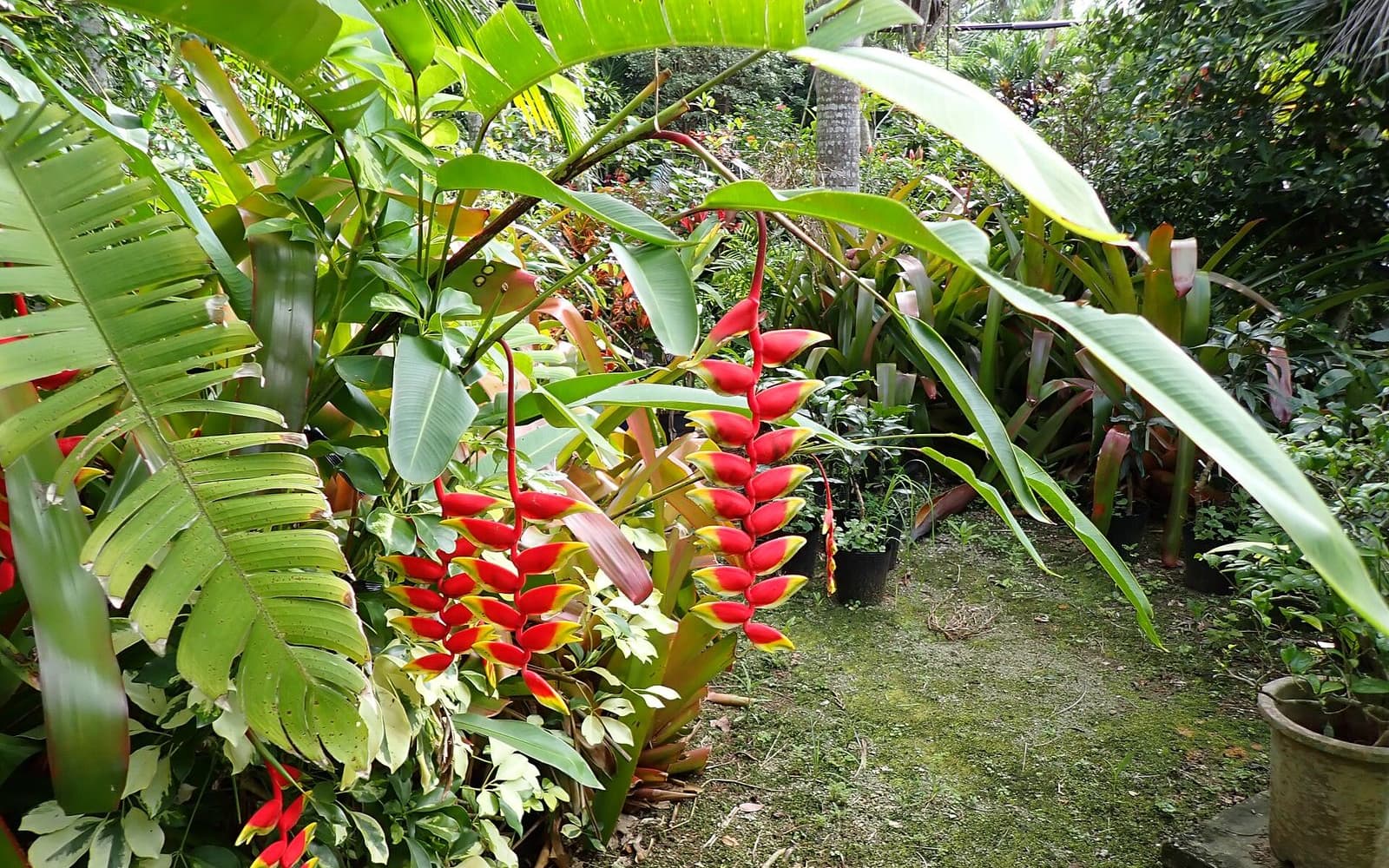
Photo by M108t on Wikimedia Commons, CC BY 4.0

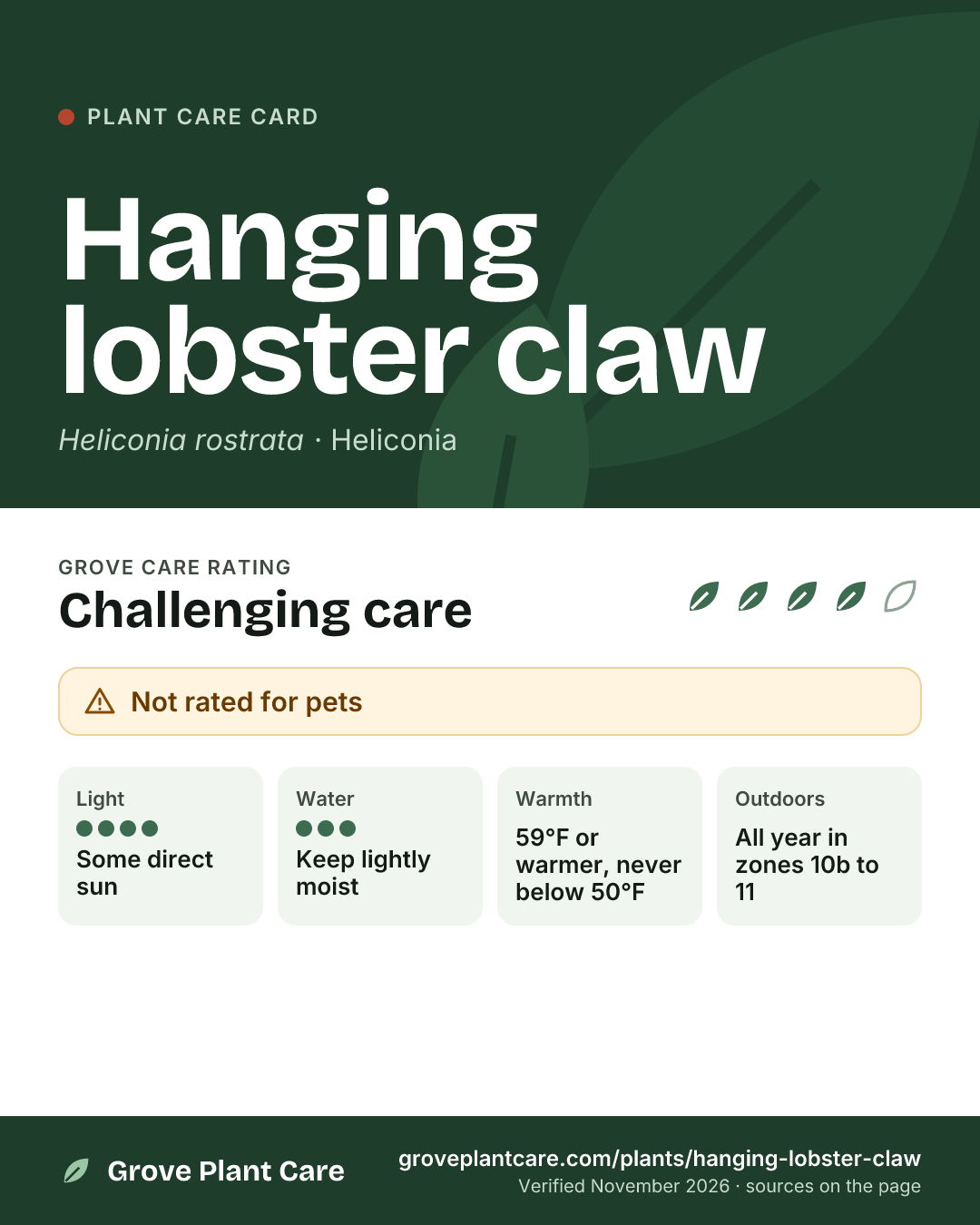
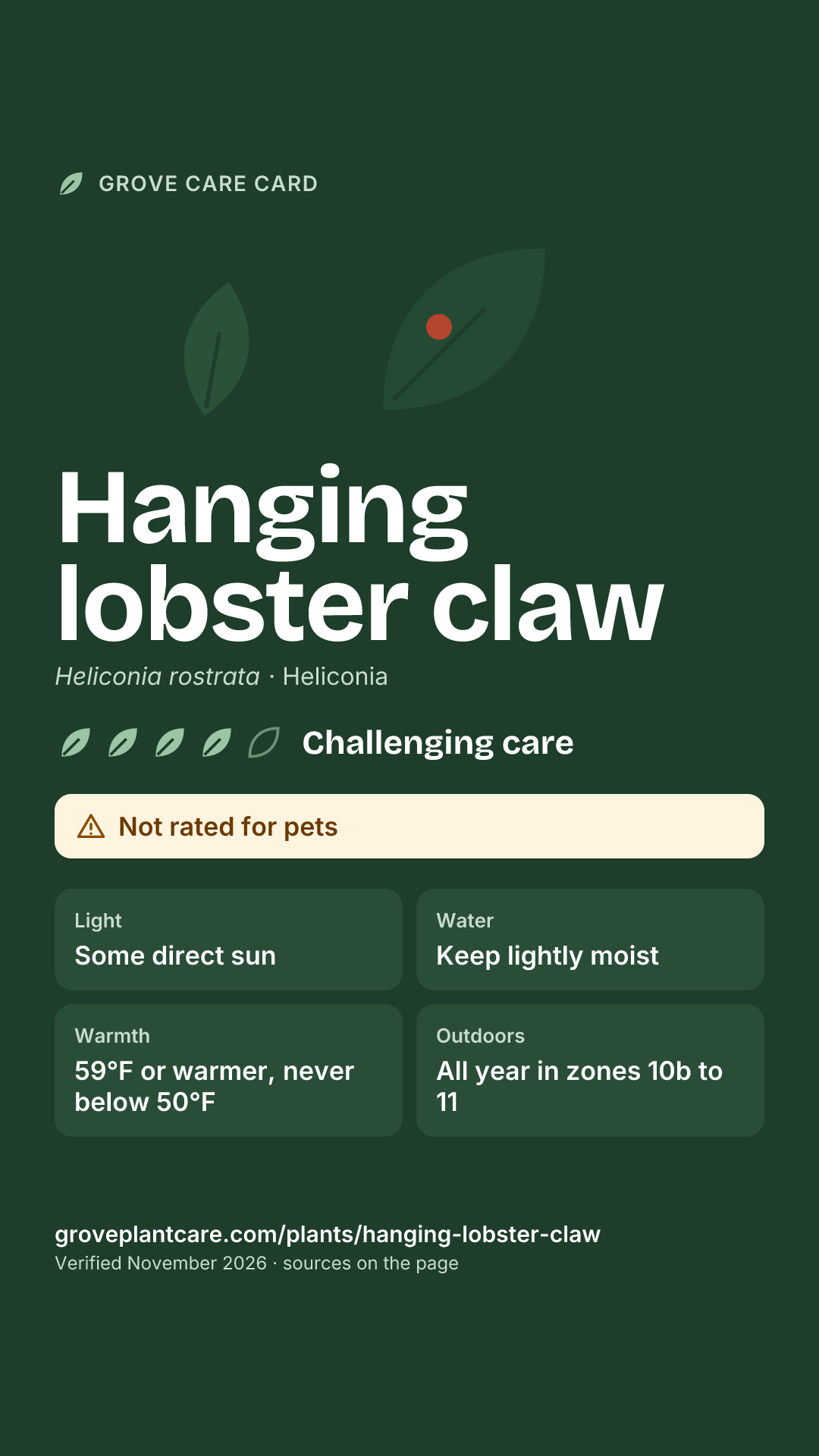
The hanging lobster claw (Heliconia rostrata) is a big tropical plant with chains of red and yellow bracts that dangle below banana-like leaves. Give it your brightest spot, keep the soil moist, and keep it above 50°F (10°C), warmer is better. Outdoors it lives all year only in USDA zones 10b to 11. Indoors it's a challenge: it needs light, warmth and humid air all year. No official list names it as invasive, and neither the ASPCA nor NC State rates it for pets.
Not rated for pets
Neither the ASPCA nor NC State rates hanging lobster claw. No reputable source lists it as toxic, but none rates it either. Hawaii's weed risk assessment found no evidence of toxicity. Children: No poisoning information found.
Pet poison line: ASPCA (888) 426-4435
Good for: frost-free tropical gardens, a sunny conservatory or very bright room, bold, long-lasting flowers · Think twice if: your home is cool or dim in winter, you want a small, low-fuss houseplant.
Needs at a glance
- Light4 of 4 · Some direct sunYour brightest window; outdoors, full sun to part shade
- Water3 of 3 · Keep lightly moistKeep the soil moist while it grows; never let the pot dry out or sit soggy
- Humidity2 of 3 · Above averageHumid air, like most heliconias
- Soil when pottedRich, moist, well-drained mixFertile potting mix with some coarse sand or grit; it tolerates acid to alkaline soil
Indoors: best at 59°F (15°C) or warmer. Keep it above 50°F (10°C) and away from drafts and heat vents.
How the rating adds up
0 = easiest · 1 = moderate · 2 = hardest
- Missed waterings2 of 2 · HardestWants fertile soil that stays moist; it handles drought poorly
- Light flexibility2 of 2 · HardestNeeds the brightest spot you have; outdoors, full or part sun
- Humidity1 of 2 · ModerateHeliconias like humid air all year
- Pests and disease1 of 2 · ModerateLeaf spots, scale, spider mites and root rot now and then
- Sensitivity to change2 of 2 · HardestNeeds warmth all year; cold nights and drafts set it back
Growing outdoors
All year: USDA zones 10b to 11, where the coldest winter nights average 35°F (2°C) or warmer.
Elsewhere: summer outside in full sun to part shade, sheltered from wind; ease it into brighter light over a week. Bring it in before nights drop below 59°F (15°C).
- A specimen clump in frost-free tropical gardens
- Big containers on a bright patio
- Long-lasting cut flowers
Sources: UF/IFAS, UF/IFAS Gardening Solutions, RHS, UW-Madison Extension, Chicago Botanic Garden, ASPCA plant list, Hawaii weed risk assessment, Clemson, USDA zone map, NTBG, FISC, Hawaii noxious weed list, Rojas-Sandoval and Acevedo-Rodríguez, TexasInvasives.org, Cal-IPC, Queensland Government and GISD. Full list below.
Verified · How we rate plants
Is the hanging lobster claw toxic to cats and dogs?
We don't know for sure. Neither the ASPCA nor NC State rates Heliconia rostrata, and we found no reputable source that lists it as toxic. Hawaii's weed risk assessment found no evidence that it harms animals or people. That's useful, but a weed screen isn't a pet safety rating. Keep it out of reach of pets that chew plants. If a pet eats some and seems unwell, call your vet or the ASPCA Animal Poison Control Center at (888) 426-4435. If a child eats some, call Poison Help at 1-800-222-1222.
Is a lobster claw the same as a bird of paradise?
No, they only look alike. UW-Madison Extension explains that heliconias have banana-like leaves much like a bird of paradise, but the flowers are very different, and heliconias belong to their own group, Heliconiaceae, with about 200 species. Hanging lobster claw is one of them, and its flower heads hang down, which is where "hanging" comes from. Many heliconias hold their flower heads upright instead, and "lobster claw" is also a name for one of those, Heliconia bihai, according to Hawaii's weed risk assessment. If your plant's bracts point up, it's a different heliconia.
UW-Madison Extension, UF/IFAS, UF/IFAS Gardening Solutions, Hawaii weed risk assessment
Can I grow a hanging lobster claw indoors?
Yes, with a lot of light and warmth. UF/IFAS lists it as suitable for growing indoors, and the RHS grows it under glass in bright, filtered light, above 15°C (59°F) all year. Outdoors in Florida, UF/IFAS says it does well in full or partial sun. UW-Madison Extension calls heliconias challenging in cold climates, since most need sun, humidity and warmth all year, and says smaller kinds are easiest in containers. Indoors, give it your sunniest window or a conservatory, and a big pot.
UF/IFAS, RHS, UW-Madison Extension, UF/IFAS Gardening Solutions
How often should I water a hanging lobster claw?
Often enough that the soil stays moist. UF/IFAS says it grows and flowers best in fertile, moist soil, and its Gardening Solutions team says heliconias are only slightly drought tolerant. The RHS wants the mix moist but well drained. Water when the surface starts to dry, let the extra drain away, and empty the saucer. A pot dries much faster than garden soil, so check it every few days in summer.
What temperature and humidity does it need?
Steady warmth. The RHS rates it for growing under glass all year, above 15°C (59°F). Chicago Botanic Garden says it needs temperatures well above 50°F (10°C) all year to thrive and flower, and Clemson Extension warns that 50°F or lower damages many tropical plants. Keep it away from cold windows and drafts in winter. UW-Madison Extension says heliconias want humid air, so a humidifier nearby helps indoors.
Why isn’t my hanging lobster claw flowering?
Usually because the stalks are too young, or it lacks light or warmth. UF/IFAS says the flowers come from stalks in their second year, so a stalk that froze or got cut back won't flower next season. UW-Madison Extension explains that each mature stalk flowers once, then dies as new shoots grow from the underground rhizome. Once a flower head turns brown, cut that stalk off at the base, as the RHS suggests. Give it bright light, warmth and regular feeding while it grows.
UF/IFAS, UW-Madison Extension, RHS, Chicago Botanic Garden, UF/IFAS Gardening Solutions
What pests and problems affect a hanging lobster claw?
A few. UF/IFAS names leaf spot diseases, scale and nematodes, though it says none are usually serious. Under glass, the RHS lists red spider mites, mealybugs and snails, plus root and stem rot. Gardening Solutions suggests checking heliconias regularly. Look under the leaves and along the stalks, and don't let the pot sit in water, which invites rot.
How do I propagate a hanging lobster claw?
Divide the clump. UF/IFAS propagates it by dividing the matted clumps, and its Gardening Solutions team says to plant the rhizomes in large sections. The RHS divides it in spring, and also grows it from seed sown in warmth, which is slower. Each division needs a piece of rhizome with at least one healthy shoot.
Can a hanging lobster claw grow outdoors, and is it invasive?
Outdoors all year it needs a nearly frost-free climate: UF/IFAS lists USDA zones 10b to 11. No source gives an exact survival temperature; zone 10b's coldest nights average about 35°F (2°C). Gardening Solutions says heliconias in central Florida may die back in cold weather and sprout again from the rhizomes when it warms. Where winters are colder, keep it in a pot, set it out once nights stay above 60°F (16°C), as Clemson suggests, and bring it in before nights drop to 59°F (15°C). On invasiveness: it isn't on Florida's, Hawaii's, Texas's or California's lists, and Hawaii's weed risk assessment rates it low risk. The clump does spread by rhizomes, and Gardening Solutions notes a container keeps spreading heliconias in place.
UF/IFAS, UF/IFAS Gardening Solutions, USDA zone map, Clemson, RHS, FISC, Hawaii noxious weed list, TexasInvasives.org, Cal-IPC, Hawaii weed risk assessment
How Grove helps
Grove sets a watering check based on how dry the soil is, so the hanging lobster claw gets water before the pot dries out. You can add a reminder to bring the pot inside before cool nights, and a task to cut spent flower stalks, and assign them to whoever looks after it.
Sources
- UF/IFAS Extension EDIS FPS248: Heliconia rostrata, Lobster Claw (Gilman, Meerow, Klein and Hansen)
- UF/IFAS Gardening Solutions: Heliconia
- Royal Horticultural Society: Heliconia rostrata (false bird of paradise, hanging lobster claw)
- University of Wisconsin-Madison Extension (Wisconsin Master Gardener): Heliconias (S. Mahr, 2017)
- Chicago Botanic Garden Plant Finder: Heliconia rostrata, hanging lobster-claws (archived page)
- ASPCA Animal Poison Control: Toxic and Non-Toxic Plants
- Hawaii-Pacific Weed Risk Assessment (Plant Pono): Heliconia rostrata, low risk, score 4 (2020)
- Clemson Cooperative Extension HGIC 1454: Moving Houseplants Indoors and Outdoors
- USDA ARS Plant Hardiness Zone Map (2023)
- National Tropical Botanical Garden, Tropical Plant Database: Heliconia rostrata
- Florida Invasive Species Council: Plant List, Category I and II and Watch List (April 2026)
- Hawaii Administrative Rules 4-68: plant species designated as noxious weeds (Hawaii Department of Agriculture)
- J. Rojas-Sandoval and P. Acevedo-Rodríguez (2015), Naturalization and invasion of alien plants in Puerto Rico and the Virgin Islands, Biological Invasions 17 (supplementary list)
- TexasInvasives.org Invasives Database: plant list (no Heliconia)
- California Invasive Plant Council (Cal-IPC): plant search, "heliconia" (no listing)
- Business Queensland: Restricted invasive plants (Biosecurity Act 2014)
- IUCN Global Invasive Species Database: Heliconia rostrata (no entry)
- Kew WCVP data release (2026-06-04 file), plant_name_id 248570: Heliconia rostrata
- Hawaii-Pacific Weed Risk Assessment (Plant Pono): Heliconia bihai (common names include lobster claw)
- Bolivia, Decreto Presidencial N° 22482 (1990): Khantuta tricolor y Patujú bandera, flores nacionales (name evidence only)
- Bolivia, Decreto Supremo N° 241 (2009), Símbolos del Estado Plurinacional: la flor del patujú, Heliconia rostrata (name evidence only)