Plant care card
Majesty palm
Ravenea rivularis · Palma majestad
Also called majestic palm
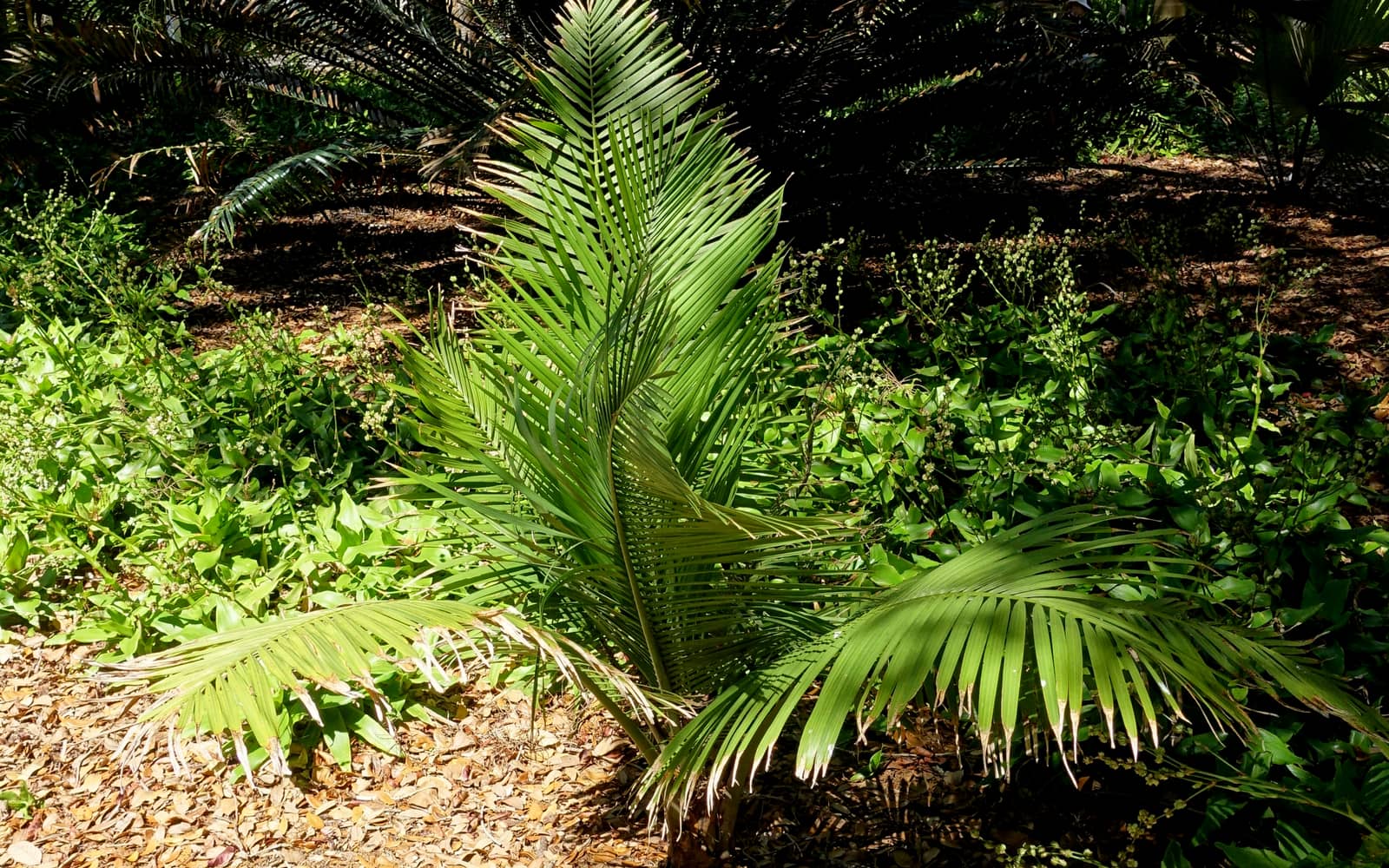
Photo by Daderot on Wikimedia Commons

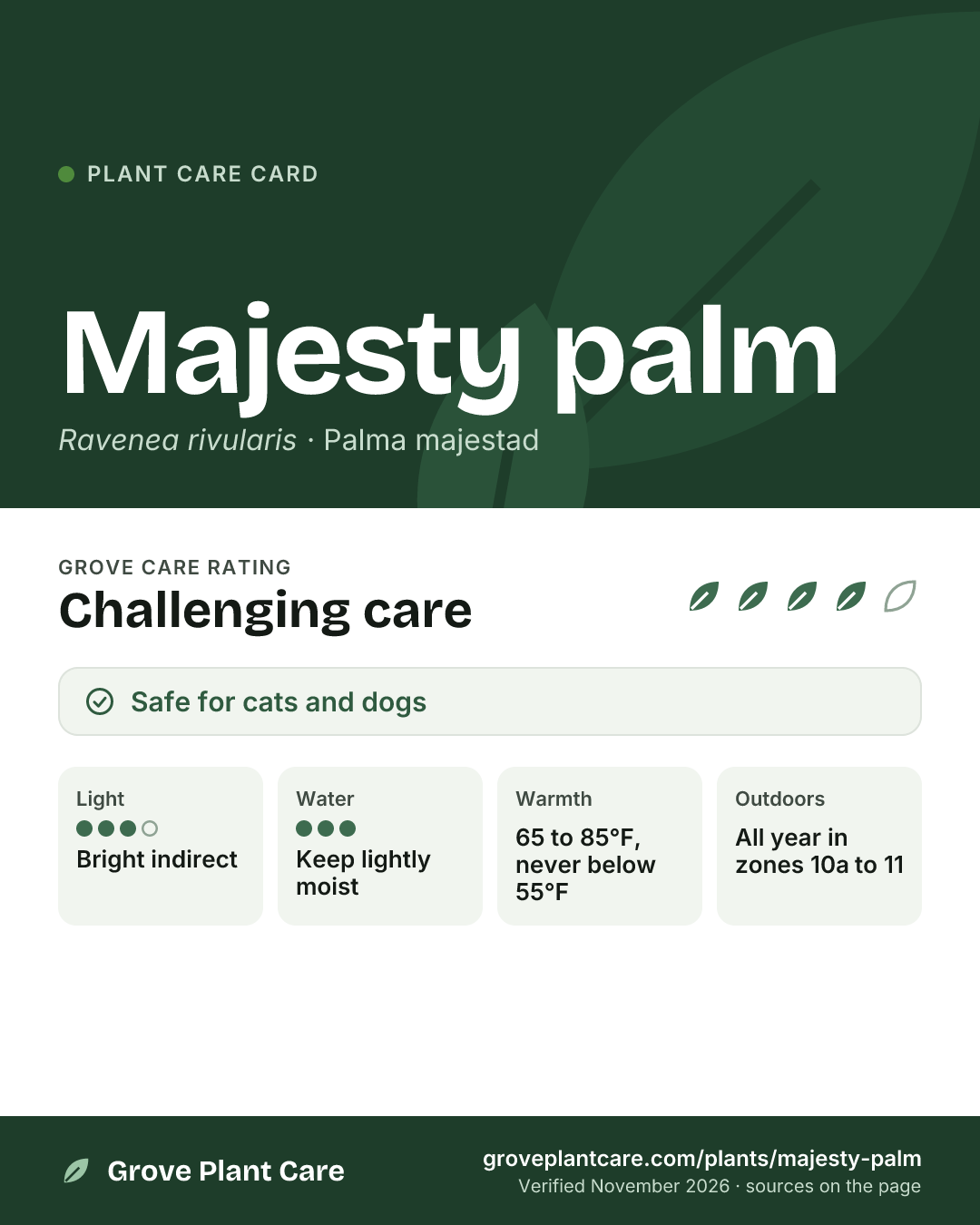
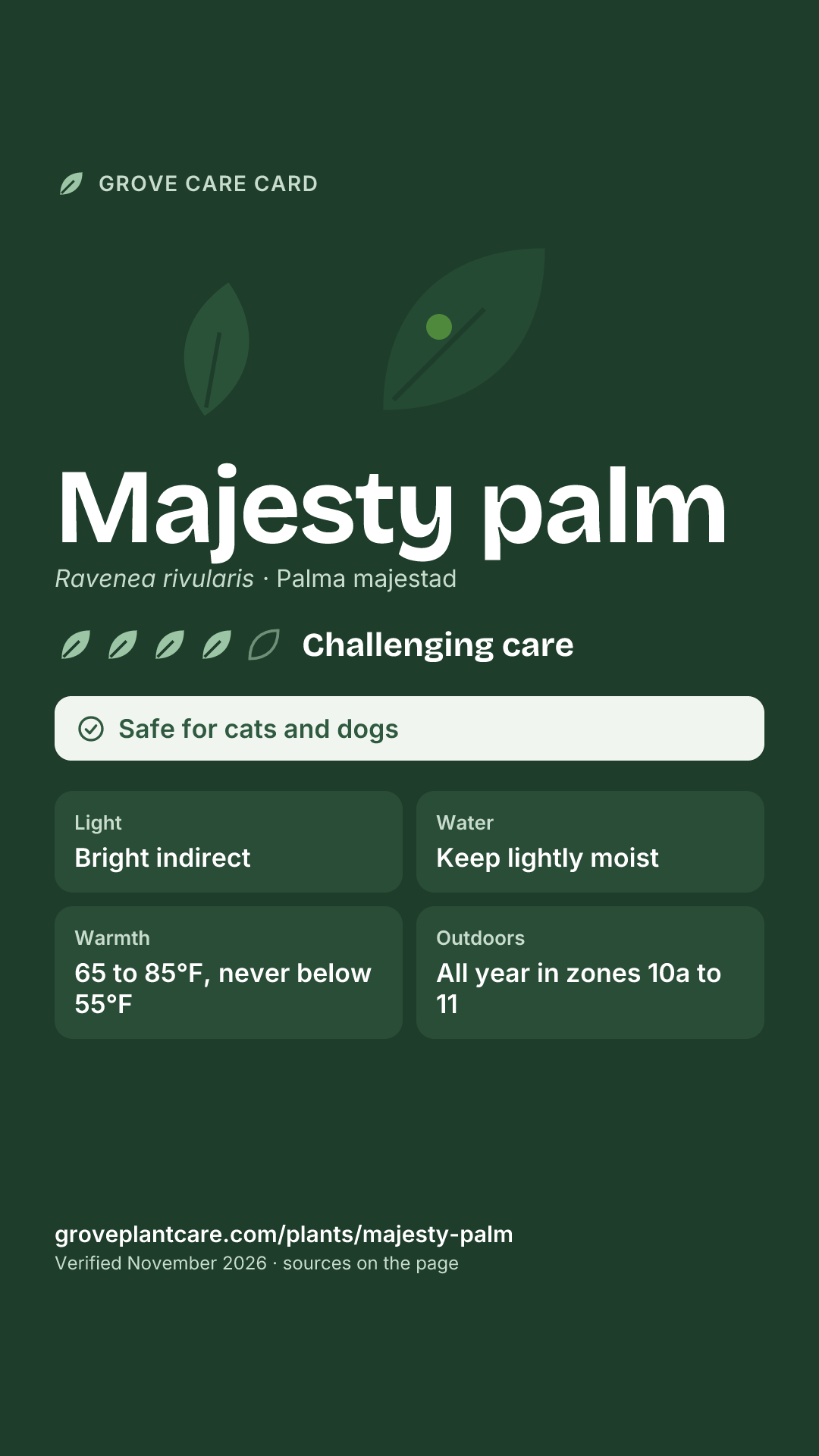
A majesty palm wants bright, indirect light, soil that never dries out completely, and humid air. It has a reputation for being a bit finicky indoors, and dry air and missed waterings are the usual reasons it yellows. The ASPCA lists it as non-toxic to cats, dogs and horses. Indoors it can reach 5 to 10 feet, so plan for a tall plant.
Non-toxic to cats, dogs and horses
No signs of poisoning listed. Any plant can still upset a pet’s stomach if it eats enough. Children: No source we checked lists it as poisonous to people.
Pet poison line: ASPCA (888) 426-4435
Good for: bright rooms with humid air, shaded patios in summer, pet-friendly homes · Think twice if: your home gets very dry in winter, you often forget to water, you have no bright window.
Needs at a glance
- Light3 of 4 · Bright indirectA bright south or east room, out of direct sun
- Water3 of 3 · Keep lightly moistLet only the top inch dry; never let the root ball dry out
- Humidity3 of 3 · HighA humidifier helps; dry air invites spider mites
- Soil when pottedRich, well-drained mixPlenty of organic matter, in a pot with a drain hole
Indoors: best at 65 to 85°F (18 to 29°C). Keep it above 55°F (13°C) and away from drafts and heat vents.
How the rating adds up
0 = easiest · 1 = moderate · 2 = hardest
- Missed waterings2 of 2 · HardestWants steady moisture; never let the root ball dry out
- Light flexibility1 of 2 · ModerateBright indirect light; direct sun scorches and dim rooms wear it down
- Humidity2 of 2 · HardestNeeds high humidity; dry air invites spider mites
- Pests and disease1 of 2 · ModerateNo serious pests, but spider mites and scale show up in dry air
- Sensitivity to change1 of 2 · ModerateKnown as a bit finicky: hates drafts and sudden temperature changes
Growing outdoors
All year: USDA zones 10a to 11, where the coldest winter nights average 30°F (−1°C) or warmer.
Elsewhere: summer outside in dappled light or bright shade. Bring it in when nights reach 55 to 65°F (13 to 18°C).
- Shaded patio or balcony pot in summer
- Screen or accent where it never freezes
- Handles heat, humidity and wet soil
Sources: NC State, NYBG, UF/IFAS, ASPCA, ASPCA plant list, USDA zone map, FISC, Hawaii weed risk assessment, Hawaii noxious weed list, Rojas-Sandoval and Acevedo-Rodríguez and GISD. Full list below.
Verified · How we rate plants
Is a majesty palm safe for cats?
Yes. The ASPCA lists the majesty palm as non-toxic to cats, dogs and horses, and NC State marks it non-toxic for all three. Any plant can still upset a pet’s stomach if it eats enough, so call your vet or the ASPCA Animal Poison Control Center at (888) 426-4435 if your pet seems unwell after chewing it. No source we checked lists it as poisonous to people. If a child eats some and seems unwell, call Poison Help at 1-800-222-1222.
Majesty palm or areca palm: which is which?
Majesty palm and majestic palm are the same plant, Ravenea rivularis. It is easy to mix up with the areca palm, since both are feathery pot palms. A majesty palm has a single trunk, but growers usually pot three or more together, NC State notes, so a pot looks like a clump. Its fronds are medium to dark green and can reach 6 to 8 feet. An areca palm truly grows in clumps, with yellow leaf stalks and stems.
Why is my majesty palm turning yellow?
NC State lists the usual causes: too little light, too little or too much water, dry air, or a lack of nutrients. NYBG reads the pattern: mottled yellow across a whole frond often means the roots dried out, yellow or brown spots point to overwatering, poor drainage or a sudden temperature change, and lower fronds yellowing one at a time is natural aging that you can trim. NYBG also says it has a reputation for being a bit finicky, so steady care matters more than any one fix.
How often should I water a majesty palm?
Often enough that the soil stays lightly moist. NYBG suggests watering until it runs out the bottom when the top inch feels dry, emptying the saucer after 15 minutes, and never letting the root ball dry out completely. NC State also asks for consistent moisture and warns that soggy soil rots the roots, so use a pot with a drain hole. In winter, when days are short and it grows slowly, water less.
How much light does a majesty palm need?
Bright, indirect light, like the light under a taller tree. NYBG suggests a bright room facing south or east, and NC State and UF/IFAS warn that direct sun can scorch the fronds. It will put up with less light for a while, but NYBG says its health slowly declines, so a dim corner is a slow goodbye. In the southern hemisphere, the brightest rooms face north.
Does a majesty palm need humidity?
Yes. NC State says it needs high humidity, and NYBG and UF/IFAS say the same. Dry air browns the frond tips and, NC State notes, invites pests such as spider mites. NYBG suggests a humidifier or a pebble tray in a dry home. Brown tips can also come from fertilizer buildup in the soil or from people brushing past young fronds, NYBG notes. If you see mites, rinse the fronds with a strong spray of water.
Can a majesty palm grow outdoors?
All year only in USDA zones 10a to 11, where winter nights stay above about 30°F (−1°C). There it can grow 15 to 20 feet in gardens and handles heat, humidity and wet soil; in the wild it can reach 100 feet. Elsewhere, NC State suggests a shaded patio or balcony for the warm months, and NYBG says dappled light outdoors. Bring it back in before nights drop to 55 to 65°F (13 to 18°C). As of November 2026, no official invasive list names it, and Hawaii’s weed risk assessment rates it low risk.
NC State, UF/IFAS, USDA zone map, NYBG, Hawaii weed risk assessment, FISC, Hawaii noxious weed list
Can I split the plants in my majesty palm pot?
Yes. NC State says growers often pot three or more majesty palms together, and since each one has a single trunk, you can divide them into separate pots. Do it gently: NYBG says palms are sensitive to repotting and usually need it only every two to three years, when thick roots appear at the top of the pot.
How should I feed a majesty palm?
Lightly. NYBG says about two half-strength feedings in summer with a palm fertilizer are enough, since palms dislike the salt buildup that too much fertilizer leaves. Feed only while it is actively growing, and keep the soil loose so the roots can take up nutrients.
How Grove helps
Grove sets a watering check based on how dry the soil is, so the majesty palm gets water before its root ball dries out. You can add a weekly humidity and spider mite check as tasks you can assign, so whoever is home that week keeps an eye on it.
Sources
- NC State Extension Gardener Plant Toolbox: Ravenea rivularis
- NYBG Plant Talk: How to Keep Your Majesty Palm Looking Majestic (C. Patterson, 2025)
- UF/IFAS Extension Santa Rosa County demonstration gardens: Majestic Palm (2024)
- NYBG Mertz Library: Guide to Palm Plants Indoors
- ASPCA Animal Poison Control: Majesty Palm
- ASPCA Animal Poison Control: Toxic and Non-Toxic Plants
- USDA ARS Plant Hardiness Zone Map (2023)
- Florida Invasive Species Council: Invasive Plant List
- Hawaii-Pacific Weed Risk Assessment (Plant Pono): Ravenea rivularis, low risk
- Hawaii Administrative Rules 4-68: plant species designated as noxious weeds (Hawaii Department of Agriculture)
- J. Rojas-Sandoval and P. Acevedo-Rodríguez (2015), Naturalization and invasion of alien plants in Puerto Rico and the Virgin Islands, Biological Invasions 17 (supplementary list)
- IUCN Global Invasive Species Database: Ravenea rivularis (no entry)
- Kew WCVP data release (2026-06-04 file), plant_name_id 177022: Ravenea rivularis
- NC State Extension Gardener Plant Toolbox: Chrysalidocarpus lutescens