Plant care card
Norfolk Island pine
Araucaria heterophylla · Araucaria
Also called Norfolk pine, house pine or star pine
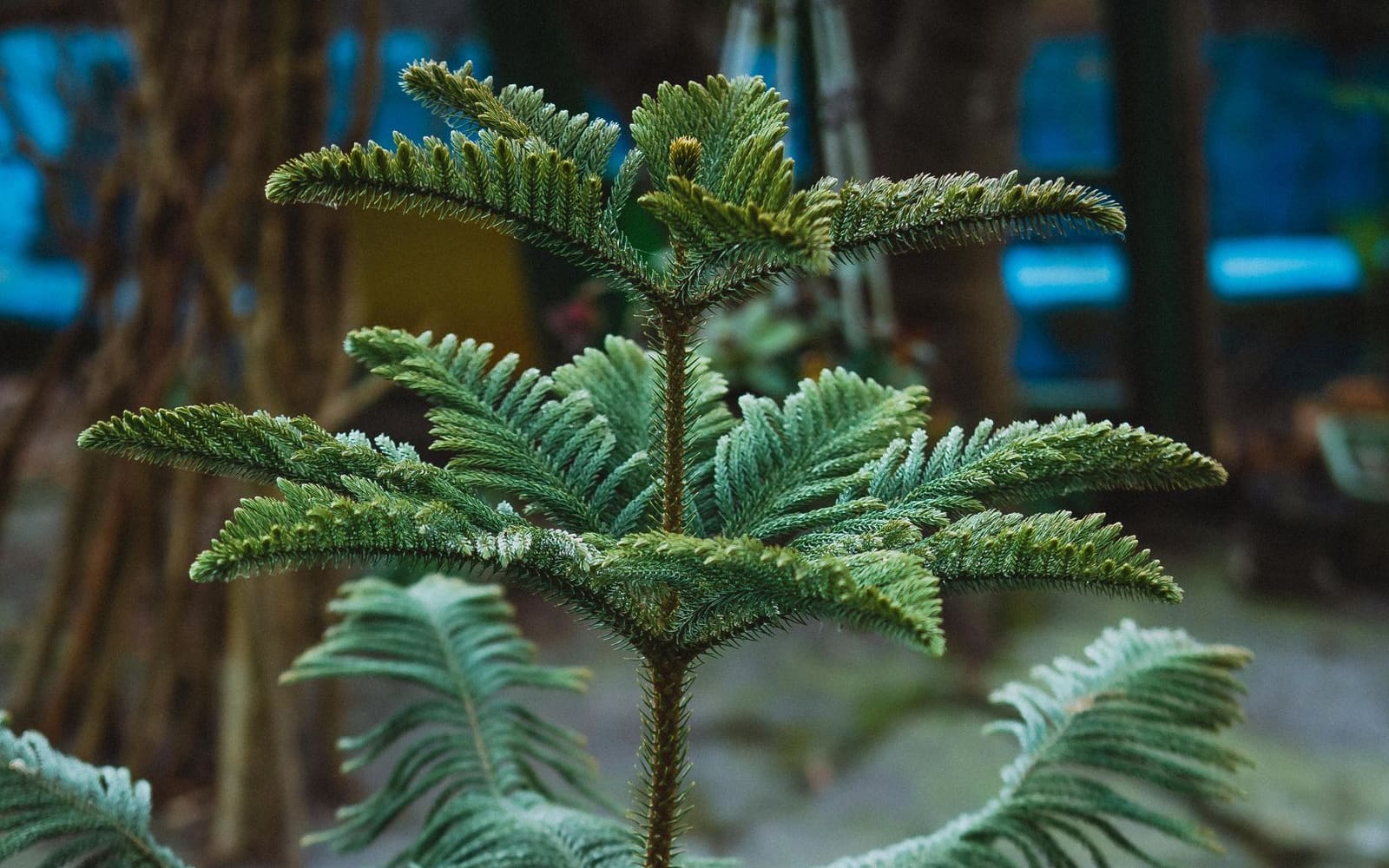
A Norfolk Island pine is a tropical tree from the South Pacific that makes an easygoing living Christmas tree. Give it bright light near a window, water when the top inch of soil is dry, and keep winter air from getting too dry. Decorate it lightly, and after the holidays keep it as a houseplant: it can live for years. Don't cut the top off, and know that a few brown needles on the oldest, lowest branches are normal.
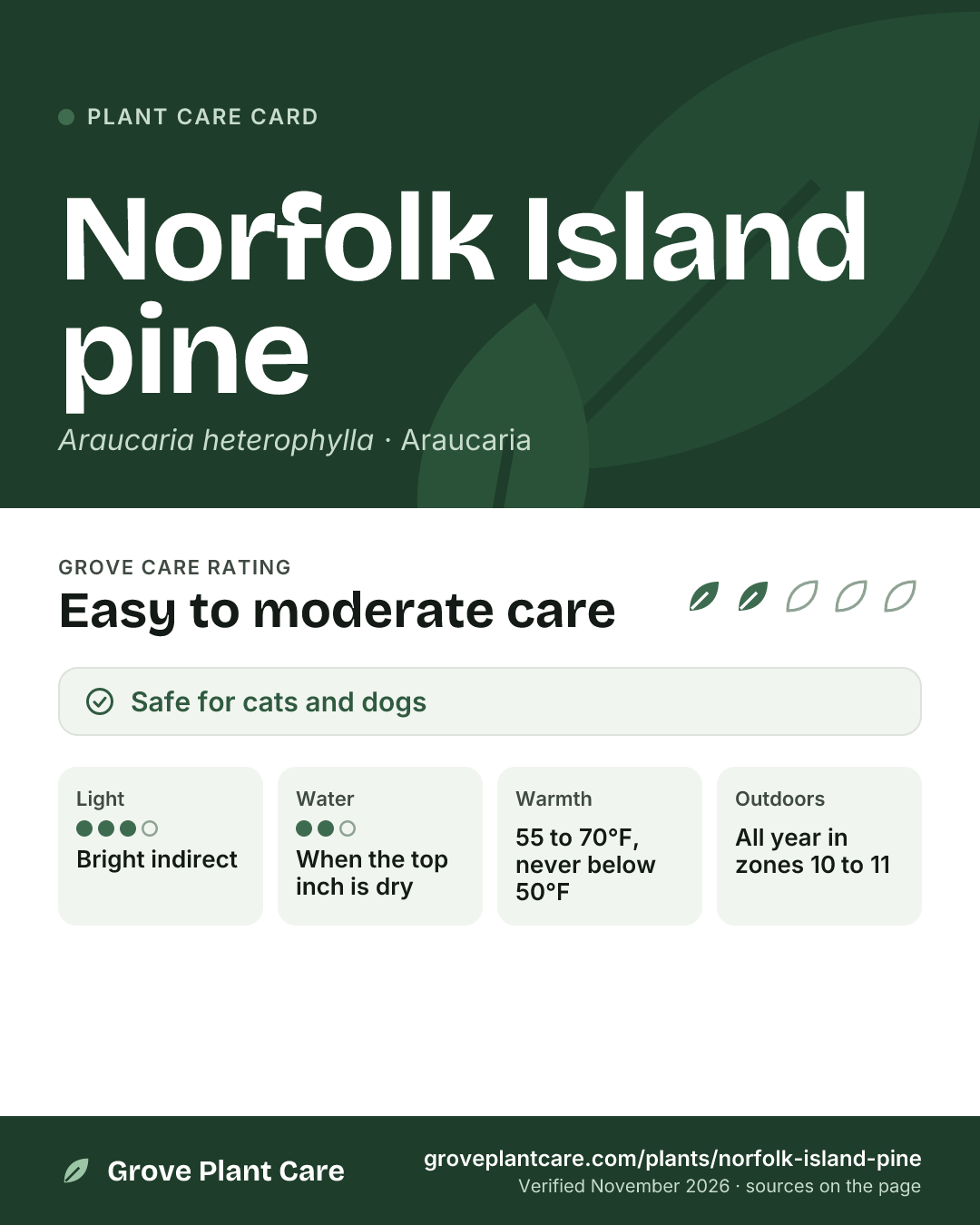
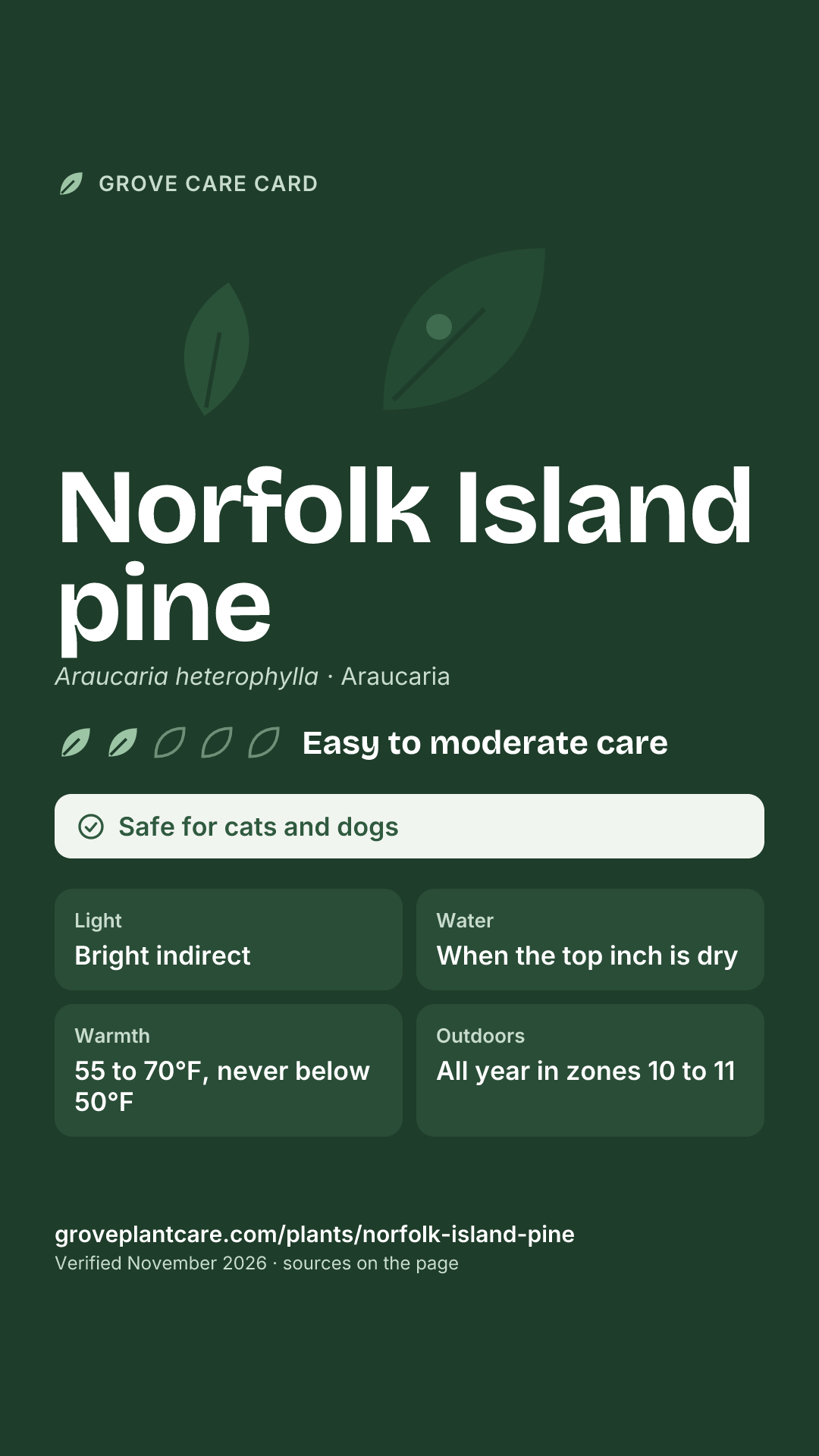
Non-toxic to cats, dogs and horses
No toxic effects listed. Chewed needles can still upset a stomach. Children: NC State lists no toxicity.
Pet poison line: ASPCA (888) 426-4435
Good for: a living Christmas tree, bright rooms all year, frost-free coastal gardens · Think twice if: your brightest spot is still dim, your home gets very dry in winter, you would need to cut it to fit a low ceiling.
Needs at a glance
- Light3 of 4 · Bright indirectNear an east, west or south window; a little sun helps
- Water2 of 3 · Let the top inch dryThen water until it drains; never let it sit in water
- Humidity2 of 3 · Above averageAbout 50%; a humidifier or pebble tray helps in winter
- Soil when pottedWell-draining potting mixIn a pot with drainage holes
Indoors: best at 55 to 70°F (13 to 21°C). Keep it above 50°F (10°C) and away from drafts and heat vents.
How the rating adds up
0 = easiest · 1 = moderate · 2 = hardest
- Missed waterings1 of 2 · ModerateDry soil browns the lower branches; soggy soil rots roots
- Light flexibility1 of 2 · ModerateNeeds bright light near a window
- Humidity1 of 2 · ModerateLikes about 50%; dry winter air drops needles
- Pests and disease0 of 2 · EasiestGenerally pest-free; scale now and then
- Sensitivity to change1 of 2 · ModerateDrafts and sudden drops in light cost branches
Growing outdoors
All year: USDA zones 10 to 11, where the coldest winter nights average 30°F (−1°C) or warmer.
Elsewhere: summer outside in bright shade, out of afternoon sun. Bring it in before nights drop below 60°F (16°C).
- Specimen tree in frost-free gardens
- Containers
- Coastal gardens (salt and wind tolerant)
Sources: NC State, Missouri Extension, Iowa State, NYBG, Illinois Extension, Purdue, UF/IFAS, RHS, ASPCA, UC Master Gardeners, Chicago Botanic Garden, USDA zone map, UConn and UF/IFAS Assessment. Full list below.
Verified · How we rate plants
Is a Norfolk Island pine safe for cats and dogs?
Yes. The ASPCA lists it (as Australian pine, also called Norfolk Island pine) as non-toxic to cats, dogs and horses, and NC State tags it non-toxic for all three. A UC Master Gardener column notes that some vets report stomach upset when pets chew the needles, so keep curious pets from snacking on it. If your pet seems unwell after chewing a plant, call your vet.
How much light does a Norfolk Island pine need?
Bright light, close to an east, west or south window. A couple of hours of direct sun is fine, but skip harsh midday sun. Turn the pot a quarter turn every week so it grows straight instead of leaning toward the window. In low light the branches get long and droopy, and NC State says the tree may hang on for 2 or 3 years before it starts losing its lower branches.
How often should I water a Norfolk Island pine?
Check the soil instead of watering on a schedule. When the top inch feels dry, water until it runs out the bottom, then empty the saucer after about 15 minutes. Both mistakes show up on the branches: soil that dries out browns the lower branches and makes them drop, and soggy roots rot. Water less in winter, when it grows slowly.
Purdue, Iowa State, Illinois Extension, Missouri Extension, NC State
Why are the lower branches on my Norfolk Island pine turning brown or falling off?
A few brown needles on the oldest, lowest branches are normal aging. When it's more than that, check five things. Dry soil: water before it dries out completely. Soggy soil: let it dry a bit and make sure the pot drains. Dry air: heated homes can drop to about 15% humidity, so add a humidifier or a pebble tray. Too little light: move it closer to a window, slowly, since a sudden move to a dim spot can make whole branches yellow and die. Drafts: keep it away from doors, vents and radiators. If you see fine webbing in the brown areas, look for spider mites and rinse the tree with water.
NYBG, Purdue, Missouri Extension, Iowa State, Illinois Extension
How do I decorate a Norfolk Island pine as a Christmas tree?
Keep it light. My branches are soft, so I can hold small ornaments, but heavy ones can bend my branches down for good. Use LED lights, which stay cool: lights that give off heat can damage my needles. Many holiday trees are sold sprayed with green paint, which blocks light, so wipe off as much as you can. Keep me in bright light the whole time I'm dressed up.
What do I do with a Norfolk Island pine after Christmas?
Keep it! With good care it lives for years as a houseplant. Take off the decorations, give it your brightest window, keep it cool and away from heaters, and raise the humidity in winter. Start feeding again in spring. Once nights stay above 50°F (10°C) and frost is over, it can spend the summer outside in bright shade, out of afternoon sun; move it out gradually so it doesn't scorch. Bring it back in before nights drop below 60°F (16°C). If it leans or dries out fast, repot one size up in spring.
Missouri Extension, Illinois Extension, Iowa State, UConn, NYBG
Can I cut the top off a Norfolk Island pine that gets too tall?
Please don't. The RHS says pruning can spoil the tree's shape for good, and the New York Botanical Garden says cutting the top stops growth at that point, which leaves most people unhappy with how it looks. UF/IFAS advises growing it with a single central leader. Outdoors, the USDA Forest Service notes that young trees can grow a new top if at least two tiers of live branches remain, and that applies to trees growing in the ground. To keep it smaller, keep it in a smaller pot: pot size limits how big it gets.
What temperature and humidity does a Norfolk Island pine like?
A cool, humid room is ideal: 55 to 70°F (13 to 21°C), and keep it above 50°F (10°C). Purdue says it thrives around 50% humidity. A humidifier works best; a tray of pebbles and water under the pot helps too. Keep it away from heat vents, radiators and cold drafts.
Iowa State, Purdue, NC State, Chicago Botanic Garden, Illinois Extension, NYBG
Can a Norfolk Island pine grow outdoors?
Yes, all year in USDA zones 10 to 11, where the coldest winter nights average 30°F (−1°C) or warmer. NC State rates it to zone 9. UF/IFAS says Orlando is about its northern limit in Florida. Plan for a big tree: 60 to 80 feet tall and 12 to 20 feet wide, with surface roots that can lift sidewalks. It handles salt spray and wind on the coast, but lightning often strikes tall ones and it does poorly in hurricanes. UF/IFAS finds it not a problem species in Florida.
UF/IFAS, Illinois Extension, NC State, USDA zone map, UF/IFAS Assessment
How do I propagate a Norfolk Island pine?
From seed, or from a cutting of the upright top shoot. Cuttings from side branches root, but they keep growing sideways and never make an upright tree, so most trees are grown from seed.
How Grove helps
Grove sets a watering check based on how dry the soil is, so nobody waters a wet pot. You can add turning the pot every week and a reminder to bring it in before fall nights get cool as tasks you can assign, so whoever is home takes care of it.
Sources
- NC State Extension Gardener Plant Toolbox: Araucaria heterophylla
- University of Missouri Extension: A Christmas tree from the South Pacific
- Iowa State University Extension: How do I care for a Norfolk Island Pine?
- New York Botanical Garden: Why is my potted Norfolk pine leaning and its needles browning?
- Illinois Extension: Grow a living Christmas tree with Norfolk Island Pine (2020)
- Purdue Consumer Horticulture: Norfolk Island Pine Needs TLC (2011)
- Illinois Extension Good Growing: Norfolk Island Pines (2020)
- UF/IFAS EDIS ENH242: Araucaria heterophylla, Norfolk Island-Pine (2018)
- Royal Horticultural Society: Araucaria heterophylla
- ASPCA Animal Poison Control: Australian Pine (Norfolk Island pine)
- UC Master Gardeners of Fresno County (UC ANR): Holiday Plants Toxic to Pets (2020)
- Chicago Botanic Garden: Norfolk Island Pine Care
- Illinois Extension The Garden Scoop: Norfolk Island pine (2017)
- USDA ARS Plant Hardiness Zone Map (2023)
- UConn Home and Garden Education Center: Norfolk Island Pine
- UF/IFAS Gardening Solutions: Norfolk Island Pine
- UF/IFAS Assessment of Non-Native Plants: Araucaria heterophylla
- USDA Forest Service, Árboles de Puerto Rico: Araucaria heterophylla (J. K. Francis)
- New York Botanical Garden: Can I prune a Norfolk Island pine houseplant?
- University of Arkansas Cooperative Extension, Plant of the Week: Norfolk Island Pine