Plant care card
Rojo Congo philodendron
Philodendron 'Rojo Congo' · Filodendro Congo Rojo
Also called Congo Red
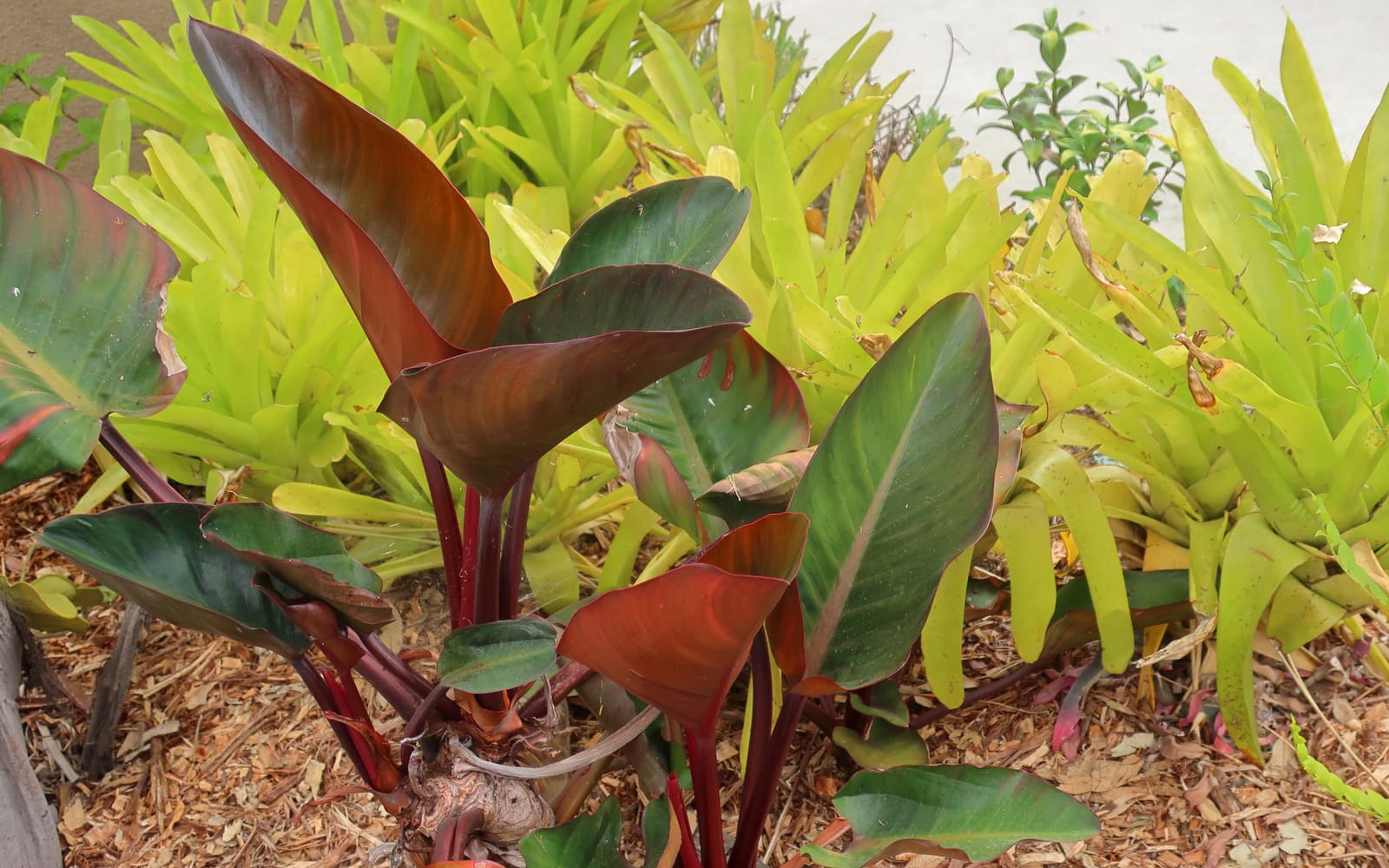
Photo by cultivar413 on Wikimedia Commons, CC BY 2.0

Rojo Congo is a self-heading philodendron: it grows upright from a short stem, with no pole needed, and its new leaves open coppery red before turning deep green. 'Imperial Red', 'Prince of Orange' and 'Black Cardinal' are close relatives with the same care. Give them medium to bright indirect light for the best color, water when the top inch of soil is dry, and keep them warm. They're easygoing, but toxic to cats and dogs.
Toxic to cats and dogs · Mild
Mouth pain and swelling, drooling, vomiting and trouble swallowing. Its sap holds calcium oxalate crystals; NC State rates philodendrons low severity. Children: low severity. NC State rates philodendrons low severity; chewing hurts the mouth and throat, and the sap can irritate skin and eyes.
Pet poison line: ASPCA (888) 426-4435
Good for: a bold floor plant that needs no pole, rooms with medium to bright light, red and orange leaves · Think twice if: pets or small children chew plants, it would sit in a busy walkway, where its brittle leaf stalks snap.
Needs at a glance
- Light2 of 4 · Medium to bright indirectThe brighter the indirect light, the stronger the red or orange
- Water2 of 3 · Let the top inch dryWater when the top inch feels dry; never leave it standing in water
- Humidity2 of 3 · Above averageLikes humid air; a humidifier helps in dry winter rooms
- Soil when pottedRich, well-drained mixLoose potting mix high in organic matter that drains quickly
Indoors: best at 65 to 85°F (18 to 29°C). Keep it above 59°F (15°C) and away from drafts and heat vents.
How the rating adds up
0 = easiest · 1 = moderate · 2 = hardest
- Missed waterings1 of 2 · ModerateWater when the top inch of soil feels dry; never let it stand in water
- Light flexibility1 of 2 · ModerateMedium to bright indirect light keeps the red; too dim and it fades to green
- Humidity1 of 2 · ModeratePrefers high humidity but usually adapts to an average home
- Pests and disease0 of 2 · EasiestFew problems; watch for aphids, mealybugs, scale and spider mites
- Sensitivity to change0 of 2 · EasiestTough and vigorous; brittle leaf stalks are the main thing to protect
Growing outdoors
All year: USDA zones 10 to 12, where the coldest winter nights average 30°F (−1°C) or warmer.
Elsewhere: summer outside in bright shade; direct sun scorches the leaves. Bring it in before nights drop below 60°F (16°C).
- An upright, self-supporting houseplant in a pot
- A patio plant in summer
Sources: NC State, UF/IFAS, Missouri Extension, Clemson, RHS, US plant patent, ASPCA, ASPCA plant list, UConn, USDA, FISC and GISD. Full list below.
Verified · How we rate plants
What is a Rojo Congo philodendron?
A hybrid bred in Altha, Florida, from a 1995 cross, with 'Imperial Red' as the mother plant and a selection of Philodendron tatei subsp. melanochlorum as the father, according to its US plant patent. The patent describes it as self-heading and self-supporting: it grows as an upright, slightly spreading clump instead of a vine. Compared with 'Imperial Red', it is larger and more vigorous, with longer, thicker leaf stalks and bigger, thicker leaves. RHS lists 'Congo Red' as another name for it.
Rojo Congo, Imperial Red, Prince of Orange or Black Cardinal: which is which?
All four are self-heading hybrid philodendrons, and Missouri Extension and UF/IFAS describe them side by side. 'Rojo Congo' opens brown to coppery red, matures to green with a hint of red and has bright red leaf stalks. 'Imperial Red', its mother plant, is smaller and turns dark green with maroon. 'Prince of Orange' opens bright orange and matures to green; NC State files it under P. erubescens. 'Black Cardinal' has 8 to 10 inch leaves that start bright burgundy and age almost black. Care is the same for all of them. Telling 'Rojo Congo' from 'Imperial Red' is hard; the patent's clearest signs are Rojo's bigger size and darker, purple-brown mature leaf stalks.
Missouri Extension, UF/IFAS, US plant patent, NC State, UConn
My label says Pink Princess, but it looks like a Rojo Congo. Which is it?
Look for pink. 'Pink Princess' is a cultivar of Philodendron erubescens with dark leaves splashed with pink patches, and it climbs. 'Rojo Congo' has no pink patches: its new leaves are coppery red and age to green, and it grows as an upright clump. If your plant has pink patches, open the Pink Princess card. If it has none, it's most likely a Rojo Congo or one of its relatives, and this card fits.
Is the Rojo Congo philodendron toxic to cats and dogs?
Yes. The ASPCA doesn't list these hybrids by name, but every philodendron it lists is toxic to cats and dogs because of insoluble calcium oxalate crystals. Clemson says all parts of philodendrons are toxic if eaten, and NC State rates them low severity. A pet that chews a leaf may drool, vomit, paw at its mouth or have trouble swallowing. The RHS warns that the sap can irritate skin and eyes, so wear gloves when you cut it. Keep it out of reach. If a pet eats some, call your vet or the ASPCA Animal Poison Control Center at (888) 426-4435. If a child eats some, call Poison Help at 1-800-222-1222.
How much light does a Rojo Congo need?
Medium to bright indirect light. Missouri Extension and UF/IFAS both say colored hybrids need that much light to keep their color; in dim rooms the new leaves come out greener. Keep it out of direct sun, which NC State says scorches philodendron leaves. Sources differ on 'Prince of Orange': UF/IFAS and Missouri say it holds its orange better than most in lower light, while Clemson says it needs high light for color. If yours is fading, move it brighter.
How often should I water a Rojo Congo?
UF/IFAS says to water whenever the top inch of soil feels dry. Missouri Extension and Clemson describe the goal as evenly moist, never soggy. In practice, that means watering thoroughly, letting the top inch dry, and never leaving the pot standing in water. Clemson warns that root rot comes from a mix that drains slowly or from watering too often. How often depends on the pot, the plant's size and the room, says Missouri, so check the soil instead of the calendar.
What temperature and humidity does a Rojo Congo like?
Normal warm rooms. NC State gives 65 to 85°F (18 to 29°C) for philodendrons, and Clemson suggests nights of 65 to 70°F with days of 75 to 85°F. The RHS sets a winter minimum of 15°C (59°F) for 'Imperial Red', and UConn says philodendrons are happy as long as they stay above 65°F. Missouri Extension says these tropical plants do best in high humidity and suggests a humidifier for dry winter air; NC State says they usually adapt to an average home.
Does a Rojo Congo need a moss pole?
No. Its patent calls it self-supporting, and Clemson groups these red-leaf hybrids with the self-heading philodendrons that stand on their own. Missouri Extension says most grow well in an 8 inch or larger pot, and UF/IFAS suggests a sturdy container, since some get big. A piece of wood or a totem is optional. Clemson notes that self-heading leaf stalks are brittle, so give it a spot away from busy walkways.
What pests and problems bother a Rojo Congo?
Few. UF/IFAS calls these hybrids generally pest- and problem-free, and Missouri Extension says philodendrons have few pest problems. Aphids, mealybugs, scale and spider mites can still show up; UF/IFAS suggests rinsing them off in a sink or shower. Clemson says diseases are rare indoors, so watering is the main thing to get right. Brown leaf tips usually point to too much fertilizer or uneven watering, say UF/IFAS and Clemson.
How do I propagate a Rojo Congo?
Nurseries grow it by tissue culture, which the patent says keeps it true to type. At home, the RHS suggests stem tip or leaf-bud cuttings for 'Prince of Orange' and air layering for 'Imperial Red'. UConn and Clemson list cuttings and air layering for philodendrons, and Clemson notes that some kinds make offsets you can separate. Self-heading plants have short stems, so expect only a few cuttings from one plant.
Can a Rojo Congo grow outdoors?
All year only in frost-free places: NC State lists USDA zones 10 to 12 for philodendrons. In colder climates it can spend summer on a patio in bright shade, since direct sun scorches the leaves. Clemson says to wait until nights stay above 60°F (16°C) before moving houseplants out, and to bring them back before it cools again; bring this one in before nights drop to 60°F (16°C). No official invasive list names these hybrids.
How Grove helps
Grove sets a watering check based on how dry the soil is, so the Rojo Congo gets water once the top inch has dried. Watering is one of the tasks you can assign, so whoever is home that week knows it's on them.
Sources
- NC State Extension Gardener Plant Toolbox: Philodendron (genus)
- UF/IFAS Gardening Solutions: Hybrid Philodendrons
- University of Missouri IPM, Missouri Environment and Garden: Philodendrons as Interior Plants (Trinklein, 2014)
- Clemson Cooperative Extension HGIC 1509: Philodendron (rev. 2016)
- RHS: Philodendron 'Prince of Orange'
- US Plant Patent PP14,116: Philodendron plant named 'Rojo Congo' (Osiecki, 2003)
- ASPCA Animal Poison Control: Heartleaf Philodendron (no entry for these cultivars; every philodendron the ASPCA lists is toxic)
- RHS: Philodendron 'Imperial Red'
- ASPCA Animal Poison Control: Toxic and Non-Toxic Plants
- UConn Home and Garden Education Center: Philodendron
- USDA ARS Plant Hardiness Zone Map (2023)
- Clemson HGIC 1454: Moving Houseplants Indoors and Outdoors (rev. 2023-12-01)
- Florida Invasive Species Council: FISC Invasive Plant List, Category I and II (April 2026)
- IUCN Global Invasive Species Database: no Philodendron record (searched 2026-11-22)
- RHS: Philodendron 'Rojo Congo'
- Kew WCVP data release (2026-06-04 file), plant_name_id 151989, Philodendron tatei subsp. melanochlorum
- US Plant Patent PP6,337: Philodendron plant named Imperial Red (DeCoster, 1988)
- NC State Extension Gardener Plant Toolbox: Philodendron erubescens (lists 'Pink Princess', 'White Princess', 'Prince of Orange')
- NC State Extension Gardener Plant Toolbox: Philodendron 'Birkin'