Plant care card
Birkin philodendron
Philodendron 'Birkin' · Filodendro Birkin
Also called Birkin, White Wave or Birkin White Wave
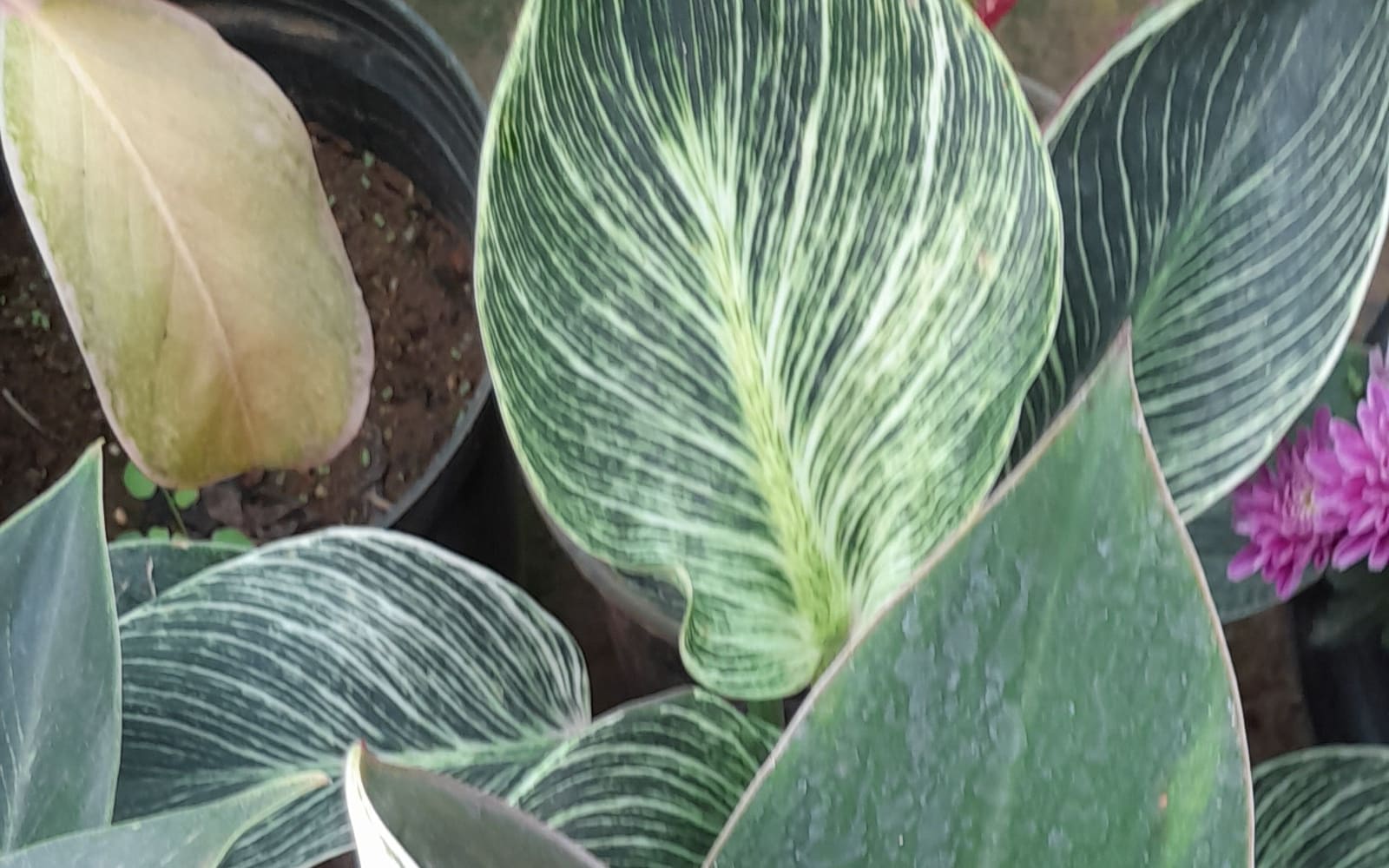
Photo by Yercaud-elango on Wikimedia Commons, CC BY 4.0

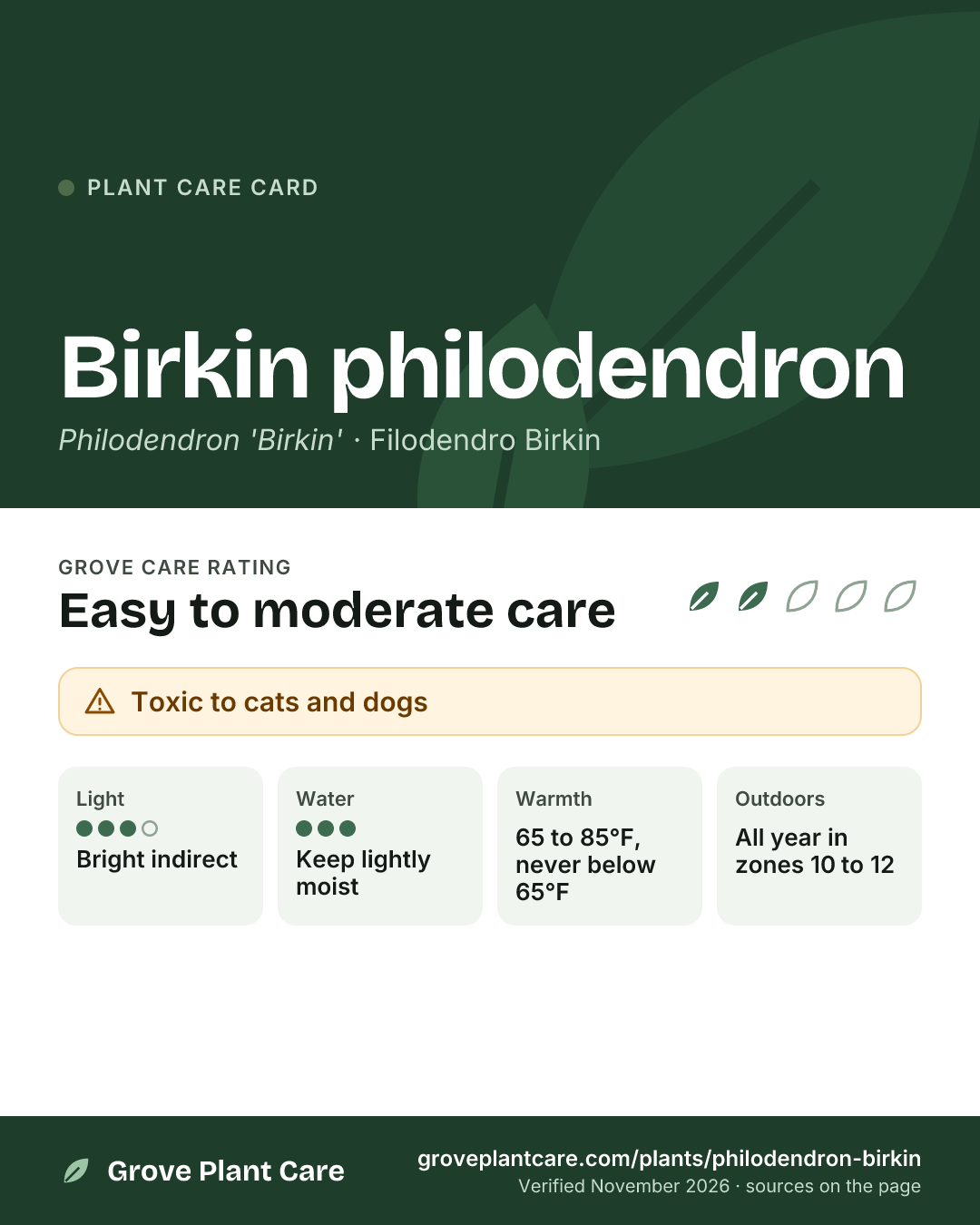
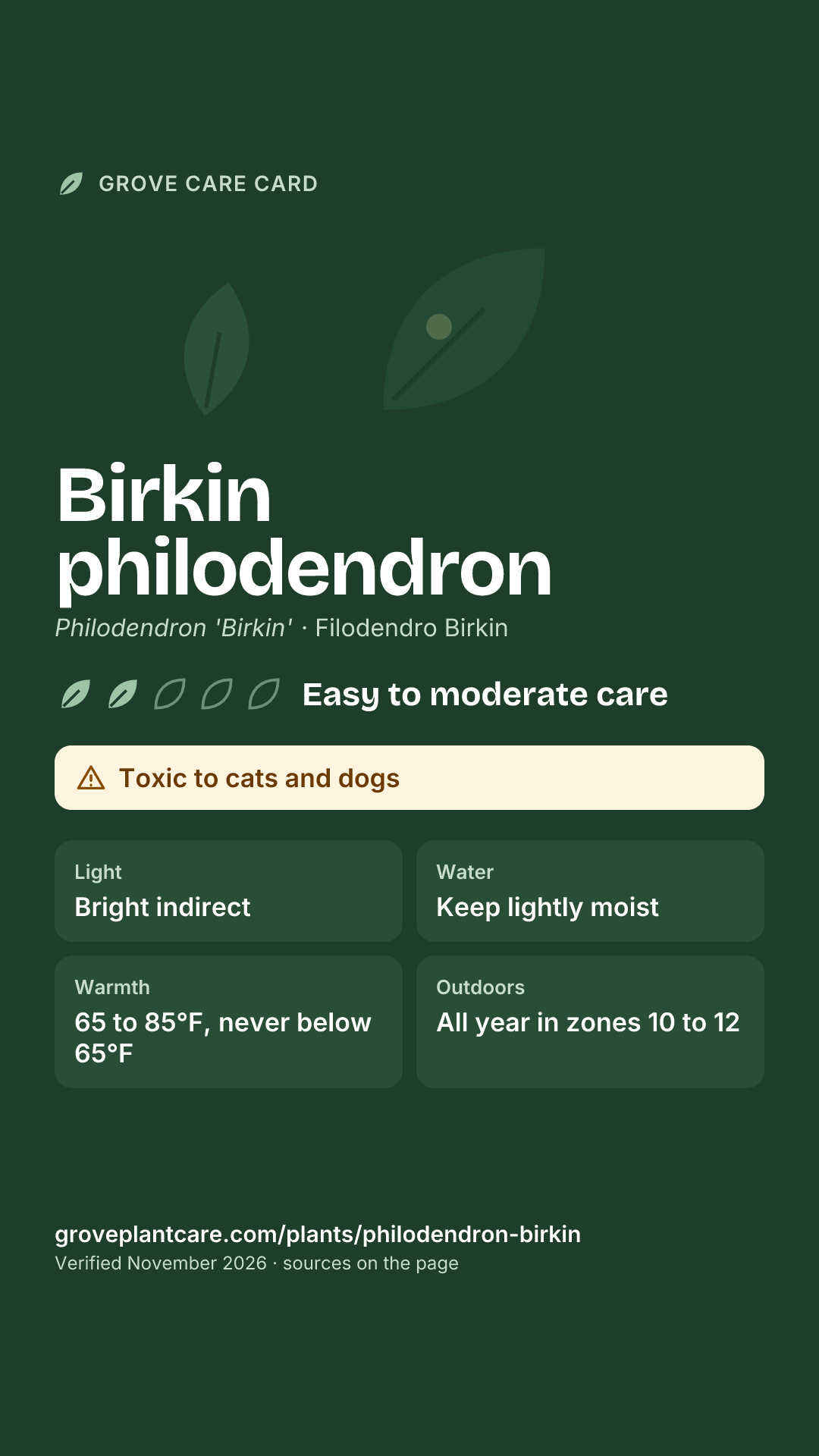
The Birkin is a compact, upright philodendron with dark green leaves and fine cream pinstripes that get bolder as each leaf matures. Give it bright, filtered light, keep the soil moist but well drained, and aim for humid air. It grows slowly, stays small enough for a desk or shelf, and is easy to keep. It's toxic to cats and dogs.
Toxic to cats and dogs · Mild
Mouth, lip, tongue and throat pain and swelling, drooling, vomiting and trouble swallowing. Its sap holds calcium oxalate crystals; NC State rates the severity as low. Children: low severity. NC State rates it low severity; chewing hurts the mouth and throat, and the sap can cause a skin rash.
Pet poison line: ASPCA (888) 426-4435
Good for: desks, tables and shelves, bright rooms without direct sun, striped leaves · Think twice if: pets or small children chew plants, your room is dim, since the stripes fade in low light.
Needs at a glance
- Light3 of 4 · Bright indirectBright, filtered light keeps the stripes crisp; no direct sun
- Water3 of 3 · Keep lightly moistMoist but well drained while it grows; a little drier in winter
- Humidity2 of 3 · Above average50 to 60% is ideal; a humidifier helps in dry rooms
- Soil when pottedWell-drained potting mixStandard houseplant mix, slightly acidic, that drains freely
Indoors: best at 65 to 85°F (18 to 29°C). Keep it above 65°F (18°C) and away from drafts and heat vents.
How the rating adds up
0 = easiest · 1 = moderate · 2 = hardest
- Missed waterings1 of 2 · ModerateKeep it moist with good drainage; water less outside the growing season
- Light flexibility1 of 2 · ModerateBright, filtered light; too little fades the stripes, direct sun scorches
- Humidity1 of 2 · Moderate50 to 60% is ideal; brown leaf tips mean the air is too dry
- Pests and disease1 of 2 · ModerateSpider mites, mealybugs, aphids and scale; leaf spot and root rot if kept wet
- Sensitivity to change0 of 2 · EasiestEasy and slow-growing; just keep it out of cold drafts
Growing outdoors
All year: USDA zones 10 to 12, where the coldest winter nights average 30°F (−1°C) or warmer.
Elsewhere: summer outside in dappled shade; direct sun scorches the leaves. Bring it in before nights drop below 65°F (18°C).
- A compact houseplant for desks and shelves
- A patio container plant
Sources: NC State, RHS, Clemson, ASPCA, ASPCA plant list, UConn, USDA, FISC and GISD. Full list below.
Verified · How we rate plants
Where does the Birkin philodendron come from?
Nobody is completely sure. NC State says it was introduced in 2010 and that it's believed to be either a rare mutation of 'Rojo Congo' or a hybrid of the cultivars 'Congo' and 'Imperial Green'. Either way, it's a plant from cultivation with no wild home. The RHS lists 'White Measure' as another name for it, and NC State lists White Wave and Birkin White Wave.
Why is my Birkin losing its stripes?
Usually too little light. NC State says low light can cost a Birkin its variegation and make it leggy with small leaves, so move it closer to a bright window, out of direct sun. Young leaves are often less striped, since NC State notes the pattern grows bolder as each leaf matures. Like other variegated plants, it can also send up a shoot of plain leaves. The RHS explains that plain shoots have more chlorophyll and grow faster, so they can take over; cut them back to a striped leaf, as UF's propagation guide advises for variegated plants.
Is the Birkin philodendron toxic to cats and dogs?
Yes. The ASPCA doesn't list 'Birkin' by name, but every philodendron it lists is toxic to cats and dogs because of insoluble calcium oxalate crystals. NC State lists 'Birkin' as a problem for cats, dogs and children and rates the severity as low. Chewing it can cause pain and swelling of the mouth, lips, tongue and throat, drooling, vomiting and trouble swallowing, and the sap can cause a skin rash. Keep it out of reach. If a pet eats some, call your vet or the ASPCA Animal Poison Control Center at (888) 426-4435. If a child eats some, call Poison Help at 1-800-222-1222.
How much light does a Birkin need?
Bright, filtered light. NC State says it prefers bright, filtered sun and that too much sun scorches the leaves; the RHS suggests bright, filtered or indirect light. An east window or a spot a few feet back from a sunnier one works well. In a dim room it keeps growing, but NC State says the stripes fade and the stems stretch.
How often should I water a Birkin?
Keep the soil moist with good drainage, says NC State. The RHS suggests watering freely while it grows in spring and summer and moderately the rest of the year. Water until it drains, then empty the saucer. NC State warns that overwatering brings root rot and yellow leaves, and Clemson adds that philodendrons should never stand in water.
What temperature and humidity does a Birkin like?
Room temperature: NC State gives 65 to 85°F (18 to 29°C) and says to keep it away from cold drafts, since it can't take frost. UConn says philodendrons do well as long as they stay above 65°F (18°C). The RHS rates 'Birkin' a little hardier, but a warm room is the safe choice. NC State puts the ideal humidity at 50 to 60% and says brown leaf tips are a sign the air is too dry; the RHS suggests misting daily. A humidifier or a group of plants nearby helps in winter.
What pests and problems bother a Birkin?
NC State lists spider mites, mealybugs, aphids and scale, and the RHS names scale and red spider mite. Check under the leaves now and then. NC State says leaf spots can show up if the leaves stay wet, so keep the water on the soil and off the leaves. Brown tips usually mean dry air, per NC State, or too much fertilizer, per Clemson.
How do I propagate a Birkin?
With stem tip or leaf-bud cuttings, says the RHS; NC State lists stem cuttings and layering for philodendrons. Take the cutting from a stem with well-striped leaves. The RHS explains that variegated plants are kept true by cuttings, and an all-plain shoot is a reversion, so a cutting from a plain stem is likely to grow plain.
Is a Birkin the same as a Rojo Congo?
No, though they may be related. NC State says the Birkin may have started as a rare mutation of 'Rojo Congo'. They look very different: the Birkin is compact and slow, about 6 in to 3 ft (15 cm to 1 m) tall, with dark green leaves and cream pinstripes. 'Rojo Congo' is a bigger, vigorous plant whose new leaves open coppery red, and it has its own card.
Can a Birkin grow outdoors?
All year only where it never frosts: NC State lists USDA zones 10 to 12. Elsewhere it can spend warm months on a shaded patio, since direct sun scorches it. Clemson says to wait for nights above 60°F (16°C) before moving houseplants out; because UConn puts the philodendron minimum at 65°F (18°C), bring the Birkin in before nights drop to 65°F (18°C). No official invasive list names it.
How Grove helps
Grove sets a watering check based on how moist the soil is, so the Birkin gets water before it dries out but never sits wet. A "check for plain shoots" task can repeat every month and go to whoever you assign.
Sources
- NC State Extension Gardener Plant Toolbox: Philodendron 'Birkin'
- RHS: Philodendron 'Birkin' (v)
- Clemson Cooperative Extension HGIC 1509: Philodendron (rev. 2016)
- NC State Extension Gardener Plant Toolbox: Philodendron (genus)
- ASPCA Animal Poison Control: Heartleaf Philodendron (no entry for this cultivar; every philodendron the ASPCA lists is toxic)
- ASPCA Animal Poison Control: Toxic and Non-Toxic Plants
- UConn Home and Garden Education Center: Philodendron
- USDA ARS Plant Hardiness Zone Map (2023)
- Clemson HGIC 1454: Moving Houseplants Indoors and Outdoors (rev. 2023-12-01)
- Florida Invasive Species Council: FISC Invasive Plant List, Category I and II (April 2026)
- IUCN Global Invasive Species Database: no Philodendron record (searched 2026-11-22)
- RHS: Reversion (variegated plants)
- UF/IFAS, University of Kentucky and Texas A&M Plant Propagation: Chimeral Reversion (2023)
- US Plant Patent PP14,116: Philodendron plant named 'Rojo Congo' (Osiecki, 2003)