Plant care card
Philodendron selloum
Philodendron bipinnatifidum · Filodendro selloum
Also called tree philodendron, lacy tree philodendron or split-leaf philodendron
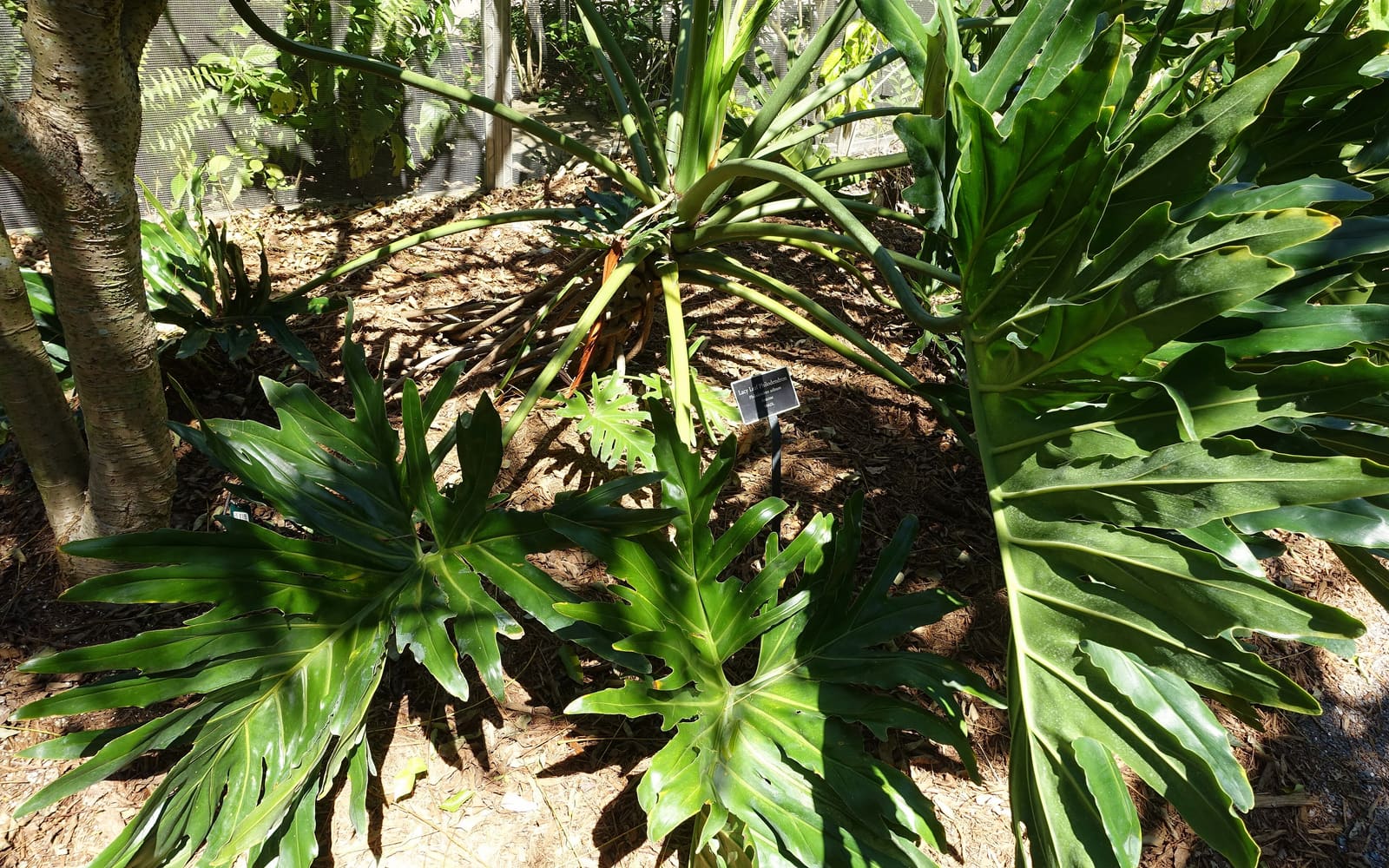
Photo by Daderot on Wikimedia Commons, CC0 1.0

Philodendron selloum, the tree philodendron, is an easygoing but very big plant: give it bright indirect light, water when the top of the soil dries, and never leave it soggy. It copes with dimmer rooms, but its leaves come in smaller with fewer lobes. Plan for space, since an older plant can spread 6 to 10 feet. It's toxic to cats, dogs and horses. Its botanical name is Philodendron bipinnatifidum, and many tags still say Thaumatophyllum.
Toxic to cats, dogs and horses · Mild
Mouth pain and swelling, drooling, vomiting (not in horses) and trouble swallowing. Its sap holds insoluble calcium oxalate crystals. Children: low severity. NC State rates it low severity; chewing irritates and swells the mouth, and the sap can irritate skin.
Pet poison line: ASPCA (888) 426-4435
Good for: a big, bright room, warm-climate gardens and patios, a bold jungle look in one pot · Think twice if: your space is small: it can spread 6 to 10 ft, pets or small children chew plants.
Needs at a glance
- Light3 of 4 · Bright indirectCopes with less light, but leaves get smaller with fewer lobes; no hot direct sun
- Water2 of 3 · Let the top dryThen water well; never let it sit soggy
- Humidity2 of 3 · Above averageModerate to high; a normal home works
- Soil when pottedRich, well-drained mixHigh in organic matter; it must drain fast
Indoors: best at 65 to 85°F (18 to 29°C). Keep it above 60°F (16°C) and away from drafts and heat vents.
How the rating adds up
0 = easiest · 1 = moderate · 2 = hardest
- Missed waterings1 of 2 · ModerateLet the top dry; it dislikes both drought and soggy soil
- Light flexibility0 of 2 · EasiestCopes with low light; leaves get smaller and less lobed
- Humidity1 of 2 · ModeratePrefers moderate to high humidity; copes with most homes
- Pests and disease1 of 2 · ModerateMealybugs, scale, mites and thrips; root rot in wet soil
- Sensitivity to change0 of 2 · EasiestTakes cool rooms better than most philodendrons
Growing outdoors
All year: USDA zones 9a to 11, where the coldest winter nights average 20°F (−7°C) or warmer.
Elsewhere: summer outside in dappled sun or part shade; harsh sun can scorch the leaves. Bring it in before nights drop below 60°F (16°C).
- Large containers and patios
- Specimen or foundation plant in warm climates
- Big indoor floor plant
Sources: NC State, RHS, Texas Tech, Clemson, UConn, ASPCA, UF/IFAS, USDA zone map, FISC, GISD and Hawaii weed risk assessment. Full list below.
Verified · How we rate plants
Is philodendron selloum the same as tree philodendron?
Yes. Philodendron selloum, tree philodendron, lacy tree philodendron and Philodendron bipinnatifidum all name the same plant. Kew's World Checklist accepts Philodendron bipinnatifidum and counts Philodendron selloum as an older name for it, and the RHS agrees. UF/IFAS and Texas Tech still use the selloum name, which is why stores and searches do too. Compact selections such as 'Hope' and 'Lundii' are the same plant in a smaller size.
Why does my plant tag say Thaumatophyllum?
For a while, botanists placed this plant and its self-heading relatives, such as Xanadu, in a separate genus called Thaumatophyllum, so many tags say Thaumatophyllum bipinnatifidum. Kew's World Checklist now puts it back in Philodendron and lists Thaumatophyllum bipinnatifidum as a synonym, and NC State lists Thaumatophyllum as a former name. Either way it's the same plant with the same care.
Is it the same plant as a monstera or a horsehead philodendron?
No. Both mix-ups come from shared names. Split-leaf philodendron is also sold as a name for the monstera (Monstera deliciosa), which NC State notes is not a true philodendron; NYBG says the tree philodendron is a different plant. Monstera leaves grow holes and splits, while selloum leaves are cut deeply into many narrow, wavy lobes. Horsehead and fiddle-leaf philodendron are names the RHS and NC State use for this plant, but the ASPCA uses them for Philodendron bipennifolium, a different philodendron. When in doubt, check the botanical name.
Is philodendron selloum toxic to cats and dogs?
Yes. The ASPCA lists it (as lacy tree philodendron, Philodendron selloum) as toxic to dogs, cats and horses. Its sap holds insoluble calcium oxalate crystals, which cause mouth pain and swelling, drooling, vomiting (horses don't vomit) and trouble swallowing. NC State rates it low severity and notes the sap can irritate skin, so wear gloves when you cut it. Keep it where pets and small children can't chew it. If a pet chews it, call your vet or the ASPCA Animal Poison Control Center at (888) 426-4435. If a child eats some, call Poison Help at 1-800-222-1222.
How often should I water a philodendron selloum?
Water when the top of the soil has dried, then water until it drains and empty the saucer. NC State says it doesn't tolerate drought, so don't let it dry out completely, but soggy soil rots the roots. The RHS says to water less outside the growing season. NC State also says salts from tap water bother it: flush the pot with plenty of water now and then, or use rain or distilled water. The RHS suggests rainwater or filtered water too.
How much light does a tree philodendron need?
Bright, indirect light is best, such as near an east, west or south window (Clemson). NC State says it prefers high light but tolerates low light, and Texas Tech lists it for low light. The cost of a dim spot is smaller leaves with fewer lobes. Keep it out of hot direct sun, which can scorch the leaves.
How big does a philodendron selloum get?
Bigger than most people expect. NC State gives 4 to 10 feet tall and 6 to 10 feet wide, and warns it may be too large for smaller homes. Texas Tech lists 3 to 4 feet for an indoor floor plant, so pot size and age make a big difference. The leaves alone can reach 3 feet long (UF/IFAS, Clemson). Clemson adds that the leaf stalks are brittle, so give it a spot away from busy walkways. UF/IFAS notes that most people who plant it forget how large it grows.
What are the roots growing out of the trunk?
Aerial roots. As it ages, a selloum builds a short trunk-like stem, 3 to 4 feet tall by UF/IFAS's count, and it may lean or creep. NC State explains that it sends roots down from that stem to help hold up its weight, and that these roots can take up water and nutrients. Given something to lean on, it can climb with them too. In the wild in Argentina and Paraguay, botanists describe the same roots reaching down to the soil from plants that started life on tree branches.
Why are the leaves on my philodendron selloum turning yellow?
Usually too much water. The RHS and UConn both say soggy soil injures the roots, which turns leaves yellow, and NC State warns of root rot in damp soil. Let the top dry before you water again and make sure the pot drains. Small new leaves with few lobes point to too little light or overwatering (NC State). Check under the leaves for mealybugs, scale and spider mites, which NC State and Texas Tech both list.
Can a philodendron selloum grow outdoors?
Yes, in warm climates. NC State and Texas Tech give USDA zones 9 to 11, and UF/IFAS and UConn say 8b: UF/IFAS says it grows outside in central and south Florida and in a protected spot in Gainesville or Jacksonville. The RHS is more careful: it rates the plant to about 34 to 41°F (1 to 5°C) and says it won't survive freezing. Outdoors it likes dappled sun or part shade, and it can grow 6 to 15 feet tall and even wider. In colder places, let it summer outside and bring it in before nights drop below 60°F (16°C). It isn't on Florida's invasive plant list or in the Global Invasive Species Database, and Hawaii's weed risk assessment rates it low risk.
NC State, Texas Tech, UF/IFAS, UConn, RHS, FISC, GISD, Hawaii weed risk assessment
How do I propagate a philodendron selloum?
Older plants make side shoots you can cut away with roots and pot up (UF/IFAS). You can also air layer the stem, which Clemson suggests for philodendrons in any season. The RHS gives seed, sown on the surface at 66 to 75°F (19 to 24°C) in spring, but indoor plants rarely flower, so seed is hard to come by.
How Grove helps
Grove sets a watering check based on how dry the soil is, so a selloum gets water when the top has dried and not on a fixed day. If it spends summer outside, you can add a task to bring it in before cool fall nights and assign it to whoever is home.
Sources
- NC State Extension Gardener Plant Toolbox: Philodendron bipinnatifidum
- Royal Horticultural Society: Philodendron growing guide
- Texas Tech University, Plant and Soil Science: Philodendron selloum (interior plant sheet)
- Clemson Cooperative Extension HGIC 1509: Philodendron
- UConn Home and Garden Education Center: Philodendron
- Royal Horticultural Society: Philodendron bipinnatifidum
- ASPCA Animal Poison Control: Lacy Tree Philodendron (Philodendron selloum)
- ASPCA Animal Poison Control: Tree Philodendron (Philodendron selloum)
- UF/IFAS EDIS FPS473: Philodendron selloum, Selloum (Gilman, Klein and Hansen, revised 2023)
- USDA ARS Plant Hardiness Zone Map (2023)
- Florida Invasive Species Council: Plant List, Category I and II and Watch List (April 2026; no Philodendron listed)
- IUCN Global Invasive Species Database: Philodendron bipinnatifidum (no record)
- Hawaii-Pacific Weed Risk Assessment (Plant Pono): Philodendron bipinnatifidum, low risk, score -1 (2013)
- Kew WCVP data release (2026-06-04 file), plant_name_id 151444: Philodendron bipinnatifidum (accepted; synonyms include Thaumatophyllum bipinnatifidum and Philodendron selloum)
- Kew WCVP data release (2026-06-04 file), plant_name_id 531721: Thaumatophyllum bipinnatifidum (synonym of Philodendron bipinnatifidum)
- Kew WCVP data release (2026-06-04 file), plant_name_id 531703: Thaumatophyllum xanadu (synonym of Philodendron xanadu)
- NC State Extension Gardener Plant Toolbox: Monstera deliciosa
- New York Botanical Garden LibGuides: Monstera
- ASPCA Animal Poison Control: Horsehead Philodendron (Philodendron bipennifolium)
- Crisci y Gancedo (1971): Sistemática y etnobotánica del güembé (Philodendron bipinnatifidum), Revista del Museo de La Plata