Plant care card
Philodendron Xanadu
Philodendron xanadu · Filodendro xanadu
Also called Xanadu philodendron or Winterbourn philodendron
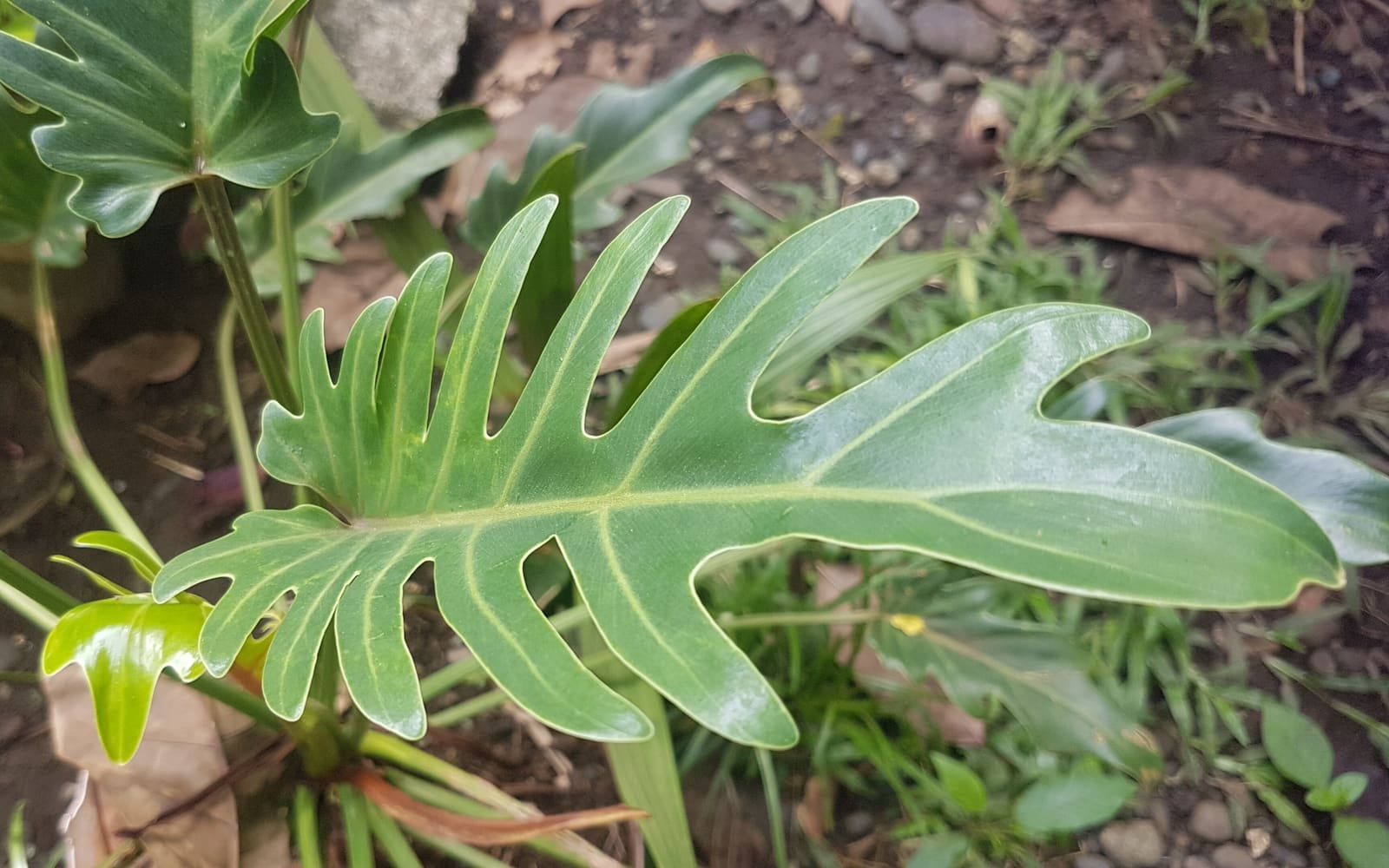
Photo by Obsidian Soul on Wikimedia Commons, CC0 1.0

Philodendron Xanadu is an easy, compact philodendron that grows in a tidy clump of deeply lobed leaves and never needs a pole. Give it bright indirect light, keep the soil lightly moist while it grows, and let the top dry before you water again: yellow leaves usually mean too much water. Plan on 2 to 5 feet tall and wider than that. NC State lists it as mildly toxic to cats and dogs. Its tag may say Thaumatophyllum xanadu or Philodendron 'Winterbourn'.
Mildly toxic to cats and dogs (NC State)
Swollen lips, tongue and mouth, mouth pain and drooling. The ASPCA list leaves it out; NC State rates it low severity, and the RHS says it is harmful to pets. Children: low severity. NC State rates it low severity; chewing swells and hurts the mouth, and the sap can irritate skin.
Pet poison line: ASPCA (888) 426-4435
Good for: a compact tropical look, shady spots in warm gardens, no pole or support needed · Think twice if: pets or small children chew plants, your only spot is dim or cold in winter.
Needs at a glance
- Light3 of 4 · Bright indirectNear a bright window, out of hot direct sun
- Water2 of 3 · Let the top dryKeep it lightly moist while it grows; yellow leaves mean too much water
- Humidity2 of 3 · Above averageSome extra humidity helps; a normal home works
- Soil when pottedRich, well-drained mixHigh in organic matter, holding some moisture
Indoors: best at 65 to 75°F (18 to 24°C). Keep it above 60°F (16°C) and away from drafts and heat vents.
How the rating adds up
0 = easiest · 1 = moderate · 2 = hardest
- Missed waterings1 of 2 · ModerateLikes even moisture; yellow leaves if overwatered
- Light flexibility1 of 2 · ModerateBright indirect light indoors; shade is fine outdoors
- Humidity1 of 2 · ModeratePrefers some humidity; copes with most homes
- Pests and disease1 of 2 · ModerateMealybugs, scale, mites, thrips; fungal leaf spots
- Sensitivity to change0 of 2 · EasiestNo source reports trouble with moves or repotting
Growing outdoors
All year: USDA zones 10 to 11, where the coldest winter nights average 30°F (−1°C) or warmer.
Elsewhere: summer outside in part shade to shade; it takes more sun once used to it. Bring it in when nights reach 60 to 65°F (16 to 18°C).
- Shady borders and mass plantings
- Tall groundcover in damp shade
- Large containers
Sources: NC State, RHS, UF/IFAS, ASPCA plant list, Clemson, USDA zone map, FISC, GISD and Hawaii weed risk assessment. Full list below.
Verified · How we rate plants
Is Xanadu a philodendron or a Thaumatophyllum?
A philodendron, by the current count. Kew's World Checklist accepts Philodendron xanadu and lists Thaumatophyllum xanadu as a synonym, and NC State and the RHS use Philodendron xanadu too. For a while, botanists placed Xanadu and its self-heading relatives, such as the tree philodendron, in a separate genus called Thaumatophyllum, so many tags still say that. UF/IFAS and UConn describe it as a hybrid, Philodendron 'Xanadu', an older view. All of these names mean the same plant with the same care.
Is Philodendron 'Winterbourn' the same as Xanadu?
Yes. NC State says 'Winterbourn' is sometimes given as a cultivar name, but it was never registered with the International Aroid Society, and plants sold under it look no different from Xanadu. The RHS still lists 'Winterbourn' with 'Xanadu' as another name for it. NC State adds that Xanadu was in the nursery trade long before botanists gave it a species name.
How is Xanadu different from a philodendron selloum?
Size and shape. UF/IFAS says Xanadu has the look and texture of selloum without the large size. Xanadu leaves reach about 18 inches long, each cut into 15 to 20 lobes, and they stay close to the ground in a low clump. Selloum leaves can reach 3 feet, and an old selloum builds a trunk 3 to 4 feet tall. Xanadu stays around 2 to 5 feet tall (UF/IFAS, NC State), while NC State gives selloum 4 to 10 feet.
Is Philodendron Xanadu toxic to cats and dogs?
Yes, mildly. The ASPCA doesn't list Xanadu by name, but NC State rates it low severity for cats, dogs and children, and the RHS says it is harmful to pets. Like other philodendrons, it holds calcium oxalate crystals: chewing it swells the lips, tongue and mouth and causes mouth pain and drooling. The sap can irritate skin too, so wear gloves when you trim it. Keep it out of reach. If a pet chews it, call your vet or the ASPCA Animal Poison Control Center at (888) 426-4435. If a child eats some, call Poison Help at 1-800-222-1222.
How often should I water a Philodendron Xanadu?
Keep the soil lightly moist while it grows, and let the top of the soil dry before you water again (RHS). Water until it drains, then empty the saucer. NC State warns that the leaves turn yellow if it's overwatered. The RHS says to water more sparingly outside the growing season.
How much light does a Xanadu need?
Indoors, bright but indirect light (NC State), such as near a bright window, out of hot direct sun (RHS). Outdoors it is more flexible: NC State gives full sun to part shade, and UF/IFAS says it is well suited to the shade of tall trees.
How big does a Philodendron Xanadu get, and does it need a pole?
Plan for 2 to 5 feet tall and 3 to 6 feet wide: NC State gives 3 to 5 feet each way, UF/IFAS 2 to 4 feet tall and 4 to 6 feet wide, and the RHS 1 to 1.5 m tall and up to 2.5 m wide after 10 to 20 years. It doesn't need a pole. It grows as an upright, spreading clump from a short, thick red stem, with some aerial roots, and the RHS says bushy philodendrons like this don't need support. Just trim out dead or yellow leaves and thin it if it gets crowded. NC State says potted plants may need a bigger pot every 1 to 2 years.
Why are the leaves on my Xanadu turning yellow?
Most often too much water. NC State says overwatering yellows the leaves, and the RHS explains that soggy soil leads to root rot, which also shows as yellow leaves. Let the top dry before you water again and check that the pot drains. Look under the leaves for mealybugs, scale, spider mites and thrips, which NC State lists, and pick off old yellow leaves as the RHS suggests.
Can a Philodendron Xanadu grow outdoors?
Yes, in warm places. UF/IFAS gives USDA zones 10 to 11 and says it grows outside only in south Florida and the warmest parts of central Florida; NC State says 9b to 11b. There it works as a border, a mass planting or a tall groundcover in damp shade, and NC State notes deer tend to leave it alone. In colder places, let it summer outside in part shade and bring it in before nights drop to 60 to 65°F (16 to 18°C). It isn't on Florida's invasive plant list or in the Global Invasive Species Database, and Hawaii's weed risk assessment rates it low risk.
UF/IFAS, NC State, RHS, FISC, GISD, Hawaii weed risk assessment
How do I propagate a Philodendron Xanadu?
The RHS suggests layering a stem in spring. Clemson notes that some philodendrons make offsets you can separate with their roots. The RHS also gives seed sown at 66 to 75°F (19 to 24°C), but UF/IFAS lists no fruit for Xanadu, so seed is hard to find.
How Grove helps
Grove sets a watering check based on how dry the soil is, so a Xanadu gets water when the top has dried and not on a fixed day. You can add a yearly "check the pot size" task and assign it, so whoever cares for it that spring sees it.
Sources
- NC State Extension Gardener Plant Toolbox: Philodendron xanadu
- Royal Horticultural Society: Philodendron xanadu
- Royal Horticultural Society: Philodendron growing guide
- UF/IFAS EDIS FPS474: Philodendron x 'Xanadu', 'Xanadu' Philodendron (Gilman, Klein and Hansen, revised 2023)
- Royal Horticultural Society: Philodendron 'Winterbourn' (synonym 'Xanadu')
- ASPCA Animal Poison Control: Toxic and Non-Toxic Plants
- Clemson Cooperative Extension HGIC 1509: Philodendron
- USDA ARS Plant Hardiness Zone Map (2023)
- Florida Invasive Species Council: Plant List, Category I and II and Watch List (April 2026; no Philodendron listed)
- IUCN Global Invasive Species Database: Philodendron xanadu (no record)
- Hawaii-Pacific Weed Risk Assessment (Plant Pono): Philodendron xanadu, low risk, score 2 (2020)
- Kew WCVP data release (2026-06-04 file), plant_name_id 257761: Philodendron xanadu (accepted; synonym Thaumatophyllum xanadu)
- Kew WCVP data release (2026-06-04 file), plant_name_id 531703: Thaumatophyllum xanadu (synonym of Philodendron xanadu)
- UConn Home and Garden Education Center: Philodendron
- UF/IFAS EDIS FPS473: Philodendron selloum, Selloum (Gilman, Klein and Hansen, revised 2023)
- NC State Extension Gardener Plant Toolbox: Philodendron bipinnatifidum