Plant care card
Traveler’s palm
Ravenala madagascariensis · Palma del viajero
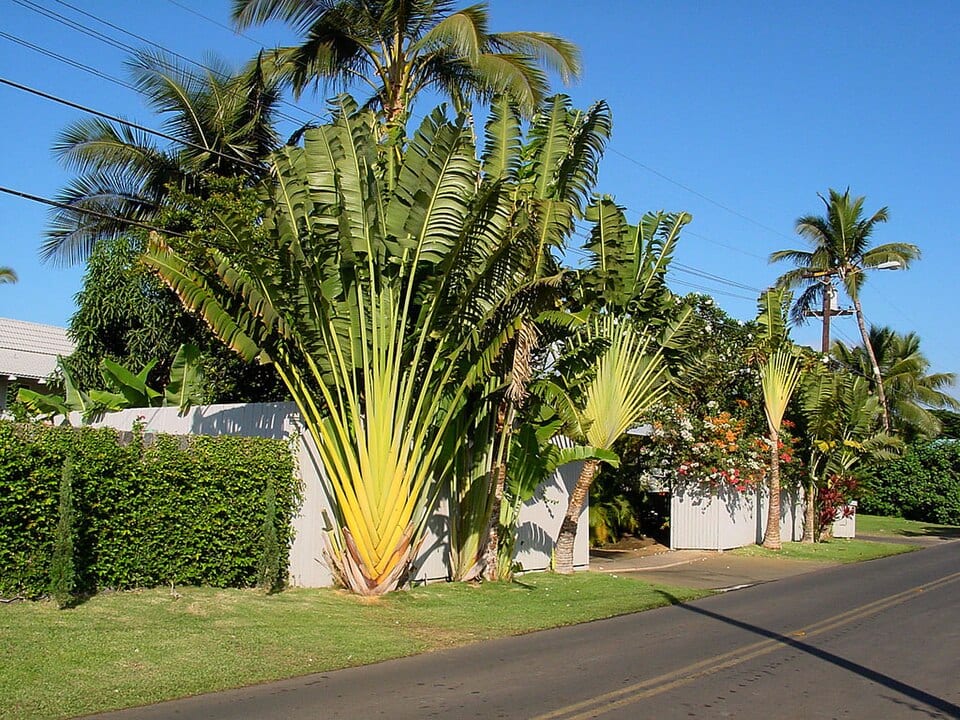
Also called traveler’s tree
Photo by Wouter Hagens on Wikimedia Commons

The traveler’s palm (Ravenala madagascariensis) isn’t a palm at all. It belongs to the bird of paradise group and holds its huge, banana-like leaves in one flat fan. Give it full sun, keep the soil moderately moist, and keep it warm: NC State says it can’t take temperatures below 40°F (4°C), and the RHS grows it above 59°F (15°C) all year. Outdoors it fits only USDA zones 10a to 11 and grows 15 to 50 feet tall. National checklists flag it as invasive in Mauritius, Réunion and South Africa. Neither the ASPCA nor NC State rates it for pets.
Not rated for pets
Neither the ASPCA nor NC State rates the traveler’s palm. No reputable source lists it as toxic, but none rates it either. Children: No poisoning information found.
Pet poison line: ASPCA (888) 426-4435
Good for: large frost-free gardens and parks, a bold, fan-shaped accent, a big, sunny greenhouse · Think twice if: your yard or room is small, your winters are cool and you have no greenhouse, you garden on an island where it escapes, like Mauritius or Réunion.
Needs at a glance
- Light4 of 4 · Some direct sunFull sun; under glass, shade it from the hottest midday sun
- Water2 of 3 · Moderately moistWater freely in summer and sparingly in winter; soggy soil rots the roots
- Humidity1 of 3 · AverageNo source asks for extra humidity
- Soil when pottedRich, well-drained loamLoam-based mix high in organic matter that stays moist and drains well
Indoors: best at 59°F (15°C) or warmer. Keep it above 40°F (4°C) and away from drafts and heat vents.
How the rating adds up
0 = easiest · 1 = moderate · 2 = hardest
- Missed waterings1 of 2 · ModerateKeep it moderately moist; water stored in the leaf bases helps it through dry spells
- Light flexibility2 of 2 · HardestWants full sun; young potted plants take some shade for a while
- Humidity0 of 2 · EasiestNo source asks for extra humidity; it comes from seasonally dry parts of Madagascar
- Pests and disease1 of 2 · ModerateLeaf spot can be serious; spider mites under glass
- Sensitivity to change2 of 2 · HardestNeeds steady warmth and shelter from wind; hard to overwinter indoors
Growing outdoors
All year: USDA zones 10a to 11, where the coldest winter nights average 40°F (4°C) or warmer.
Elsewhere: summer outside in full sun, sheltered from strong wind; ease it into the sun over a week. Bring it in before nights drop below 59°F (15°C).
Invasive in: Mauritius, Réunion, South Africa. Florida, Hawaii, Texas and California don’t list it. National checklists flag it invasive in Mauritius, Réunion and South Africa; on Mauritius it nearly forms pure stands on forest slopes. Lists checked .
- A specimen tree in large frost-free gardens and parks
- Big tubs on a deck or patio
- A greenhouse or conservatory plant
Sources: NC State, RHS, UF/IFAS, NParks Singapore, Kew, ASPCA plant list, USDA zone map, Clemson, GRIIS Mauritius, GRIIS Réunion, GRIIS South Africa, NTBG, Hawaii weed risk assessment, FISC, Hawaii noxious weed list, TexasInvasives.org, Cal-IPC, Rojas-Sandoval and Acevedo-Rodríguez, Queensland Government and GISD. Full list below.
Verified · How we rate plants
Is the traveler’s palm toxic to cats and dogs?
We don’t know for sure. Neither the ASPCA nor NC State rates Ravenala madagascariensis, and we found no reputable source that lists it as toxic. That doesn’t make it safe, so keep it out of reach of pets that chew plants. If a pet eats some and seems unwell, call your vet or the ASPCA Animal Poison Control Center at (888) 426-4435. If a child eats some, call Poison Help at 1-800-222-1222.
Is the traveler’s palm a real palm?
No. The National Tropical Botanical Garden says plainly that it isn’t a true palm. Kew, NC State, UF/IFAS and the RHS all place it in the Strelitziaceae, the same group as the bird of paradise. True palms, like the areca palm that also comes from Madagascar, belong to the palm group, Arecaceae. Its leaves give it away: each one is a huge, banana-like paddle on a long stalk, 6 to 10 feet long, and they all line up in one flat fan. UF/IFAS adds that this flat fan is how you tell it from the giant white bird of paradise, whose leaves spiral around the stem and whose flowers have blue petals.
Can I grow a traveler’s palm indoors?
Only for a while, or in a big greenhouse. The RHS grows it under glass in a large container or greenhouse bed, in full light and above 15°C (59°F) all year. NC State says large containers limit its size but that overwintering it indoors is difficult, and suggests a greenhouse in colder areas, keeping its eventual size in mind. UF/IFAS says small potted plants can stay in shade for a period, though it grows best in full sun. Plan on your sunniest spot and a very large, heavy tub.
How much sun does a traveler’s palm need?
Lots. NC State lists full sun, six or more hours a day, and the RHS agrees. UF/IFAS says it grows best in full sun, and NParks Singapore says full sun or light shade. Under glass, the RHS shades it from the hottest sun. Whatever the light, shelter it from strong wind: NC State and NParks both warn that wind shreds the big leaves.
How often should I water a traveler’s palm?
Keep the soil moderately moist, as NC State puts it. The RHS waters freely while it grows and sparingly in winter. NC State warns that overwatering can cause root rot, and notes that the water stored in its leaf bases may help it handle dry spells; UF/IFAS rates its drought tolerance as moderate. Use a rich, loam-based mix that drains well, and empty the saucer after watering.
How cold can a traveler’s palm get?
Not very. NC State says it isn’t winter hardy and won’t tolerate temperatures below 40°F (4°C), and UF/IFAS says to plant it only where it never frosts. The RHS grows it above 15°C (59°F) all year under glass. UF/IFAS also notes that the giant white bird of paradise handles cold better. A pot that spends summer outside should come in before nights drop to 59°F (15°C), and go back out only once nights stay above 60°F (16°C), as Clemson suggests for tropical plants.
How fast and how big does a traveler’s palm grow?
Big, at a medium pace. UF/IFAS gives 15 to 30 feet tall and 15 to 18 feet wide, and NC State says it reaches 30 to 50 feet in its native habitat 10 to 20 years after planting. NParks says growth is slow at first, and the trunk can take up to three years to rise above ground, then it speeds up. UF/IFAS calls it too large for most modest yards, so give it room.
What pests bother it, and how do I propagate it?
Pests are few. UF/IFAS says none are a major concern, but it calls Cercospora leaf spot a very serious disease, so check the leaves for spots now and then. Under glass, the RHS says red spider mites may show up. To make a new plant, divide off a rooted sucker in spring, as the RHS and UF/IFAS suggest. Seed works too, but it is slow to sprout. NC State notes that suckers left in place turn it into a clump instead of a single trunk.
Can a traveler’s palm grow outdoors, and is it invasive?
Outdoors all year it needs a frost-free climate: NC State lists USDA zones 10a to 11 and UF/IFAS 10a through 11, in full sun and out of strong wind. It isn’t on Florida’s, Hawaii’s, Texas’s or California’s invasive lists, and Hawaii’s weed risk assessment rates it low risk there. Elsewhere it has escaped. The Global Register of Introduced and Invasive Species flags it as invasive in the national checklists for Mauritius, Réunion and South Africa. On Mauritius, the National Tropical Botanical Garden and Hawaii’s assessment both describe it nearly forming pure stands on slopes around Black River Gorges National Park. Wherever you live, keep it where you planted it.
NC State, UF/IFAS, FISC, Hawaii noxious weed list, TexasInvasives.org, Cal-IPC, Hawaii weed risk assessment, GRIIS Mauritius, GRIIS Réunion, GRIIS South Africa, NTBG
How Grove helps
Grove sets a watering check based on how dry the soil is, with less water in winter. You can add a reminder to bring the tub inside before cool nights and a task to check for leaf spot, and assign them to whoever looks after it.
Sources
- NC State Extension Gardener Plant Toolbox: Ravenala madagascariensis (traveller’s palm)
- Royal Horticultural Society: Ravenala madagascariensis (traveller’s palm)
- UF/IFAS Extension EDIS ENH-723 (ST565): Ravenala madagascariensis, Travelers-Tree (Gilman et al., rev. December 2018)
- National Parks Board Singapore, Flora & Fauna Web: Ravenala madagascariensis
- Kew WCVP data release (2026-06-04 file), plant_name_id 260806: Ravenala madagascariensis (Strelitziaceae)
- ASPCA Animal Poison Control: Toxic and Non-Toxic Plants
- USDA ARS Plant Hardiness Zone Map (2023)
- Clemson Cooperative Extension HGIC 1454: Moving Houseplants Indoors and Outdoors
- Global Register of Introduced and Invasive Species (GRIIS), Mauritius checklist (2026, doi 10.15468/nke0es): Ravenala madagascariensis, invasive
- Global Register of Introduced and Invasive Species (GRIIS), Réunion checklist (2020, doi 10.15468/8lardu): Ravenala madagascariensis, invasive
- Global Register of Introduced and Invasive Species (GRIIS), South Africa checklist (2026, doi 10.15468/l6smob): Ravenala madagascariensis, invasive
- National Tropical Botanical Garden, Tropical Plant Database: Ravenala madagascariensis
- Hawaii-Pacific Weed Risk Assessment (Plant Pono): Ravenala madagascariensis, low risk in Hawaii, score 5 (2004)
- Florida Invasive Species Council: Plant List, Category I and II and Watch List (April 2026)
- Hawaii Administrative Rules 4-68: plant species designated as noxious weeds (Hawaii Department of Agriculture)
- TexasInvasives.org Invasives Database: plant list (no Ravenala)
- California Invasive Plant Council (Cal-IPC): plant search, "ravenala" (no listing)
- J. Rojas-Sandoval and P. Acevedo-Rodríguez (2015), Naturalization and invasion of alien plants in Puerto Rico and the Virgin Islands, Biological Invasions 17 (supplementary list)
- Business Queensland: Restricted invasive plants (Biosecurity Act 2014)
- IUCN Global Invasive Species Database: Ravenala madagascariensis (no entry)
- Kew WCVP data release (2026-06-04 file), plant_name_id 267253: Strelitzia nicolai
- Kew WCVP data release (2026-06-04 file), plant_name_id 39866: Chrysalidocarpus lutescens
- UF/IFAS EDIS ENH-79: Bird-of-Paradise (S. P. Brown and R. J. Black, rev. 2024)