Plant care card
Ruffled fan palm
Licuala grandis · Palma licuala
Also called Vanuatu fan palm or licuala palm
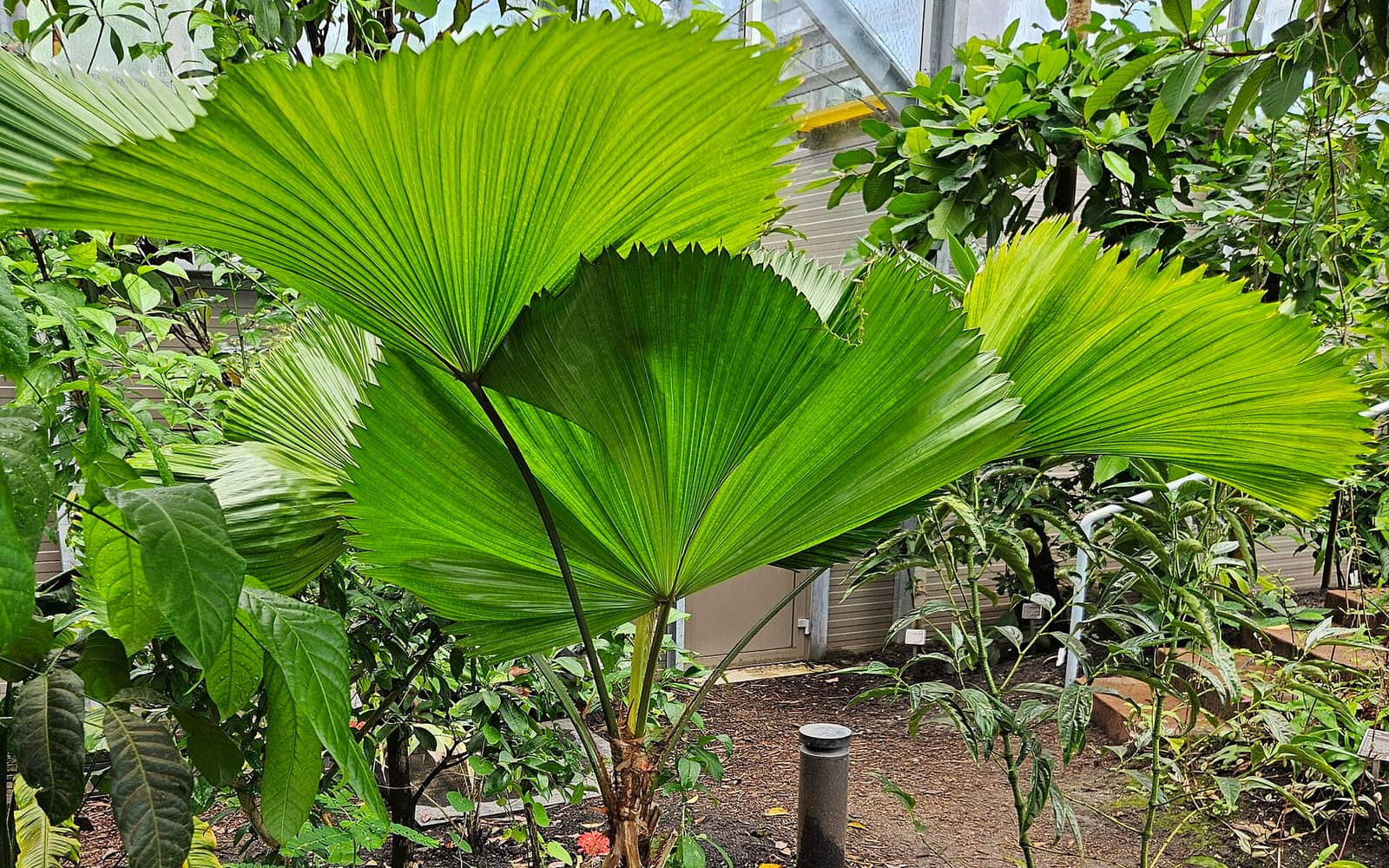
Photo by Arn on Wikimedia Commons, CC BY 4.0

The ruffled fan palm grows in the shade of rainforest trees, and it wants the same at home: shade or bright shade with no direct sun, soil that stays moist, humid air and shelter from wind. Chicago Botanic Garden says it won’t survive below 40°F (4°C). It grows very slowly, so a small plant stays small for years. Neither the ASPCA nor NC State rates it for pets.
Not rated for pets
Neither the ASPCA nor NC State rates the ruffled fan palm. No reputable source lists it as toxic, but none rates it for pets either. Its leaf stalks carry small sharp teeth. Children: No poisoning information found; the fruit is safe to touch; the leaf stalks have small sharp teeth.
Pet poison line: ASPCA (888) 426-4435
Good for: shady corners of frost-free gardens, bright rooms with a humidifier, a bold, round leaf shape · Think twice if: your home has dry winter air, the spot is windy or gets hot direct sun, small children brush past the toothed leaf stalks.
Needs at a glance
- Light2 of 4 · Medium indirectShade to bright shade; direct sun browns the leaves
- Water3 of 3 · Keep lightly moistNever let the soil dry out
- Humidity3 of 3 · HighHumid air; run a humidifier when it drops below 50%
- Soil when pottedRich, moist, sandy mixHumusy and sandy, moist but well drained
Indoors: best at 70 to 80°F (21 to 27°C). Keep it above 45°F (7°C) and away from drafts and heat vents.
How the rating adds up
0 = easiest · 1 = moderate · 2 = hardest
- Missed waterings2 of 2 · HardestKeep the soil consistently moist
- Light flexibility1 of 2 · ModerateShade to bright shade; direct sun browns the leaves
- Humidity2 of 2 · HardestA rainforest palm that needs high humidity
- Pests and disease1 of 2 · ModerateScale, mealybugs and spider mites, like most indoor palms
- Sensitivity to change1 of 2 · ModerateWind tears the leaves and cold below 40°F kills it; otherwise easy
Growing outdoors
All year: USDA zones 11 to 13, where the coldest winter nights average 40°F (4°C) or warmer.
Elsewhere: summer outside in shade or bright shade, sheltered from wind. Bring it in before nights drop below 45°F (7°C).
- Understory specimen in shady frost-free gardens
- Slow container palm for bright rooms
- Sheltered patios out of the wind
Sources: Missouri Botanical Garden, Chicago Botanic Garden, Hawaii weed risk assessment, NParks Singapore, UF/IFAS, Clemson, Penn State, NTBG, Fairchild Tropical Botanic Garden, ASPCA plant list, FISC, Hawaii noxious weed list, Rojas-Sandoval and Acevedo-Rodríguez, TexasInvasives.org, Cal-IPC, Queensland Government and GISD. Full list below.
Verified · How we rate plants
Is a ruffled fan palm safe for cats and dogs?
Nobody has rated it. The ruffled fan palm is on neither ASPCA list, NC State has no page for it, and we found no reputable source that calls it toxic. Hawaii’s weed risk assessment lists it as non-toxic, but that is a weed screen, so we can’t call it pet safe. One thing to know: the leaf stalks carry small, curved teeth near the base, which UF/IFAS and the weed assessment both point out. If your pet chews it and seems unwell, call your vet or the ASPCA Animal Poison Control Center at (888) 426-4435. If a child eats some and seems unwell, call Poison Help at 1-800-222-1222.
Ruffled fan palm or Chinese fan palm: which is which?
Both have fan-shaped leaves, so look at the edges. The ruffled fan palm’s leaf is a round, pleated fan that stays almost whole, with notched tips, NParks Singapore says. The Chinese fan palm’s leaf splits into many long tips that droop like a fountain, and that palm wants sun and grows to about 30 feet, UF/IFAS says. The ruffled fan palm wants shade and stays about 10 feet. Vanuatu fan palm and licuala palm are other names for this same plant, and the RHS just calls it fan palm. The spiny licuala is a clumping cousin with leaves cut like the spokes of a wheel. The feather palms people grow, like the areca, Christmas and majesty palms, have long leaves made of many leaflets instead.
NParks Singapore, UF/IFAS, Chicago Botanic Garden, NTBG, RHS, NC State
Does a ruffled fan palm need sun or shade?
Shade. It is a rainforest understory palm, and NParks says direct sun turns its leaves brown. NParks lists semi-shade to full shade, Chicago Botanic Garden calls for bright shade, and UF/IFAS says it does best in shade. Indoors, give it a bright room but keep hot sun off the leaves.
NParks Singapore, Chicago Botanic Garden, UF/IFAS, Hawaii weed risk assessment
How often should I water a ruffled fan palm?
Often enough that the soil stays moist. Chicago Botanic Garden wants a humusy, sandy soil kept consistently moist, and Hawaii’s weed risk assessment says it needs moisture. NParks lists moderate water and moist to well-drained soil, so let extra water drain away and never leave the pot standing in a full saucer. Check the soil with a finger every few days and water as soon as the surface starts to dry.
Chicago Botanic Garden, Hawaii weed risk assessment, NParks Singapore, Clemson
What temperature and humidity does a ruffled fan palm need?
Warm, humid and still air. Chicago Botanic Garden says it won’t withstand temperatures below 40°F (4°C) and should spend winter somewhere warm with no drafts. General palm advice from Clemson and Penn State is 70 to 80°F (21 to 27°C) by day, about 60°F (16°C) at night, and above 45°F (7°C) to avoid chill damage. Hawaii’s weed risk assessment says it needs high humidity, so run a humidifier in dry rooms; Clemson adds humidity for palms whenever it falls below 50%.
Chicago Botanic Garden, Clemson, Penn State, Hawaii weed risk assessment
Why are my ruffled fan palm’s leaves torn or brown?
Usually wind, sun or cold. The big pleated fans tear in wind, NTBG says, and NParks and Fairchild Tropical Botanic Garden both say to shelter it. Direct sun browns the leaves, NParks notes. Fairchild says it sometimes suffers on Miami’s coldest winter nights, and general palm advice is that chill damage shows up as reddish brown dead patches a few days after the cold. Brown tips can also come from dry air or too much fertilizer, Clemson says. Old leaves die and hang on the trunk, NTBG notes; cut them off, since this palm doesn’t drop them on its own.
NTBG, NParks Singapore, Fairchild Tropical Botanic Garden, Clemson, Penn State, UF/IFAS
How big does a ruffled fan palm get, and how fast?
Slowly, to about 10 feet. UF/IFAS lists it at about 10 feet tall and 6 feet wide, and Chicago Botanic Garden says it can reach 15 feet but 10 is more typical, with very slow growth. NTBG describes a single slender trunk up to about 3 meters (10 feet). NParks notes that its slow growth suits a pot, so a small plant stays a manageable size for years.
Can a ruffled fan palm grow outdoors?
Only where it never gets cold. Chicago Botanic Garden lists USDA zones 11 to 13 and says it won’t take temperatures below 40°F (4°C). Fairchild Tropical Botanic Garden grows it in Miami, where it is popular in shady gardens but sometimes suffers on the coldest nights. Plant it in shade, out of the wind and away from salty breezes, since UF/IFAS rates its salt tolerance as low. Anywhere cooler, keep it in a pot and bring it in before nights fall to 45°F (7°C). No official invasive list names it; Hawaii’s weed risk assessment says to evaluate it further, and it has gone wild in French Polynesia.
Chicago Botanic Garden, Fairchild Tropical Botanic Garden, UF/IFAS, Clemson, Hawaii weed risk assessment, NTBG, FISC, GISD
How do I propagate a ruffled fan palm?
From seed. NParks lists seed as the way to grow it, and it grows slowly from there, so most people buy a started plant. Under good conditions it bears long stalks of round fruit that ripen red, Fairchild and NParks say, each holding one seed. When roots fill the pot, general palm advice from Clemson and Penn State is to move it up gently every 2 to 3 years, in spring or early summer.
NParks Singapore, Fairchild Tropical Botanic Garden, Clemson, Penn State
How Grove helps
Grove sets frequent soil checks for a palm that should never dry out, and a weekly humidity and pest check you can add as tasks you can assign. In fall, a reminder to bring it in before nights hit 45°F (7°C) means whoever is home that week moves it in time.
Sources
- Missouri Botanical Garden Plant Finder: Licuala grandis (no record found through search; hand check pending)
- Chicago Botanic Garden Plant Finder: Licuala grandis (fan licuala palm)
- Hawaii-Pacific Weed Risk Assessment (Plant Pono): Licuala grandis, evaluate, score 6 (2012)
- National Parks Board Singapore, Flora & Fauna Web: Licuala grandis
- UF/IFAS EDIS ENH21: Ornamental Palms for South Florida (T. K. Broschat and R. J. Black; rev. 2016, reviewed 2017)
- Clemson Cooperative Extension HGIC 1508: Indoor Palms
- Penn State Extension: Palms as Houseplants (M. L. Smith, 2023)
- National Tropical Botanical Garden, Tropical Plant Database: Licuala grandis
- Fairchild Tropical Botanic Garden, Tropical Plants of Lincoln Road: Licuala grandis (palma de palas)
- ASPCA Animal Poison Control: Toxic and Non-Toxic Plants
- Florida Invasive Species Council: Plant List, Category I and II and Watch List (April 2026)
- Hawaii Administrative Rules 4-68: plant species designated as noxious weeds (Hawaii Department of Agriculture)
- J. Rojas-Sandoval and P. Acevedo-Rodríguez (2015), Naturalization and invasion of alien plants in Puerto Rico and the Virgin Islands, Biological Invasions 17 (supplementary list)
- TexasInvasives.org Invasives Database: plant list (no Licuala, Wodyetia, Livistona or other palm)
- California Invasive Plant Council (Cal-IPC): plant search, "licuala" (no listing)
- Business Queensland: Restricted invasive plants (Biosecurity Act 2014)
- IUCN Global Invasive Species Database: Licuala grandis (no entry)
- Kew WCVP data release (2026-06-04 file), plant_name_id 112172: Licuala grandis
- UF/IFAS EDIS ENH-524: Livistona chinensis, Chinese Fan Palm (Broschat, Klein, Hilbert; rev. March 2024)
- RHS Plants: Licuala grandis (fan palm)
- NC State Extension Gardener Plant Toolbox: Chrysalidocarpus lutescens
- NC State Extension Gardener Plant Toolbox: Adonidia merrillii
- NC State Extension Gardener Plant Toolbox: Ravenea rivularis