Plant care card
Heartleaf philodendron
Philodendron hederaceum · Filodendro corazón
Also called sweetheart plant, parlor ivy or philodendron cordatum
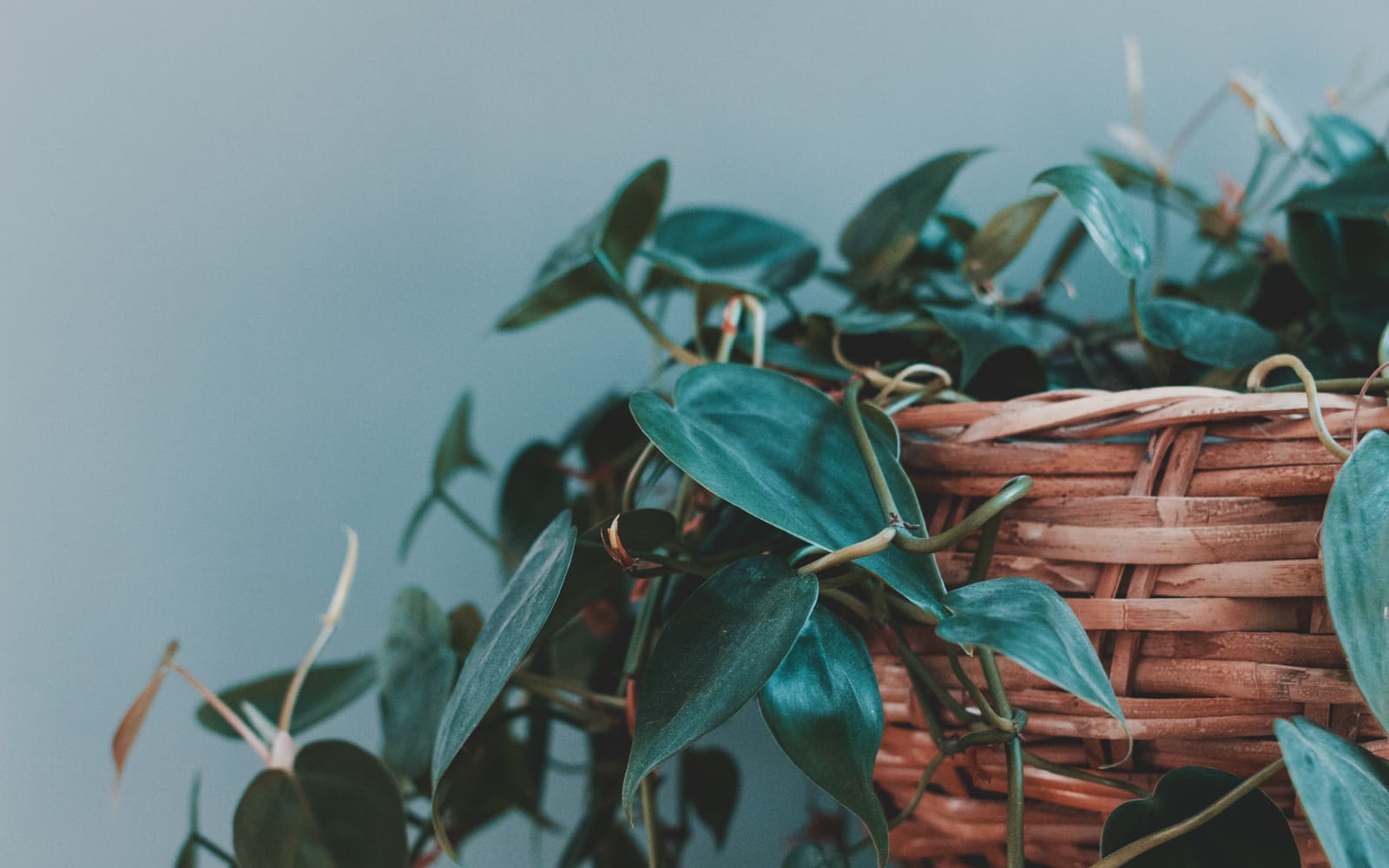
Photo by Greg Weaver on Wikimedia Commons, CC0 1.0

Heartleaf philodendron is one of the easiest houseplants there is: it gets by in low light, shrugs off dry home air and trails happily from a shelf or basket. Keep the soil lightly moist and let the top inch dry before you water again, because soggy soil is the quickest way to lose one. It's toxic to cats, dogs and horses if chewed, so hang it out of reach.
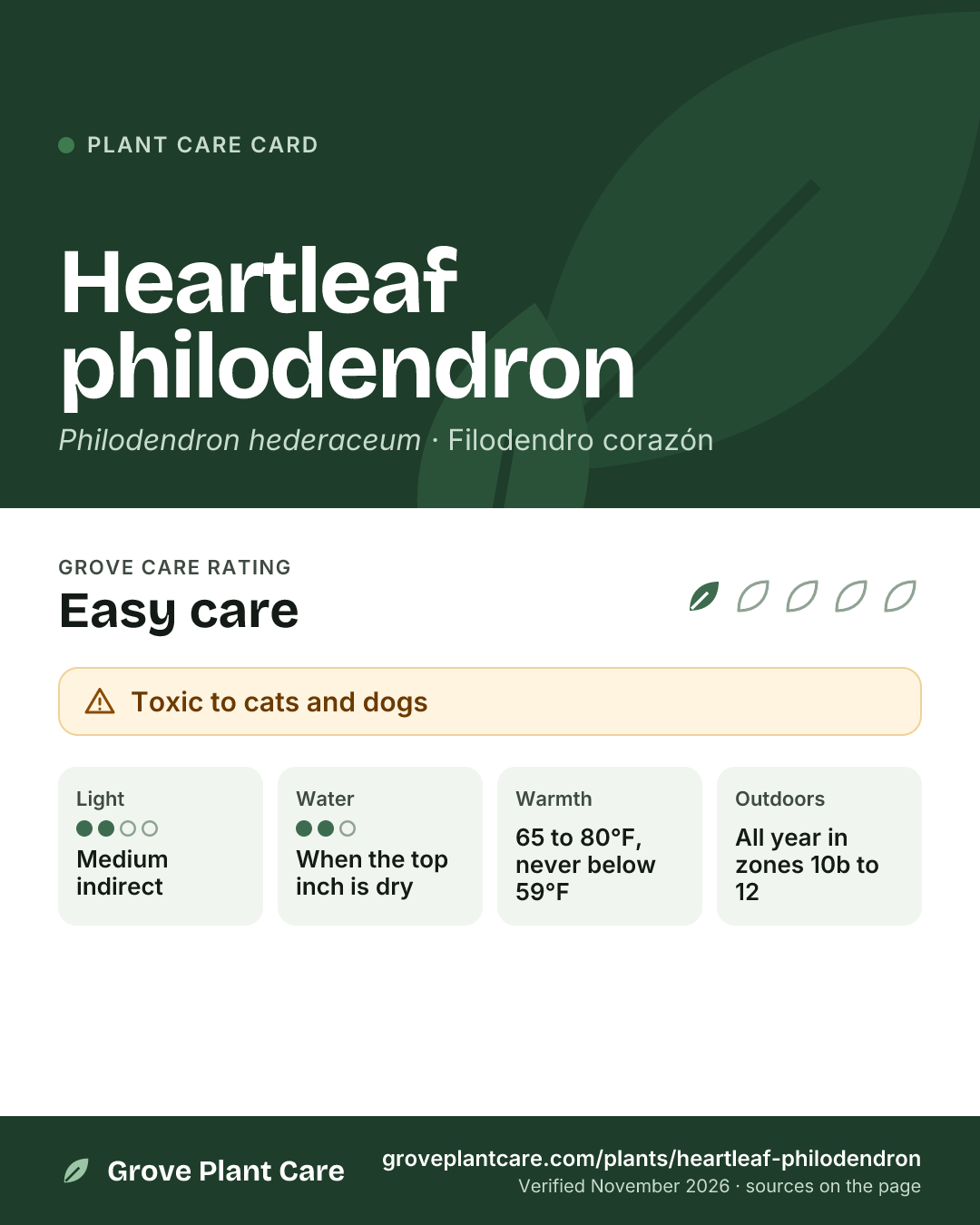
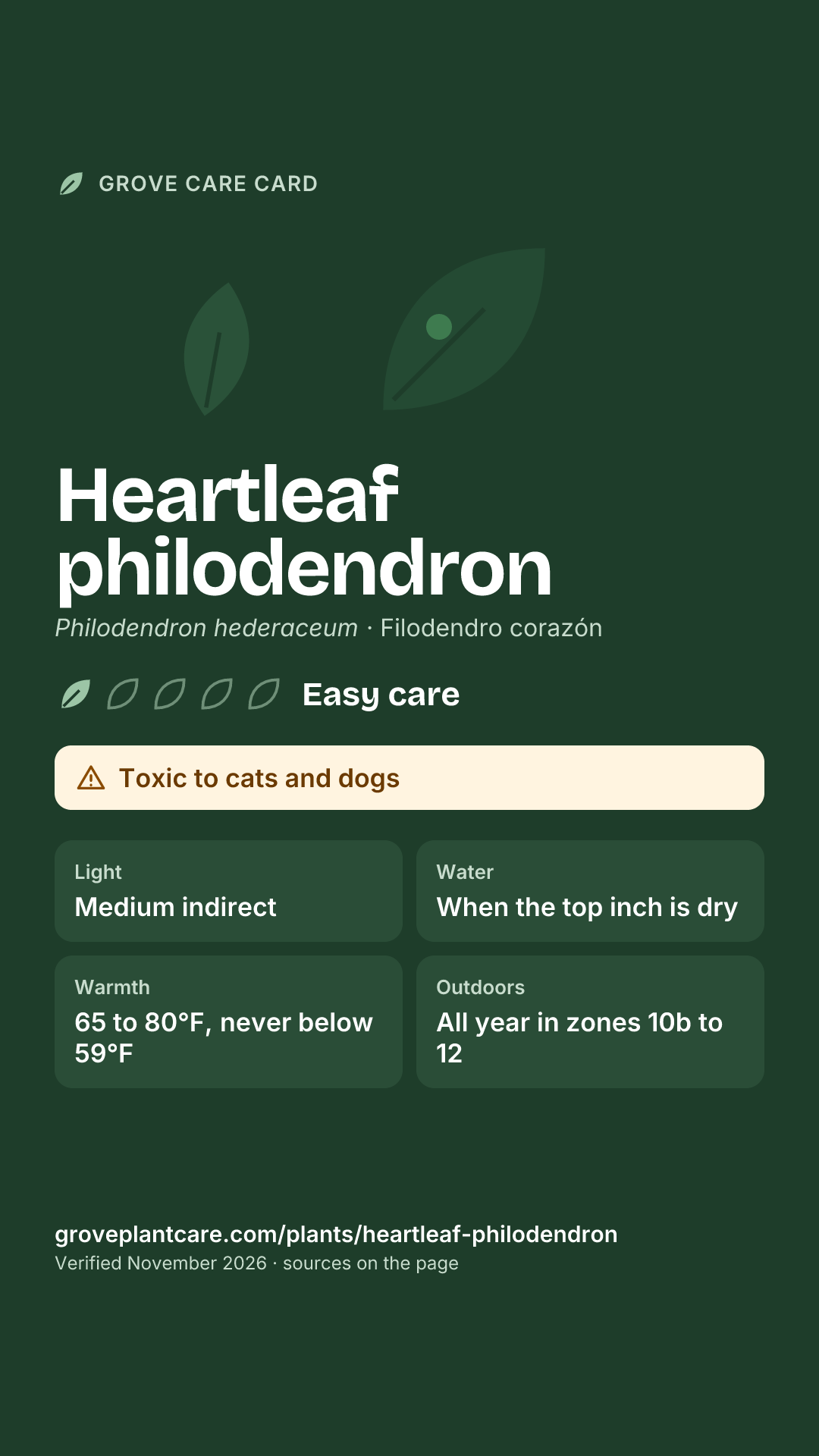
Toxic to cats, dogs and horses · Mild
Mouth pain and swelling, drooling, vomiting and trouble swallowing. Its sap holds needle-like calcium oxalate crystals; NC State rates the severity as low. Children: low severity. NC State rates it low severity; chewing burns the mouth and lips, and the sap can irritate skin.
Pet poison line: ASPCA (888) 426-4435
Good for: rooms with low to medium light, hanging baskets and high shelves, people new to houseplants · Think twice if: pets or small children chew plants, you tend to water on a fixed schedule.
Needs at a glance
- Light2 of 4 · Medium indirectCopes with low light; direct sun burns the leaves
- Water2 of 3 · Let the top inch dryKeep it lightly moist, never soggy; water less in winter
- Humidity1 of 3 · AverageNormal home air is fine; extra humidity helps leaf size
- Soil when pottedAll-purpose potting mixLoose and well-drained, in a pot with drainage holes
Indoors: best at 65 to 80°F (18 to 27°C). Keep it above 59°F (15°C) and away from drafts and heat vents.
How the rating adds up
0 = easiest · 1 = moderate · 2 = hardest
- Missed waterings1 of 2 · ModerateLikes lightly moist soil; water when the top inch dries
- Light flexibility0 of 2 · EasiestSurvives very low light; medium indirect light is best
- Humidity0 of 2 · EasiestHandles dry home air; likes more if you can give it
- Pests and disease1 of 2 · ModerateAphids, mealybugs, scale, spider mites; root rot if kept wet
- Sensitivity to change0 of 2 · EasiestAdapts to most homes; Clemson calls it very easy
Growing outdoors
All year: USDA zones 10b to 12, where the coldest winter nights average 35°F (2°C) or warmer.
Elsewhere: summer outside in shade, such as a covered porch; full sun burns it. Bring it in before nights drop below 60°F (16°C).
- Hanging baskets and shelves
- On a moss pole or totem
- Shade groundcover in frost-free gardens
Sources: NC State, Clemson, Iowa State, UF/IFAS, University of Missouri, Illinois Extension, RHS, ASPCA, ASPCA plant list, UConn, USDA, FISC, UF/IFAS Assessment and Hawaii weed risk assessment. Full list below.
Verified · How we rate plants
Is heartleaf philodendron toxic to cats and dogs?
Yes. The ASPCA lists heartleaf philodendron as toxic to cats, dogs and horses. Its sap holds needle-like crystals of calcium oxalate, so chewing a leaf causes mouth pain and swelling, drooling, vomiting and trouble swallowing. NC State rates the severity as low, and the sap can also irritate skin. Hang it where pets and small children can't reach it. If a pet chews it and seems unwell, call your vet or the ASPCA Animal Poison Control Center at (888) 426-4435. If a child eats some, call Poison Help at 1-800-222-1222.
Heartleaf philodendron vs pothos: how do I tell them apart?
Look at the leaf stalk and the newest leaf. A heartleaf philodendron's leaf stalk is smooth and round, and a pothos leaf stalk has a groove along it. Each new philodendron leaf comes out of a thin sheath that dries up and falls off, and pothos has no sheath. Pothos leaves are also thicker and glossier, often flecked with gold, white or yellow. NC State lists the two as plants that are often confused. Care is close, but Clemson says pothos wants more light and warmth.
How often should I water a heartleaf philodendron?
Water when the top inch of soil feels dry, then let the extra drain away. NC State and Clemson say to keep the soil lightly and evenly moist, never soggy, and to water less in winter. Never let the pot sit in a saucer of water. UConn's horticulturist calls trailing philodendrons both the easiest plants to grow and the easiest to kill, and overwatering is how they die: the roots rot, leaves drop and the vines wither.
Can a heartleaf philodendron live in low light?
Yes, better than most houseplants. NC State says it prefers medium light but can survive long periods in very low light, and Clemson says it grows under ordinary room light or near a north, east or west window. It will grow faster and fuller with more light, so a spot a few feet from a bright window is ideal. Keep it out of direct sun, which burns the leaves.
NC State, Clemson, UF/IFAS, Iowa State, University of Missouri
Why are my heartleaf philodendron leaves turning yellow?
Usually too much water or too little light. Clemson and UF/IFAS both name these two causes for yellow lower leaves, so check that the soil dries a little between waterings and that the pot drains, then move the plant closer to a window. Brown, curled leaf tips point to too much fertilizer. Check under the leaves for aphids, mealybugs, scale and spider mites too.
Is it the same plant as Philodendron scandens, oxycardium or cordatum?
Mostly, yes. Philodendron scandens, Philodendron oxycardium and Philodendron micans are older names that NC State and Kew now place under Philodendron hederaceum. Kew splits the species into two varieties, var. hederaceum and var. oxycardium, and the velvet-leaved form sold as 'Micans' belongs to the first. "Cordatum" is a trade name for heartleaf, but Philodendron cordatum is a different species from southern Brazil, so a tag that says cordatum usually means heartleaf.
What is a philodendron 'Lemon Lime'?
A heartleaf cultivar with bright yellow to chartreuse leaves, says NC State. UConn adds that the leaves turn light green to yellow in bright light, so give it a brighter spot than a plain green one. It needs the same care as any heartleaf. Watch the label, though: a different, upright philodendron is also sold as 'Lemon Lime'. It is a Philodendron domesticum cultivar patented in the US in 2010, and it grows as a bushy clump instead of a trailing vine.
How do I propagate a heartleaf philodendron?
Take a stem cutting 3 to 6 inches long and pull off the lower leaves. Root it in water, changing the water often, or in perlite or moist potting mix, and pot it up once the roots are a few inches long. Clemson says cuttings and air layering work in any season. Iowa State adds that rooting hormone speeds things up in perlite.
Can a heartleaf philodendron grow outdoors?
Yes, all year where it never freezes: USDA zones 10b to 12, going by UF/IFAS (10b to 11) and NC State (11 to 12). There it makes a shade groundcover or climbs trees, with leaves over a foot long. Elsewhere it can summer outside in shade, such as under a covered porch, where you still control the watering. Bring it in before nights drop below 60°F (16°C); the RHS gives 59°F (15°C) as its minimum. In Florida, UF/IFAS lists it as not a problem species. Hawaii's weed risk assessment rates it high risk, though, so never dump cuttings outdoors.
UF/IFAS, NC State, UConn, RHS, UF/IFAS Assessment, Hawaii weed risk assessment
How Grove helps
Grove turns watering into a quick check of the top inch of soil, so a heartleaf philodendron gets water when it's ready instead of on a fixed day. You can add trimming or turning the pot as a repeating task and assign it to anyone who helps with the plants. If you're unsure whether it's a philodendron or a pothos, a photo gives you a best guess you can correct.
Sources
- NC State Extension Gardener Plant Toolbox: Philodendron hederaceum
- Clemson Cooperative Extension HGIC 1509: Philodendron (rev. 2016)
- Iowa State University Extension, Yard and Garden: Growing Philodendrons at Home (A. Steil, reviewed 2025)
- UF/IFAS Gardening Solutions: Heartleaf Philodendron
- University of Missouri IPM, Missouri Environment and Garden: Philodendrons as Interior Plants (D. Trinklein, 2014)
- University of Illinois Extension, Houseplants: Philodendron
- Royal Horticultural Society: Philodendron hederaceum var. hederaceum (heart-leaf philodendron), AGM
- UF/IFAS EDIS ENH893: Cultural Guidelines for Commercial Production of Interiorscape Philodendron (McConnell, Chen, Henny and Everitt; reviewed 2024)
- ASPCA Animal Poison Control: Heartleaf Philodendron
- ASPCA Animal Poison Control: Toxic and Non-Toxic Plants
- UConn Home & Garden Education Center: Philodendron (from Penn State NE-53)
- USDA ARS Plant Hardiness Zone Map (2023)
- UConn Home & Garden Education Center: I "Heart" Philodendrons (M. Lisy, 2026-03-28)
- Florida Invasive Species Council: Plant List, Categories I and II (April 2026)
- UF/IFAS Assessment of Non-Native Plants: Philodendron hederaceum var. oxycardium and var. hederaceum
- Hawaii-Pacific Weed Risk Assessment (Plant Pono): Philodendron hederaceum, high risk, score 8 (2023)
- Kew WCVP data release (2026-06-04 file), plant_name_id 151646: Philodendron hederaceum
- Clemson Cooperative Extension HGIC: How to Grow Pothos Indoors
- US Plant Patent PP20,757 (2010): Philodendron plant named 'Lemon Lime' (Philodendron domesticum, upright)