Monstera moss pole: how to give your climber a lift
A monstera is a climbing vine, so once it starts getting big it needs a sturdy support to keep its heavy stems from flopping or breaking. A damp moss pole works best because the aerial roots can grip it, and sources say climbing monsteras usually reward you with bigger leaves.
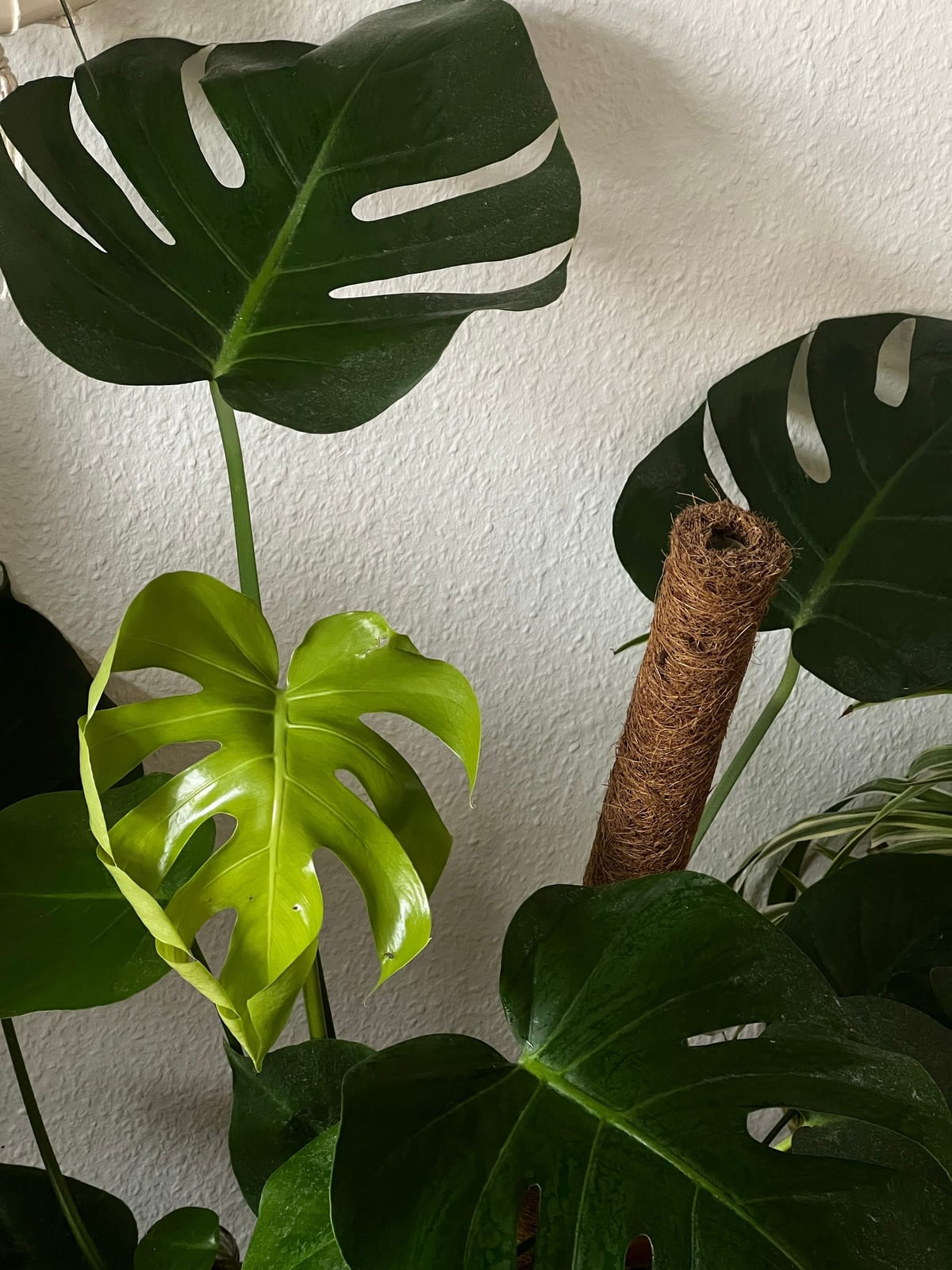
Why does a monstera climb, and what does a pole do for it?
Read moreShow less
Think of a monstera as a plant that's always looking for a tree. NC State Extension says it starts life on the forest floor and turns into a climber once it reaches a sturdy trunk. UW-Madison Extension and UConn add an odd detail: seedlings grow toward the darkest spot nearby, because shade usually means the base of a big tree. From there it climbs high into the canopy, gripping bark with long aerial roots.
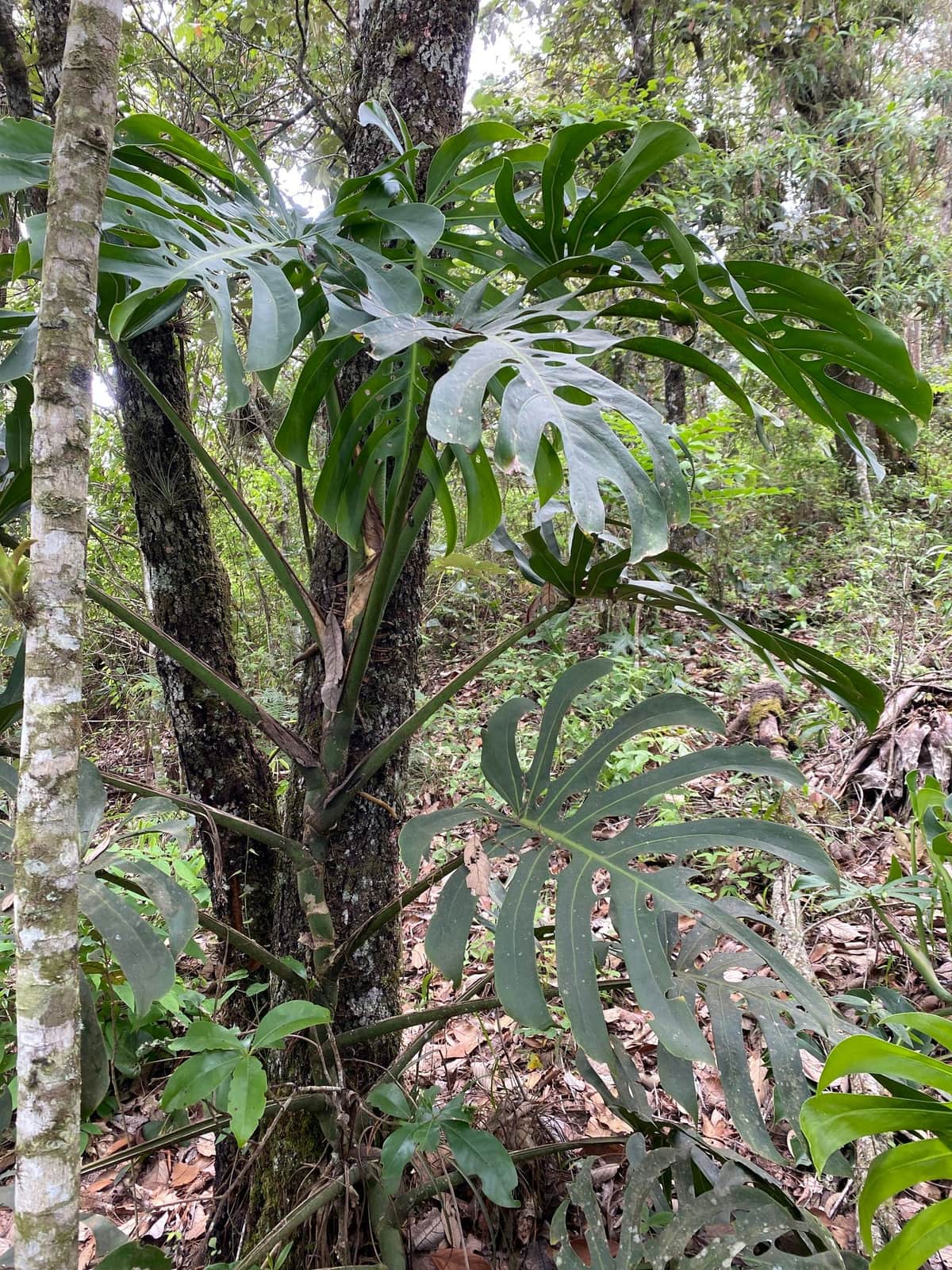
Indoors, a pole stands in for that tree. NC State and Wisconsin Extension say a vigorous monstera needs sturdy support so its thick stems don't snap. The bigger payoff is the leaves. UConn says leaf size usually jumps once the vines attach to a support, and the RHS says a climbing plant often makes larger, more mature leaves with more holes. Clemson Extension says the same pattern holds for most philodendrons, monstera's climbing cousins: their leaves don't reach full size unless the plant grows upward for several years.
A pole is one part of the recipe. Splits only come on mature leaves, and a monstera in dim light stays small and solid no matter what it climbs, as Wisconsin Extension and NYBG explain. Check the light first on the monstera care card, which rates how much light it needs.
Which support should I use: moss, coir, plank or trellis?
Penn State Extension says moss sticks, trellises, bamboo stakes and boards covered in sphagnum moss all work, as long as the support is sturdy. Here is how the options compare, based on what our sources describe:
| Support | What it does | Sources |
|---|---|---|
| Moss pole (sphagnum) | Holds stems up, and aerial roots can root into the damp moss | RHS, NYBG, UConn, Wisconsin Extension |
| Moss-covered board or bark plank | Works like a moss pole with a flat face; Wisconsin suggests tree bark or a moss-wrapped wooden slat | Penn State, Wisconsin Extension |
| Bamboo or garden stake | Holds stems up; nothing for the roots to grip | Penn State, UConn |
| Trellis | Holds stems up across a wider frame | Penn State |
| Coir (coconut fiber) pole | Sold widely as a moss pole alternative; none of our sources compare it with moss | none |
UConn says a moss pole works because it mimics the porous bark a monstera climbs in the wild. If you like a project, NYBG describes filling a tube of rolled plastic netting with sphagnum moss, and Wisconsin Extension describes wrapping sphagnum around a wooden slat and tying it on with fishing line or nylon thread.
What size moss pole does a monstera need?
Read moreShow less
A monstera usually reaches 6 to 8 feet (1.8 to 2.4 m) indoors, according to NC State and Penn State, and NYBG says a well-kept plant can grow well past ten feet. That means the pole needs to be strong, and the pot needs weight. NYBG suggests setting one end of the pole deep in the soil, and the RHS suggests a pot heavy enough that it won't topple. Since the plant will keep climbing, you'll add height later anyway (see what to do when it outgrows the pole).
How do I put a monstera on a moss pole?
Repotting is the easiest moment, because you can place the pole without stabbing through the roots. Repot only when roots fill the pot or poke out of the drainage hole, according to UConn and NYBG, and NC State suggests spring. Our repotting guide covers the repotting itself.
- Wait until the roots fill the pot, ideally in spring, so the plant is ready for repotting anyway.
- Choose a pot only a little bigger than the old one and heavy enough that it won't tip, as the RHS suggests.
- Soak the moss pole so it's damp all the way through before it goes in.
- Put some fresh mix in the pot and push the pole in first, deep and upright, so it never has to go through the roots.
- Set the plant right up against the pole, with the side where the aerial roots grow facing it.
- Fill in around the roots with mix, firm it gently, and water until it drains.
- Tie each stem to the pole loosely with a soft tie in a figure eight.
- Press a few aerial roots against the moss and leave the rest free.
Putting the pole in before the plant follows general staking advice from Penn State Extension: keep stakes close to the stem without damaging the roots. If you can't repot right now, you can still add a pole to the existing pot: push it in gently, close to the stem, and stop if you feel it pressing into roots. For the mix itself, see our monstera soil guide.
How do I tie the stems without hurting them?
Read moreShow less
Penn State's monstera guide simply says to attach the plant gently. General staking advice fills in the how. Penn State Extension says to tie the string firmly around the stake first, then loop it loosely around the stem in a figure eight, so the tie can't pinch or choke the stem as it grows. The RHS says the figure eight puts a cushion between stem and support, and warns that wire cuts into stems as they thicken. Both suggest soft materials and checking ties now and then, easing any that start to bite.
Tie each stem just under a leaf, near where the aerial roots come out. As new growth climbs, add a new tie higher up. Once aerial roots have a firm grip on the moss, the plant holds on by itself and the old ties matter less.
What do I do with the aerial roots?
Read moreShow less
Aerial roots are the brown, cord-like roots that grow from the stem near each leaf, as Penn State describes. NYBG says they help the plant climb and take in nutrients, so don't remove healthy ones. As the plant grows, NYBG suggests guiding some of them into the moss-covered support and leaving the rest exposed to the air. Wisconsin Extension and the RHS both say the roots and stems root into the support when it stays damp, which is what keeps a tall plant steady.
If an aerial root sticks out where you'd rather it didn't, you can usually just turn it toward the pole or down toward the soil. Wondering about trimming them? That's covered in our monstera pruning guide.
How do I keep a moss pole damp?
Read moreShow less
Wisconsin Extension says to water the moss-covered support as well as the potting mix, so the aerial roots can take up water and nutrients. NYBG suggests misting the plant and its moss pole every day, or using a pebble tray. The RHS adds that stems root into the pole only if it stays moist.
The pole and the soil follow different rules. The moss stays damp; the soil still dries at the top between waterings, because soggy soil rots monstera roots. The card's watering answer explains how to tell when the soil is ready.
What do I do when my monstera outgrows the pole?
Read moreShow less
None of our sources describe how to extend a pole, so here are the principles they do give. NYBG says healthy aerial roots are worth keeping, and roots that have grown into the moss tear if you pull the plant away. That makes adding a section on top, or fixing a second pole to the first, kinder than swapping poles. Keep tying new growth higher as it climbs, as Penn State's staking advice suggests, and keep the new section damp too.
There's a limit to how tall a living room gets. The RHS says a monstera that outgrows its space can be pruned back in spring, and that new stems make smaller leaves with fewer holes for a while. Our pruning guide shows where to cut, and the top you remove can become a new plant with our propagation guide.
Why is my monstera falling over, and how do I fix it?
Read moreShow less
Work through the likely causes, starting with the most common:
- No support, or too little. The RHS says monsteras get top-heavy as they grow, and NC State says heavy stems break without sturdy support. Add a pole and tie the stems to it.
- A pot that's too light. The RHS suggests a pot heavy enough not to topple. Moving it into a heavier pot at the next repotting steadies it.
- Low light. Penn State and NYBG say low light gives long, stretched stems, and Penn State pictures a leggy monstera that needs staking. Move it closer to a bright window; our indoor light guide shows how to measure.
- Rot at the base. UConn says root and stem rot can make the plant wilt and can damage stems right at the soil line. If the base feels soft or the soil stays wet, read our root rot guide.
- It fell over after repotting. If the stem was set too high, UConn says a vine with established aerial roots can be planted 2 to 3 inches (5 to 7.5 cm) deeper, below its first leaf, with little risk of rot. Keep the growing tip above the soil.
If the plant is simply too big for the room, cutting it back is a fair fix. The sap can irritate skin, according to NC State and Penn State, so wear gloves, and keep cut pieces away from pets, since the monstera care card explains it's toxic to cats and dogs.
Sources
- Monstera deliciosa : North Carolina State Extension Gardener Plant Toolbox
- Swiss-Cheese Plant, Monstera deliciosa : University of Wisconsin-Madison Extension (revised October 2026)
- Monstera as a Houseplant : Penn State Extension (updated December 2024)
- Monstera deliciosa : UConn Home & Garden Education Center (revised 2020)
- Monstera (Monstera deliciosa) : New York Botanical Garden, LuEsther T. Mertz Library
- How to grow Swiss cheese plants : Royal Horticultural Society
- How to tie-in climbers : Royal Horticultural Society
- Supporting Herbaceous Plants in a Flower Garden : Penn State Extension (updated March 2026)
- Philodendron (HGIC 1509) : Clemson Cooperative Extension Home & Garden Information Center
- Swiss Cheese Plant : ASPCA Animal Poison Control