How to propagate a monstera from cuttings
To propagate a monstera, cut a piece of stem that includes a node, the bump where a leaf joins the stem, and root it in moist perlite, potting mix, sphagnum moss or water. Roots usually show up in about 2 to 6 weeks, and the new plant is ready for its own pot once the roots are firm and it starts growing.
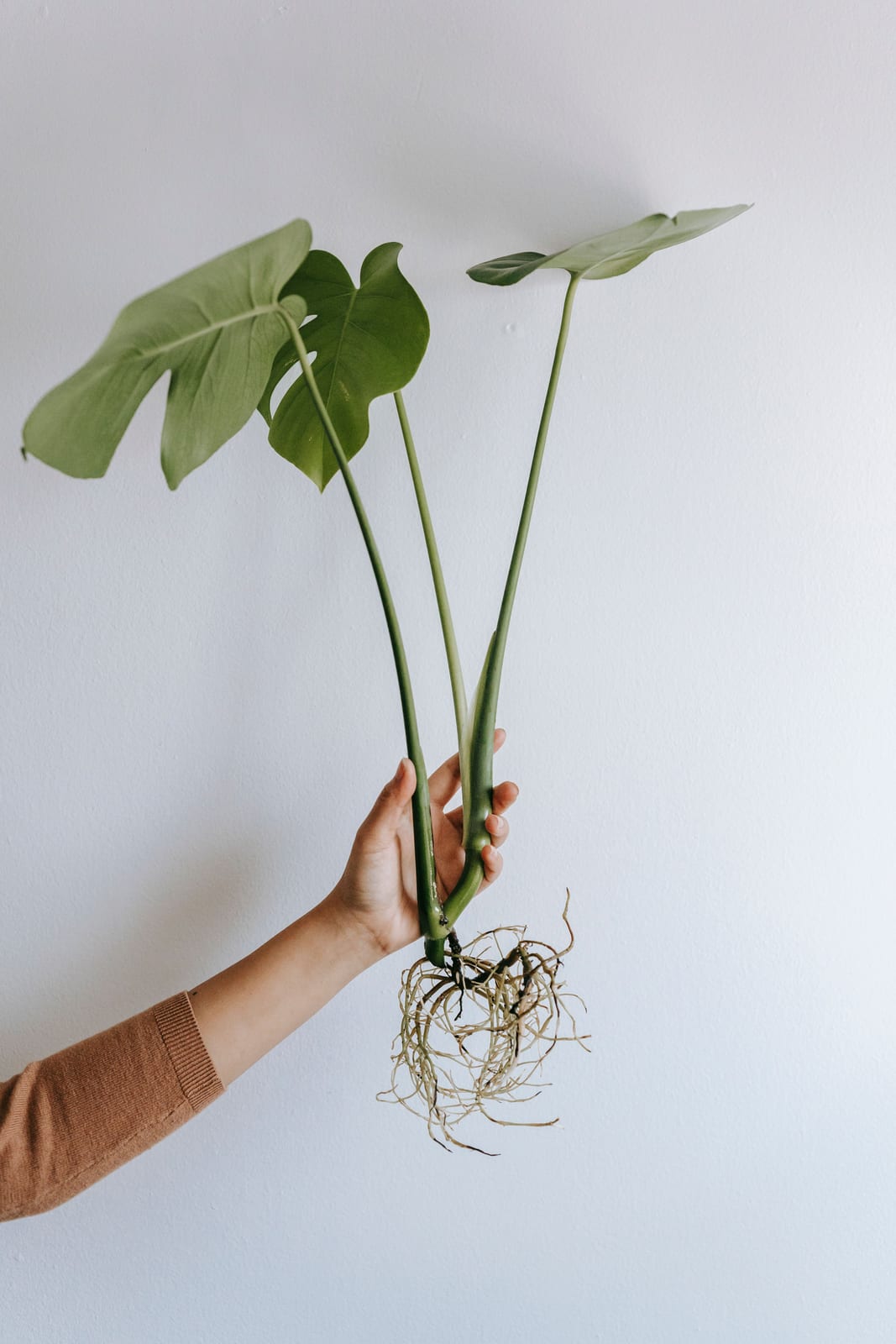
What is a monstera node, and why does a cutting need one?
Read moreShow less
Look along a monstera stem and you'll see rings or slight bumps where each leaf stalk attaches. That's a node. University of Vermont Extension describes it simply as the bump where the leaf meets the stem. University of Minnesota Extension explains that a monstera can only be propagated from a piece that includes a node, because new growth starts from the bud tucked at the node.
Nodes often have an aerial root nearby, one of the brown, cord-like roots a monstera uses to climb. University of Wisconsin-Madison Extension suggests cutting just below an aerial root, and UConn's Home & Garden Education Center suggests keeping as many aerial roots on the cutting as you can. Think of the aerial root as a head start: the node does the growing, and the root is already halfway to being a real one.
Can I grow a monstera from a leaf or an aerial root?
Read moreShow less
University of Minnesota Extension says leaves and leaf stalks without a node never make new growth and eventually rot, since there's no bud to grow from. The same logic applies to an aerial root snipped off by itself: the sources tie new growth to the node, so pick a piece with a node attached.
Leafless stem pieces are a different story. UConn lists cane cuttings for monstera, and Wisconsin Extension describes cutting a long vine into 1 foot (30 cm) sections and pressing them halfway into a bed of rooting medium. The NC State Extension Gardener Handbook explains cane cuttings for thick-stemmed houseplants: short leafless sections with one or two nodes, laid flat or half buried with a bud facing up, and potted once roots and shoots appear. They are slower to show life, since there's no leaf making food yet.
Which propagation methods work for a monstera?
UF/IFAS Extension names stem cuttings as the most common way to propagate monstera, and Penn State Extension says stem cuttings and air layering are the easiest. Here is what the sources say about each rooting option.
| Method | What the sources say | Source |
|---|---|---|
| Perlite | The most common medium for monstera cuttings: it holds the cutting up and gives roots both air and moisture | University of Minnesota Extension; Iowa State University Extension |
| Potting mix | Works well kept moist. Very wet, cold mix can lead to damping off, and Iowa State suggests using soil as part of a lighter mix | University of Minnesota Extension; University of Vermont Extension; Iowa State University Extension |
| Sphagnum moss | Holds a lot of water and stays airy, and it's hard to rewet once it dries out completely | Iowa State University Extension |
| LECA (clay pebbles) | Drains so well that you can water more often without raising the risk of rot; reusable, though it costs more | University of Minnesota Extension |
| Water | Roots in plain water and lets you watch them grow; water roots are weaker than roots grown in a solid medium | University of Minnesota Extension; Iowa State University Extension |
| Air layering | Roots a stem while it stays on the plant, wrapped in damp moss | University of Wisconsin-Madison Extension; Penn State Extension; University of Minnesota Extension |
| Simple layering | Pin a node of a long stem against the soil, then cut it free once it roots | University of Wisconsin-Madison Extension; University of Nevada, Reno Extension |
| Seed | Possible and slow, and seedlings need steady warmth | University of Wisconsin-Madison Extension; UConn |
Rooting in water is the method people search for most, and it has its own pages. Our water propagation guide covers rooting cuttings of any plant in a jar, and monstera in water covers keeping a monstera in water and moving it to soil. If LECA appeals to you, our semi-hydroponics guide explains how it works long term.
When is the best time to propagate a monstera?
Read moreShow less
Minnesota and Wisconsin Extension both say monstera cuttings can be taken any time of year. Iowa State University Extension calls early spring ideal for houseplant cuttings, and the University of Nevada, Reno Extension says the right moment is when the plant is in full growth. So watch the plant more than the calendar: new leaves unfurling are your cue. Where a monstera grows all year, as in warm climates, that cue matters more than the month.
Minnesota Extension adds that cuttings started in late fall or early winter may need 2 to 3 hours of extra light a day, since short days slow everything down.
How do I propagate a monstera cutting, step by step?
This is the method the sources describe in the most detail: a stem cutting rooted in a solid medium, which grows stronger roots than water.
- Put on gloves and wipe a sharp knife or pruners with rubbing alcohol, or a mix of 1 part bleach to 9 parts water, so you don't spread disease into the fresh cut.
- Water the parent plant the day before, so the cutting starts out fully hydrated.
- Pick a healthy stem with a node, ideally one with an aerial root, and keep one or two leaves above it to feed the cutting while it roots.
- Cut the stem 1 to 2 inches (2.5 to 5 cm) below the node, or up to 3 to 5 inches (8 to 13 cm) below it as UConn suggests, keeping any aerial roots.
- If you like, dust the node with rooting hormone poured into a separate dish; monstera can root without it.
- Fill a heavy pot with a drainage hole, at least 4 inches (10 cm) wide and 5 inches (13 cm) deep, with moist perlite or potting mix.
- Make a hole, set the cutting in with the node below the surface and no leaves buried, firm the mix around it, and tie it to a small stake so it can't tip.
- Cover it loosely with a clear plastic bag to hold in humidity, leaving room for air, or mist it every 2 to 3 days instead.
- Keep it in bright, indirect light and warm air of about 65 to 75°F (18 to 24°C), out of direct sun.
- Keep the medium moist for the first 1 to 2 weeks, then let the top dry slightly between waterings, and always let the pot drain.
- After 2 to 4 weeks, lift the cutting gently with a spoon or plant label; if the roots are firm and creamy white, it's rooted, and if there are few or none, tuck it back in and wait.
The steps come from Minnesota Extension's monstera instructions, with Iowa State on hydration, light and warmth, the NC State Gardener Handbook on cleaning tools, UConn and Wisconsin on where to cut, and Vermont Extension on covering the pot. Minnesota recommends a heavy pot because monstera cuttings are top heavy. Iowa State adds that a heat mat warming the mix to 75 to 80°F (24 to 27°C) speeds rooting, and warns that too much sun can scorch a cutting under plastic.
How long does a monstera cutting take to root?
| What happens | How long | Source |
|---|---|---|
| Roots form in perlite or similar medium | About 2 to 4 weeks | University of Minnesota Extension |
| Roots form on most houseplant cuttings | 3 to 6 weeks | Iowa State University Extension |
| Roots form in water or soil | Days, weeks or sometimes months | University of Vermont Extension |
| First new leaves from a rooted node | Up to 2 to 3 months | University of Minnesota Extension |
| Roots form on an air layer | A few weeks to several months | University of Nevada, Reno Extension |
A rooted cutting that hasn't made a new leaf yet is normal. Minnesota Extension says that once healthy roots have formed, new stems and leaves often follow every few weeks. As long as the stem stays firm and green, patience is the right move, as Vermont Extension puts it.
When should I pot up a rooted cutting?
Read moreShow less
Sources give a small range. Iowa State suggests potting once roots are about 1 inch (2.5 cm) long, Vermont Extension waits for roots over 2 to 3 inches (5 to 7.5 cm) on water-rooted cuttings, and Minnesota Extension says to move the cutting when healthy roots have formed and it's actively growing.
Minnesota Extension suggests moist potting mix with about 2 inches (5 cm) of space between the cutting and the side of the pot, and warns that an oversized pot makes it hard to judge moisture. Iowa State says to keep the new plant watered and in bright, indirect light; it should settle in within a few weeks, and then you can start feeding it. Our monstera soil guide covers what to put in that first pot. Cuttings rooted in water often sulk for a bit after the move, and monstera in water explains how to ease that change.
How do I air layer a monstera?
Read moreShow less
Air layering suits a tall, leggy monstera, because the stem keeps drinking from the parent plant while it roots. The NC State Gardener Handbook explains that this is why layering usually works: the stem never goes thirsty, and it keeps its food supply. The University of Nevada, Reno Extension lists monstera as easy to air layer.
The NC State Gardener Handbook describes the method for plants like monstera:
- Choose a spot on the stem about 1 foot (30 cm) from the tip, just below a node.
- Make an upward cut about one third of the way through the stem and hold it open with a toothpick.
- Dust the cut with rooting hormone if you like; the handbook notes it isn't always needed.
- Wrap the area in damp sphagnum moss, cover it with plastic and tie it in place, or use aluminum foil.
- Keep the moss from drying out. The Nevada Extension sheet says roots can take a few weeks to several months.
- When the moss is full of roots, cut the stem below the moss and pot the new plant, then give it gentle care for a few weeks while its roots settle.
Why is my monstera cutting rotting or slow to root?
Minnesota Extension says brown, soft roots mean the cutting is getting too much water or the pot isn't draining, and a rotted cutting may never recover, so taking a fresh one is often easier. It also warns that wet, cold mix invites damping off, a fungal rot. Iowa State adds that in too little light, rooting slows and a cutting can rot or dry out before roots form. If the base of a potted plant goes soft, our root rot guide walks through what to do.
| What you see | Likely cause | What to try | Source |
|---|---|---|---|
| Stem or roots brown and mushy | Too wet, or poor drainage | Trim to healthy tissue or take a new cutting; use a draining pot and let the top dry between waterings | University of Minnesota Extension |
| A leaf in water that never roots | No node | Take a new cutting with a node | University of Minnesota Extension |
| No roots after several weeks | Cool air, low light or low humidity | Warm it to 65 to 75°F (18 to 24°C), give bright indirect light, cover it loosely | Iowa State University Extension |
| Still nothing, and the stem is firm | Just slow | Wait; some cuttings take months | University of Vermont Extension |
| Wilting after a move from water to soil | Water roots adjusting to soil | Keep care steady for a few weeks | Iowa State University Extension |
Leaves matter too. Minnesota Extension says leaves help a cutting root by making food, so keep one or two. Iowa State notes that trimming very large leaves cuts water loss, which can help a huge leaf that keeps wilting.
Is it safe to take monstera cuttings around pets and kids?
Penn State Extension recommends gloves because the sap can cause a skin rash, and the NC State Plant Toolbox notes that contact with the sap may irritate skin. The ASPCA lists monstera as toxic to cats and dogs: its calcium oxalate crystals cause mouth irritation, drooling, vomiting and trouble swallowing if chewed. A cutting sitting in a low jar is easy for a curious cat to reach, so give it a high shelf.
Our monstera care card has the full ratings and safety details. If you think a pet chewed some, call your vet or the ASPCA Animal Poison Control Center at (888) 426-4435 (a fee may apply).
Sources
- Propagating Monstera deliciosa : University of Minnesota Extension (reviewed 2024)
- Swiss-Cheese Plant, Monstera deliciosa : University of Wisconsin-Madison Extension (revised October 2026)
- Monstera deliciosa : UConn Home & Garden Education Center
- Monstera as a Houseplant : Penn State Extension
- Monstera deliciosa : NC State Extension Gardener Plant Toolbox
- Monstera Growing in the Florida Home Landscape (HS311) : UF/IFAS Extension
- Chapter 13: Propagation : NC State Extension Gardener Handbook
- How to Propagate Houseplants by Stem Tip Cuttings : Iowa State University Extension and Outreach (last reviewed January 2025)
- More, Please: Propagating Houseplants : University of Vermont Extension (December 2022)
- La propagación de las plantas de interior (Página de Información 99-60) : University of Nevada, Reno Extension (in Spanish)
- Swiss Cheese Plant : ASPCA Animal Poison Control