Monstera types: from Swiss cheese plant to rare collector vines
Most monsteras in homes are one species, Monstera deliciosa, or one of its named forms such as 'Thai Constellation', 'Albo Variegata' and 'Aurea'. The rest are separate species, from the easy Monstera adansonii to slow, rare collector plants like Monstera obliqua, and each one asks for slightly different care.
What is the difference between a monstera species and a cultivar?
Read moreShow less
Kew's checklist of the world's plants accepts more than 70 species of Monstera, according to Plants of the World Online data from the Royal Botanic Gardens, Kew. Only a handful are common houseplants.
Cultivars sit inside a species. The North Carolina State Extension Gardener Plant Toolbox lists 'Albo Variegata' and 'Thai Constellation' as cultivars of M. deliciosa, and the Royal Horticultural Society (RHS) files 'Thai Constellation' the same way. So a Thai Constellation is a Swiss cheese plant in a fancy coat: same roots, same basic care, different leaves. Monstera adansonii and Monstera obliqua are different species altogether, with their own size, leaves and habits.
That's why this page splits the two. For the everyday care every monstera shares, the monstera care card has light, water and humidity with ratings.
What is the difference between stable and unstable variegation?
Read moreShow less
Variegation means streaks or patches of a second color, usually white, cream or yellow, where the leaf has little chlorophyll. The University of Minnesota Extension explains that the white and yellow in variegated monsteras come from mutations, that some of those mutations are unstable, and that green growth can take over because it has more chlorophyll to work with.
Many variegated plants are chimeras: their growing tip holds two kinds of cells in layers. The University of Florida's plant propagation guide on chimeras says a whole mutated layer gives the most stable pattern, while a mutation in just a sector of the tip is relatively unstable and tends to throw all-green or all-white shoots over time. Growers keep the pattern by cutting off the stems that lose it.
- Stable: 'Thai Constellation'. A 2024 study in Horticulturae describes it as a relatively genetically stable variant and multiplies it in the lab from buds.
- Unstable: 'Albo Variegata' and 'Aurea'. Their white or yellow patches change from leaf to leaf, which behaves like the unstable variegation described by Florida and Minnesota Extension.
Less chlorophyll also means slower growth, Minnesota Extension notes. A variegated monstera is basically running on a smaller solar panel, so it needs brighter light than a green one.
Which monstera types will I meet?
Read moreShow less
Rarity labels name their source. Where no reputable source rates a plant's rarity, the label says "general guidance".
Swiss cheese plant (Monstera deliciosa)
- Botanical name: Monstera deliciosa Liebm., the species (Kew). Also sold as split-leaf philodendron.
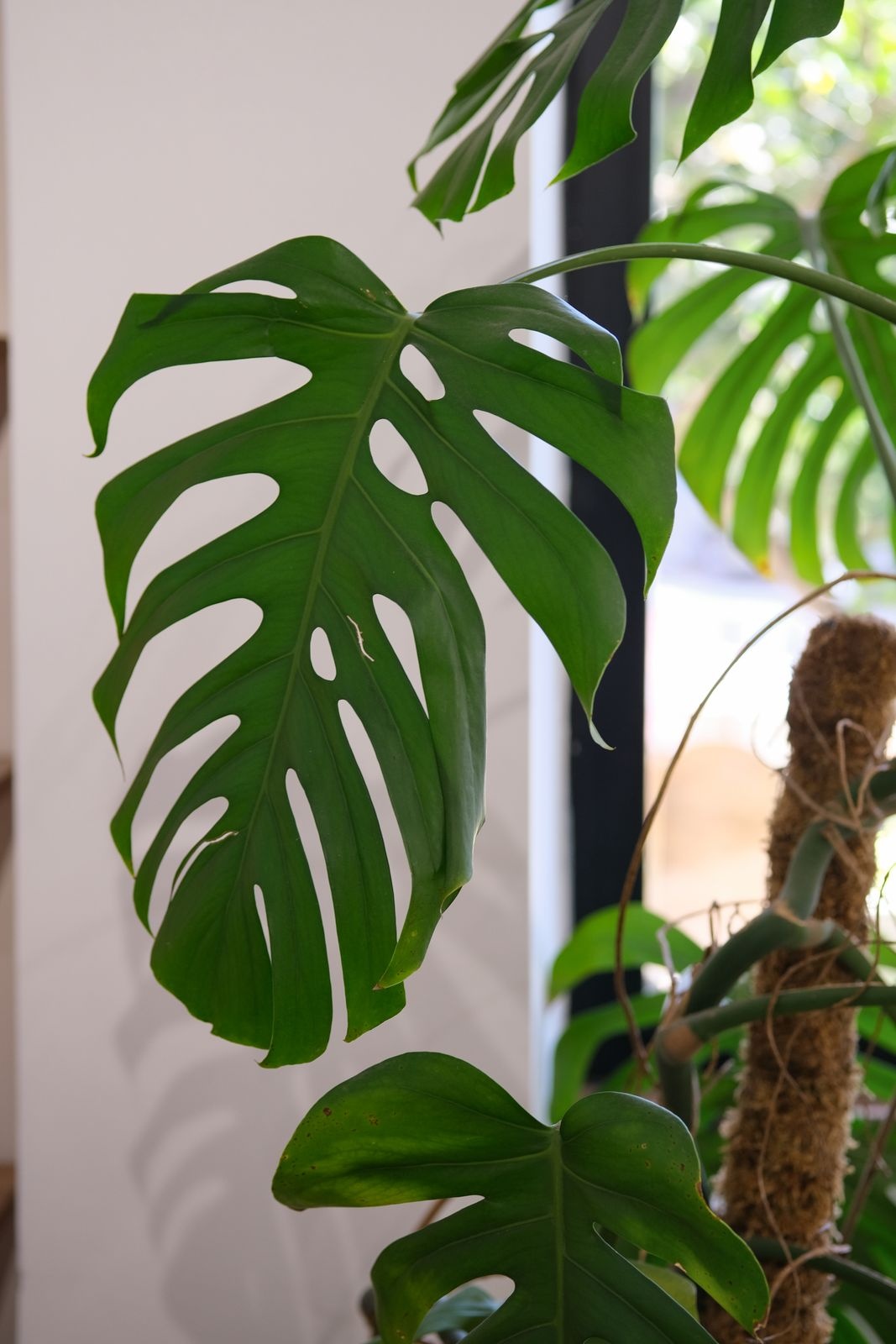
- How to recognize it: young leaves are solid hearts; the splits and holes come as the plant matures and gets enough light (NC State, University of Wisconsin-Madison Extension).
- Size indoors: usually 6 to 8 feet (about 2 to 2.5 m), NC State says.
- Care: this is the baseline every other card compares to. The monstera care card covers it, and a moss pole helps it make bigger leaves.
- Rarity: common. The RHS calls it the most popular Swiss cheese plant, sold all year.
- Pets: the ASPCA lists it as toxic to cats and dogs.
Thai Constellation
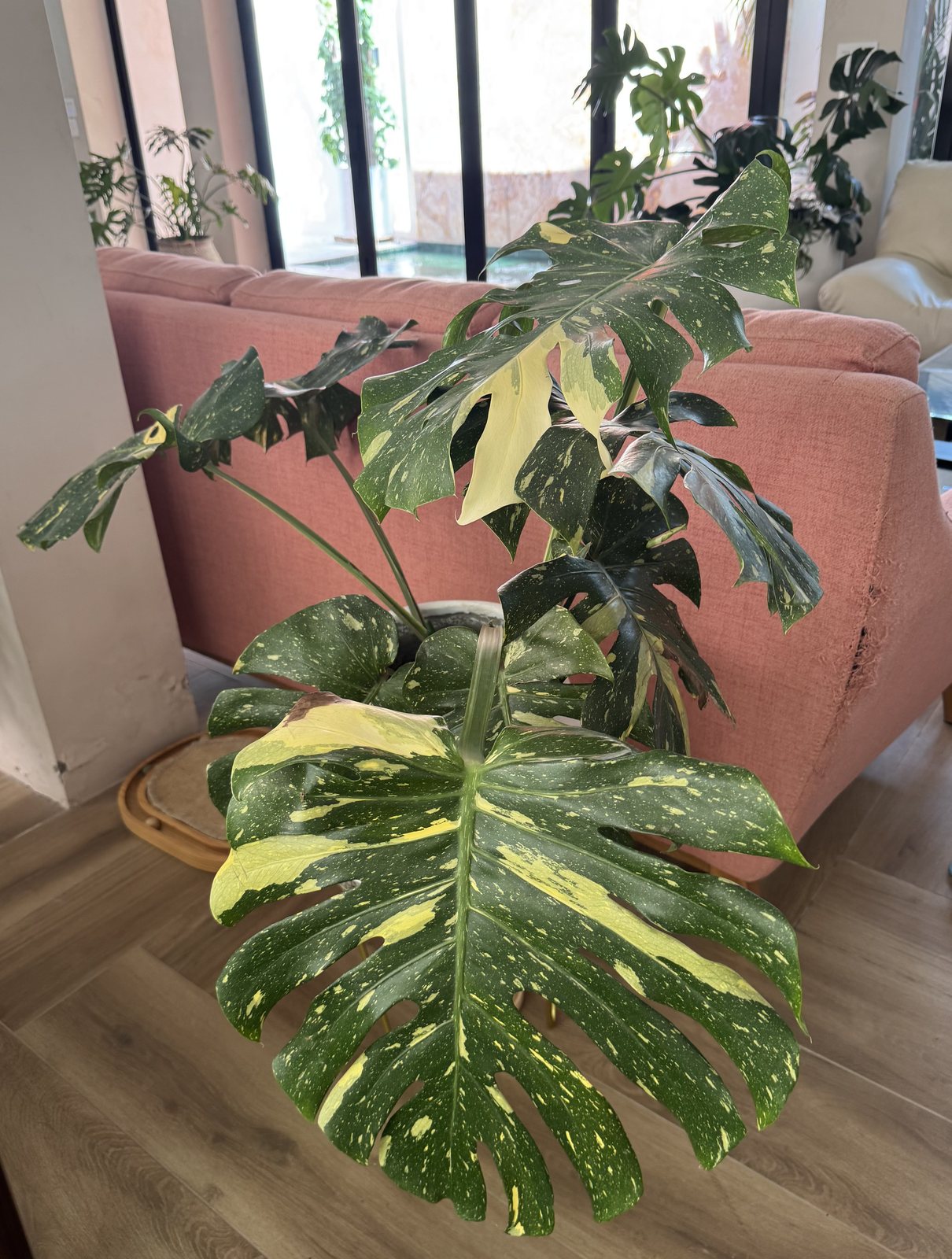
- Botanical name: Monstera deliciosa 'Thai Constellation', a cultivar.
- How to recognize it: cream speckles and marbling scattered over the whole leaf, like a sky full of stars, says NC State. The RHS adds that it grows a little more slowly than the green species, with leaves set closer together.
- Size indoors: large, like M. deliciosa. The RHS gives about 8 to 13 feet (2.5 to 4 m) at full size.
- Care: give it brighter light than a green monstera; NC State says variegated cultivars need more sun than dark green ones. Expect slower growth.
- Variegation: stable, per the 2024 Horticulturae study. Labs multiply it from buds, so plants come out true to type.
- Rarity: rare, according to NC State.
- Pets: as a M. deliciosa, toxic to cats and dogs (ASPCA); the RHS also lists it as harmful to pets.
Albo Variegata (Albo Borsigiana)
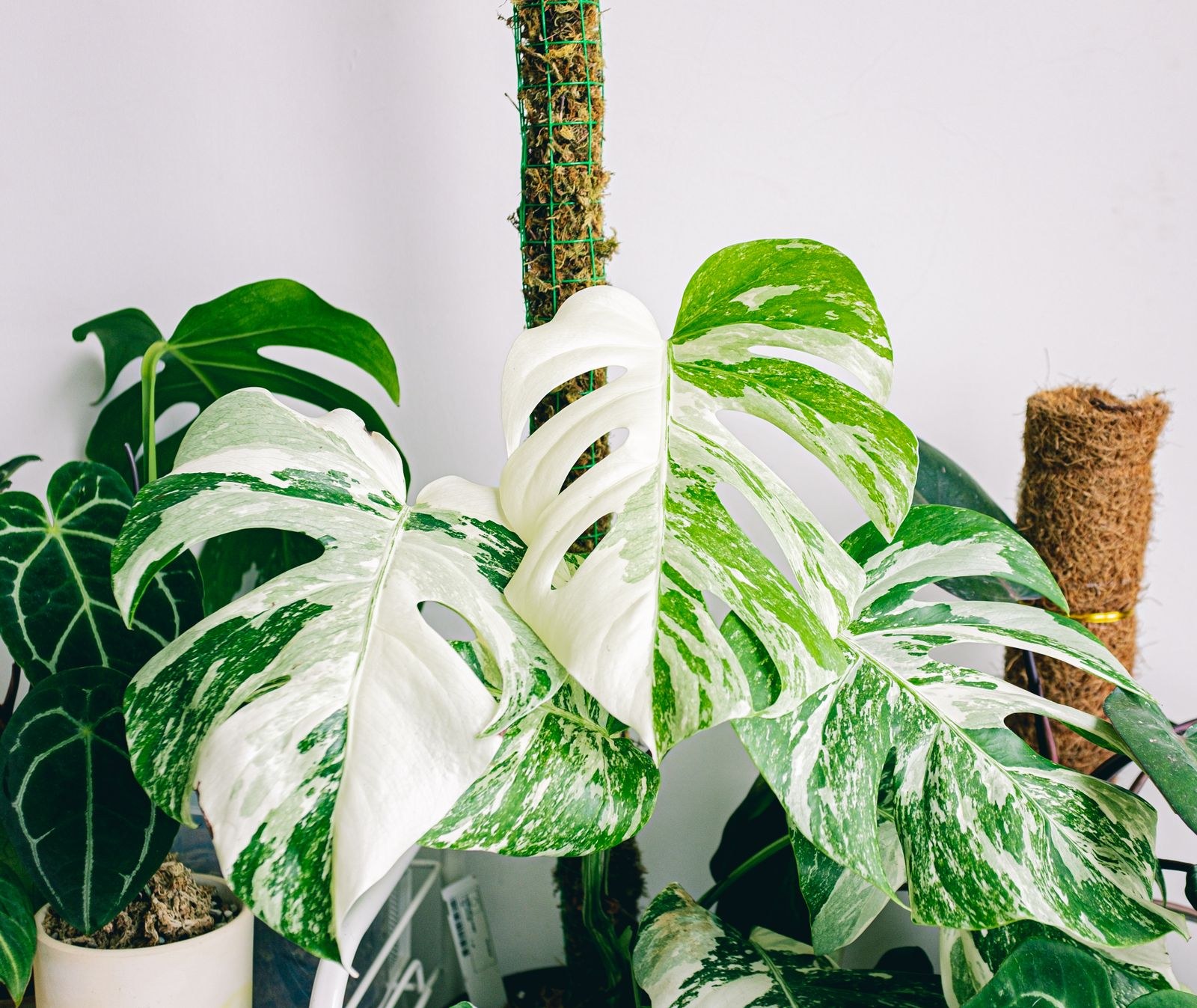
- Botanical name: Monstera deliciosa 'Albo Variegata', a cultivar group. Sellers also say 'Albo Borsigiana' or just "Albo"; references spell it 'Albo-Variegata' or 'Albovariegata'. Older references also list a 'Variegata' with creamy marbling, and sellers use these names loosely.
- How to recognize it: big blocks and streaks of bright white that change from leaf to leaf. Wisconsin Extension notes that variegated cultivars tend to have somewhat smaller leaves than the species.
- Size indoors: close to green M. deliciosa, growing more slowly.
- Care: brighter light than a green plant (NC State), slower growth (Minnesota Extension). Cut off stems that come out all green, as Florida's chimera guide suggests for variegated plants, so the green doesn't take over.
- Variegation: unstable.
- Rarity: rare. NC State calls it rare and expensive, and the RHS says the white forms are much less widely sold and cost more.
- Pets: toxic to cats and dogs, as for every M. deliciosa (ASPCA).
Aurea (Marmorata)
- Botanical name: Monstera deliciosa 'Aurea', also sold as 'Marmorata', a cultivar. Minnesota Extension names the two together, and a 2026 US plant patent describes a new plant that came from the variegated 'Aurea'.
- How to recognize it: the Albo pattern in yellow. Minnesota Extension describes yellow coloring from the same kind of mutation.
- Size indoors: large, like M. deliciosa.
- Care: the same as Albo: bright light, patience, and trimming back any all-green stems.
- Variegation: unstable.
- Rarity: rare. University of Florida IFAS Extension says variegated forms like 'Marmorata' may be hard to find in nurseries.
- Pets: toxic to cats and dogs, as for every M. deliciosa (ASPCA).
Monstera adansonii
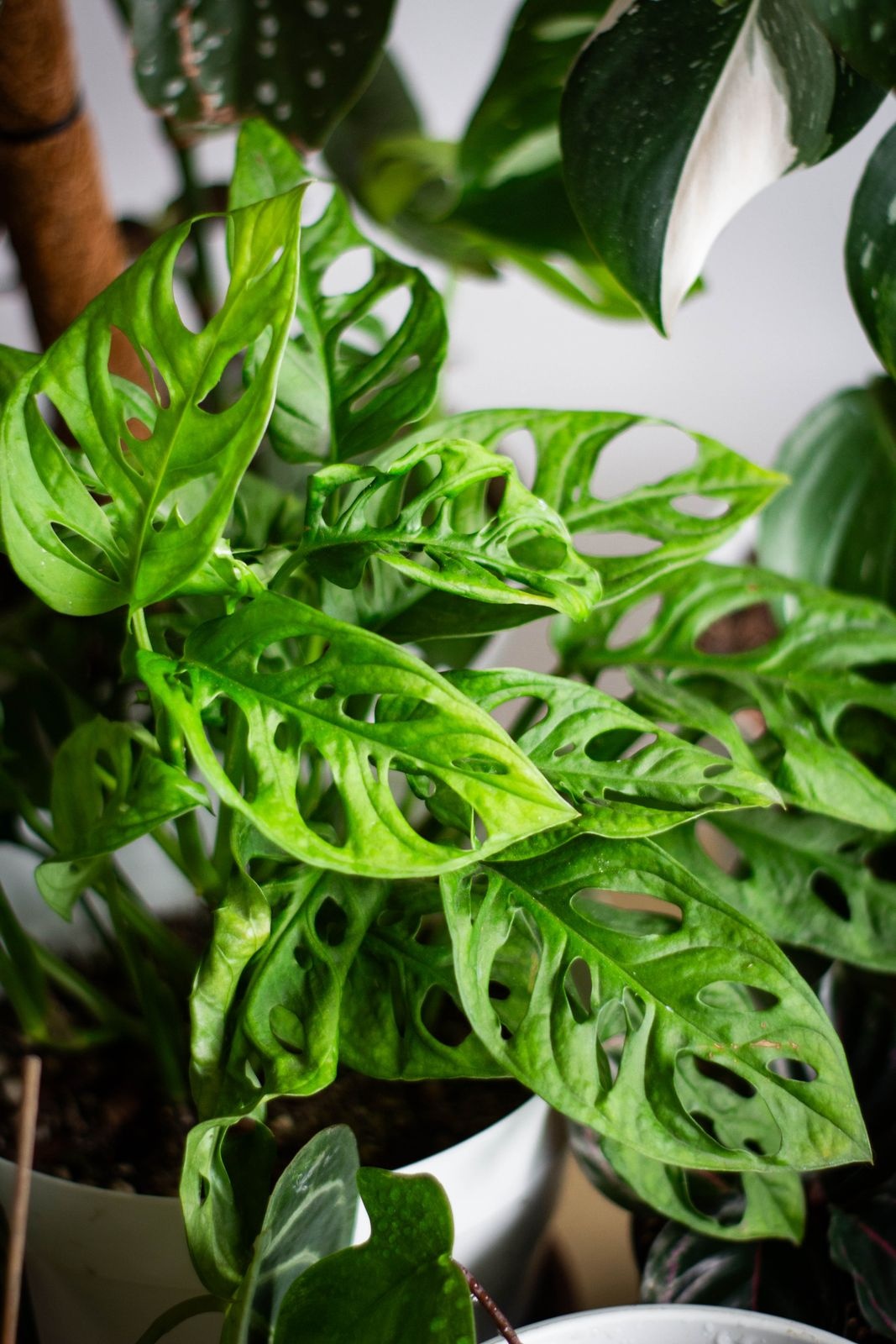
- Botanical name: Monstera adansonii Schott, a separate species (Kew). Kew splits it into subspecies, and the old name Monstera friedrichsthalii belongs to one of them.
- How to recognize it: smaller, thinner leaves than M. deliciosa, heart shaped and full of oval holes, with one side of the leaf base a little wider than the other (NC State, RHS).
- Size indoors: 3 to 8 feet tall on a pole or trellis, NC State says, or let it trail from a basket.
- Care: it grows fast. NC State suggests moist, well-drained soil and keeping it above 50°F (10°C), away from cold drafts. Direct sun can scorch it.
- Rarity: common. NC State calls it a popular houseplant, and the RHS says it is more and more widely sold.
- Pets: NC State lists it as toxic to people and pets, and the RHS agrees.
Monstera obliqua
- Botanical name: Monstera obliqua Miq., a separate species (Kew).
- How to recognize it: very thin leaves, per the National Parks Board Singapore. The form collectors want has leaves that are more hole than leaf, glossy and lacy (RHS). Botanists note it is very variable, and many wild plants have few holes or none (Croat and colleagues, 2024).
- Size indoors: small. The RHS gives about 3 to 5 feet (1 to 1.5 m), reached over 10 to 20 years.
- Care: think humid, steady and patient. The RHS suggests bright indirect light, moderate to high humidity, water while it grows and keep the mix just moist when growth slows.
- Rarity: rare, according to the RHS.
- Pets: the RHS lists it as harmful to pets if eaten.
Monstera siltepecana
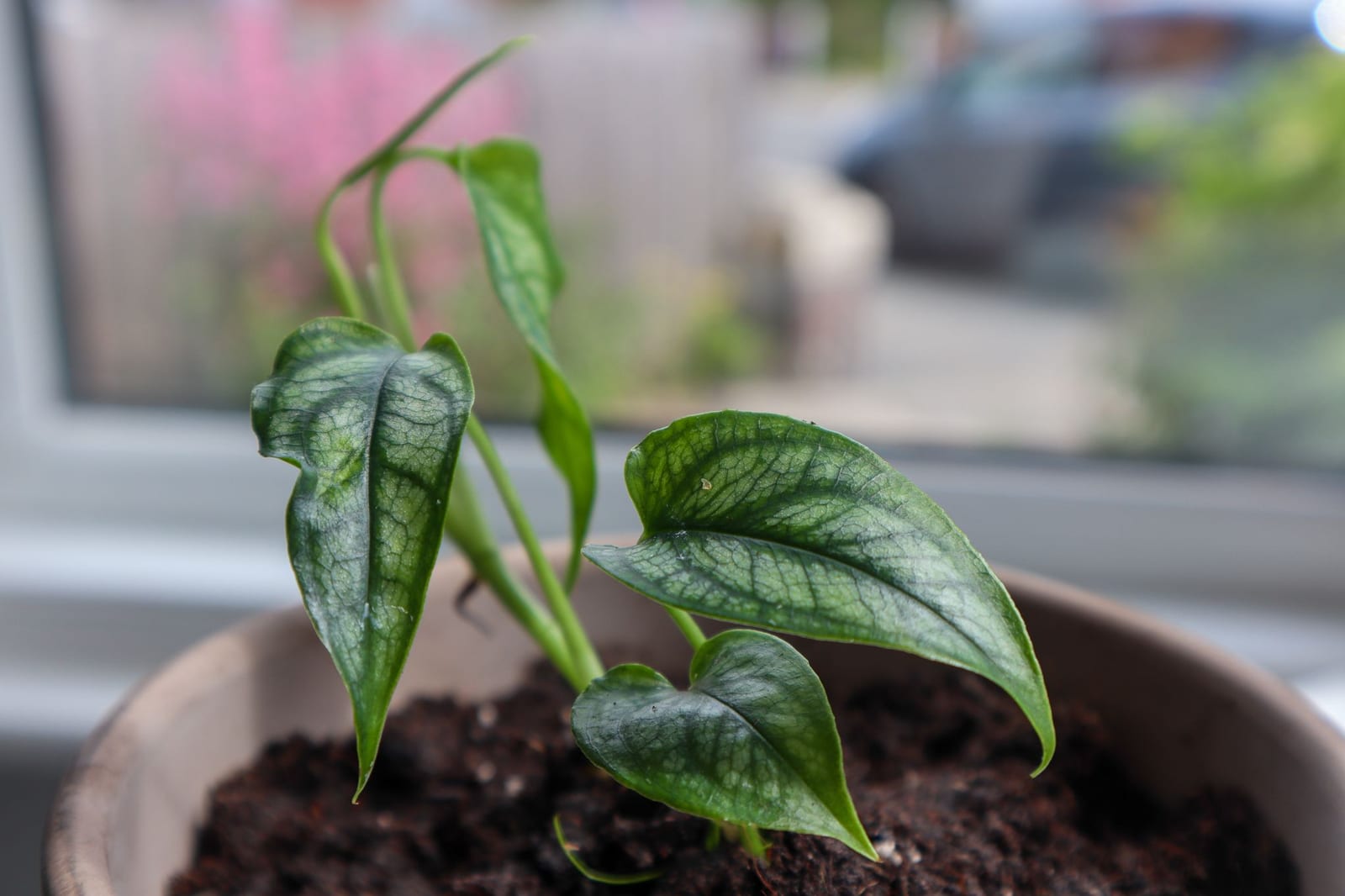
- Botanical name: Monstera siltepecana Matuda, a separate species (Kew). NC State lists a compact cultivar, 'El Salvador'.
- How to recognize it: small, pointed, silvery green leaves with dark veins while young. Once it climbs, new leaves grow bigger, greener and get holes (NC State, RHS). Let it trail and it keeps its silver baby leaves.
- Size indoors: 5 to 8 feet, NC State says.
- Care: one of the easiest. NC State rates it low maintenance and says to water when the top 1 to 2 inches of soil are dry.
- Rarity: uncommon, general guidance. NC State calls it a very popular houseplant, but the RHS lists no UK seller.
- Pets: NC State lists it as toxic to cats, dogs and people.
Monstera standleyana
- Botanical name: Monstera standleyana G.S.Bunting, a separate species (Kew).
- How to recognize it: long, pointed, dark green leaves. Plants sold under this name are often heavily speckled cream, sometimes over half the leaf, with small holes on bigger plants (RHS). Wild plants are plain green and usually have no holes, according to Croat and colleagues.
- Size indoors: small and slow. The RHS gives about 3 to 5 feet (1 to 1.5 m) over 10 to 20 years.
- Care: bright indirect light, moderate to high humidity, and a just-moist mix when growth slows (RHS).
- Rarity: uncommon, general guidance.
- Pets: the RHS lists it as harmful if eaten, and no pet list covers it, so treat it as toxic to cats and dogs.
Monstera dubia
- Botanical name: Monstera dubia (Kunth) Engl. and K.Krause, a separate species (Kew).
- How to recognize it: young plants lay their leaves completely flat against whatever they climb, like shingles on a roof, sometimes mottled and never holed, say Croat and colleagues. The RHS describes silvery green leaves with mosaic-like veins. Mature plants grow larger leaves that can have holes.
- Size indoors: small. The RHS gives about 2 to 3 feet (0.5 to 1 m), reached slowly.
- Care: give it a flat support, such as a board, so the leaves have something to press against. The RHS suggests bright indirect light and moderate to high humidity.
- Rarity: uncommon, general guidance.
- Pets: the RHS lists it as harmful if eaten, and no pet list covers it, so treat it as toxic to cats and dogs.
Monstera pinnatipartita
- Botanical name: Monstera pinnatipartita Schott, a separate species (Kew).
- How to recognize it: mature leaves are deep green, up to about 28 inches (70 cm) long and cut almost to the middle vein into as many as 9 long lobes on each side (RHS).
- Size indoors: large. The RHS gives a climber of 13 to 26 feet (4 to 8 m) at full size, so plan for a tall, sturdy support.
- Care: bright indirect light, moderate to high humidity, water while it grows and keep it just moist when growth slows (RHS).
- Rarity: uncommon, general guidance.
- Pets: the RHS lists it as harmful to pets if eaten.
Monstera subpinnata
- Botanical name: Monstera subpinnata (Schott) Engl., a separate species (Kew).
- How to recognize it: palm-like leaves cut into deep, narrow lobes, according to the RHS, which looks nothing like a Swiss cheese plant at first glance.
- Size indoors: about 5 to 8 feet (1.5 to 2.5 m), the RHS says.
- Care: the RHS calls it quick growing; water freely while it grows, keep it just moist when growth slows, and give it moderate to high humidity.
- Rarity: uncommon, general guidance.
- Pets: the RHS lists it as harmful if eaten, and no pet list covers it, so treat it as toxic to cats and dogs.
How do the types compare?
| Type | Botanical name | Kind | How to recognize it | Care compared with M. deliciosa | How easy to find | Pets |
|---|---|---|---|---|---|---|
| Swiss cheese plant | Monstera deliciosa | Species | Big glossy leaves; splits and holes come with age and good light | The baseline: bright indirect light and a support to climb | Easy to find | Toxic to cats and dogs |
| Thai Constellation | Monstera deliciosa 'Thai Constellation' | Cultivar of M. deliciosa, variegated (stable) | Cream speckles and marbling over the whole leaf, like stars | More light than a green plant; grows a little slower | Rare | Toxic to cats and dogs |
| Albo Variegata | Monstera deliciosa 'Albo Variegata' | Cultivar of M. deliciosa, variegated (can revert) | Bold white blocks and streaks that change from leaf to leaf | More light, slower growth; cut off stems that turn all green | Rare | Toxic to cats and dogs |
| Aurea | Monstera deliciosa 'Aurea' | Cultivar of M. deliciosa, variegated (can revert) | The Albo pattern in yellow; also sold as Marmorata | Like Albo: bright light, patience, trim all-green stems | Rare | Toxic to cats and dogs |
| Monstera adansonii | Monstera adansonii | Species | Smaller, thinner heart-shaped leaves full of oval holes | Grows fast; climbs or trails; keep above 10 °C (50 °F) | Easy to find | Toxic to cats and dogs |
| Monstera obliqua | Monstera obliqua | Species | Very thin leaves; collector forms are more hole than leaf | High humidity, steady moisture and years of patience | Rare | Toxic to cats and dogs |
| Monstera siltepecana | Monstera siltepecana | Species | Silvery young leaves with dark veins; greener with holes once it climbs | Easy; water when the top 1 to 2 inches of soil are dry | Less common | Toxic to cats and dogs |
| Monstera standleyana | Monstera standleyana | Species | Long pointed dark green leaves, often speckled cream in shops | Compact and slow; humid air and a just moist mix in winter | Less common | Not on pet lists; treat as toxic |
| Monstera dubia | Monstera dubia | Species | Young leaves lie flat against their support like shingles | Give it a flat board to climb, plus humid air | Less common | Not on pet lists; treat as toxic |
| Monstera pinnatipartita | Monstera pinnatipartita | Species | Mature leaves cut almost to the midrib into up to 9 lobes a side | A big climber: plan a tall, sturdy support and humid air | Less common | Toxic to cats and dogs |
| Monstera subpinnata | Monstera subpinnata | Species | Palm-like leaves cut into deep, narrow lobes | Grows quickly; water freely in growth, humid air | Less common | Not on pet lists; treat as toxic |
Every value in the table comes from the cards above, and each row links back to its card.
Is Monstera borsigiana a different plant?
Read moreShow less
Kew's Plants of the World Online lists Monstera borsigiana K.Koch, and the variety name M. deliciosa var. borsigiana, as synonyms. The 2024 revision by Croat, Cedeño-Fonseca and Ortiz does the same. The name lives on in shops, mostly in "Albo Borsigiana", which is simply a white-variegated M. deliciosa.
How can I tell Monstera obliqua from Monstera adansonii?
Read moreShow less
The two really do look alike. The National Parks Board Singapore points to leaf thickness, with M. adansonii the thicker of the two. The 2024 revision of Central American monsteras adds that holed forms of M. obliqua can be mistaken for a dry-forest form of M. adansonii, and that M. obliqua is so variable it may turn out to be several species.
That's exactly why mislabeling is easy. No reputable source puts a number on how often it happens in shops. Here's what helps:
- Hold a leaf up to the light. Very thin, almost see-through tissue points to obliqua; firmer leaves point to adansonii.
- Be wary of a cheap "obliqua". The RHS calls the real plant rare and very slow, taking 10 to 20 years to reach full size, so it is rarely sold in quantity.
- Ask the seller where the plant came from and for photos of the exact plant you'll get.
What is Monstera Peru?
Read moreShow less
Kew's checklist treats Monstera karstenianum, the name often printed on "Monstera Peru" labels, as a synonym of Philodendron opacum. The RHS lists "Monstera Peru" and Monstera karstenianum as other names for Epipremnum pinnatum [Marble Planet], a climber with glossy, textured leaves and deeply sunken veins. The two references disagree on what the plant is, and a name record can't tell you what a particular shop plant is anyway.
So we left it out of the type cards. If you have one, it is a pretty climber either way; the RHS suggests bright, filtered light and letting the mix almost dry between waterings, and it lists the plant as harmful if eaten.
Why are some monsteras so rare and expensive?
Read moreShow less
Several things stack up:
- Slow plants: white and yellow tissue makes less food, so variegated plants grow more slowly (Minnesota Extension), and the RHS says 'Thai Constellation' grows a little slower than the green species.
- Slow propagation: every new plant needs a stem piece with a node (see how to propagate a monstera). A 2025 review in Technology in Horticulture notes that air layering, a common way to propagate monsteras, works well but is slow.
- Unstable variegation: an Albo cutting may lose its white, so growers can't count on every piece (Florida and Minnesota Extension).
- Tissue culture: labs can grow many identical plants from a few buds. University of Florida IFAS Extension says more than half of tropical foliage crops are now grown this way, and that starting a new variety in the lab is the most costly step. Shoots grown from buds come out true to type, while shoots grown from other tissue can come out different. That's why a stable type like 'Thai Constellation' became easier to produce, while unstable types stay scarce.
- Demand: the 2025 review links high prices to limited supply, high demand and unusual variegation, and the RHS says variegated forms are less widely sold and more expensive.
We don't quote prices here, because they change constantly and vary by seller and size.
How do I buy a rare monstera without getting scammed?
Read moreShow less
Rare plants attract shortcuts. A few habits keep you safe:
- Skip variegated seeds. Minnesota Extension says variegation comes from mutations that seeds don't pass on, so seedlings come up green.
- Check the botanical name. Ask for the full name with the cultivar in quotes, like Monstera deliciosa 'Thai Constellation'. Vague labels like "rare monstera" or "Monstera Peru" tell you little.
- See the actual plant. Ask for photos of the exact plant or cutting, including the node and, for variegated types, the newest leaf. A cutting with no node can't grow (see propagation).
- Watch for look-alikes. Obliqua and adansonii get confused, and trade names like 'Mint' circulate with no reputable description yet, so we left 'Mint' off this page.
- Choose nursery-grown plants. Buy from growers who propagate their own stock or use lab-grown plants. Wild monsteras belong in their forests.
Once your new plant is home, the soil guide and moss pole guide help it settle in.
Are all monstera types toxic to cats and dogs?
Read moreShow less
The ASPCA lists M. deliciosa, including every cultivar, as toxic to cats and dogs, because its insoluble calcium oxalates irritate the mouth and can cause drooling, vomiting and trouble swallowing. NC State lists M. adansonii and M. siltepecana as toxic to pets, and the RHS lists M. obliqua, M. pinnatipartita and the variegated deliciosa forms as harmful to pets. For M. standleyana, M. dubia and M. subpinnata, the RHS lists them as harmful if eaten and no pet list covers them.
The RHS suggests gloves when handling monsteras, since the sap can irritate skin, and keeping them away from pets and children. A high shelf, a hanging basket or a room your pets don't visit works well. If your pet chewed one and seems unwell, call your vet.
Sources
- Monstera species records : Plants of the World Online and World Checklist of Vascular Plants, Royal Botanic Gardens, Kew (checked 2026-11-08)
- Revision of Monstera (Araceae: Monsteroideae) of Central America : Croat, Cedeño-Fonseca and Ortiz, Phytotaxa 656 (2024)
- Monstera deliciosa, Monstera adansonii and Monstera siltepecana : North Carolina State Extension Gardener Plant Toolbox
- How to grow Swiss cheese plants and plant pages for M. deliciosa 'Thai Constellation', M. adansonii, M. obliqua, M. standleyana, M. dubia, M. siltepecana, M. pinnatipartita, M. subpinnata and Epipremnum pinnatum Marble Planet : Royal Horticultural Society
- Monstera deliciosa : University of Minnesota Extension
- Swiss-Cheese Plant, Monstera deliciosa : University of Wisconsin-Madison Extension
- Monstera Growing in the Florida Home Landscape and Commercial Production of Ornamental Tropical Foliage Plants: Micropropagation : University of Florida IFAS Extension
- Genetic selection: chimeras : PropG, University of Florida, University of Kentucky and Texas A&M
- Monstera obliqua : National Parks Board Singapore, Flora and Fauna Web
- Micropropagation and Acclimatization of Monstera deliciosa 'Thai Constellation' : Jing, Beleski and Vendrame, Horticulturae 10 (2024)
- Exploring the diversity, propagation, impacts, and market dynamics of houseplants : Oboni and Hossain, Technology in Horticulture 5 (2025)
- US Plant Patent PP37613 : United States Patent and Trademark Office (2026)
- Swiss Cheese Plant : American Society for the Prevention of Cruelty to Animals