Monstera in water: what the experts say, and what growers try
A monstera cutting roots in a jar of water without much fuss, and plenty of growers keep one there for months or even years. No extension service or botanical garden we checked recommends that for the long run, so here is what they do say, what growers report, and how to give a jar-grown monstera its best shot.
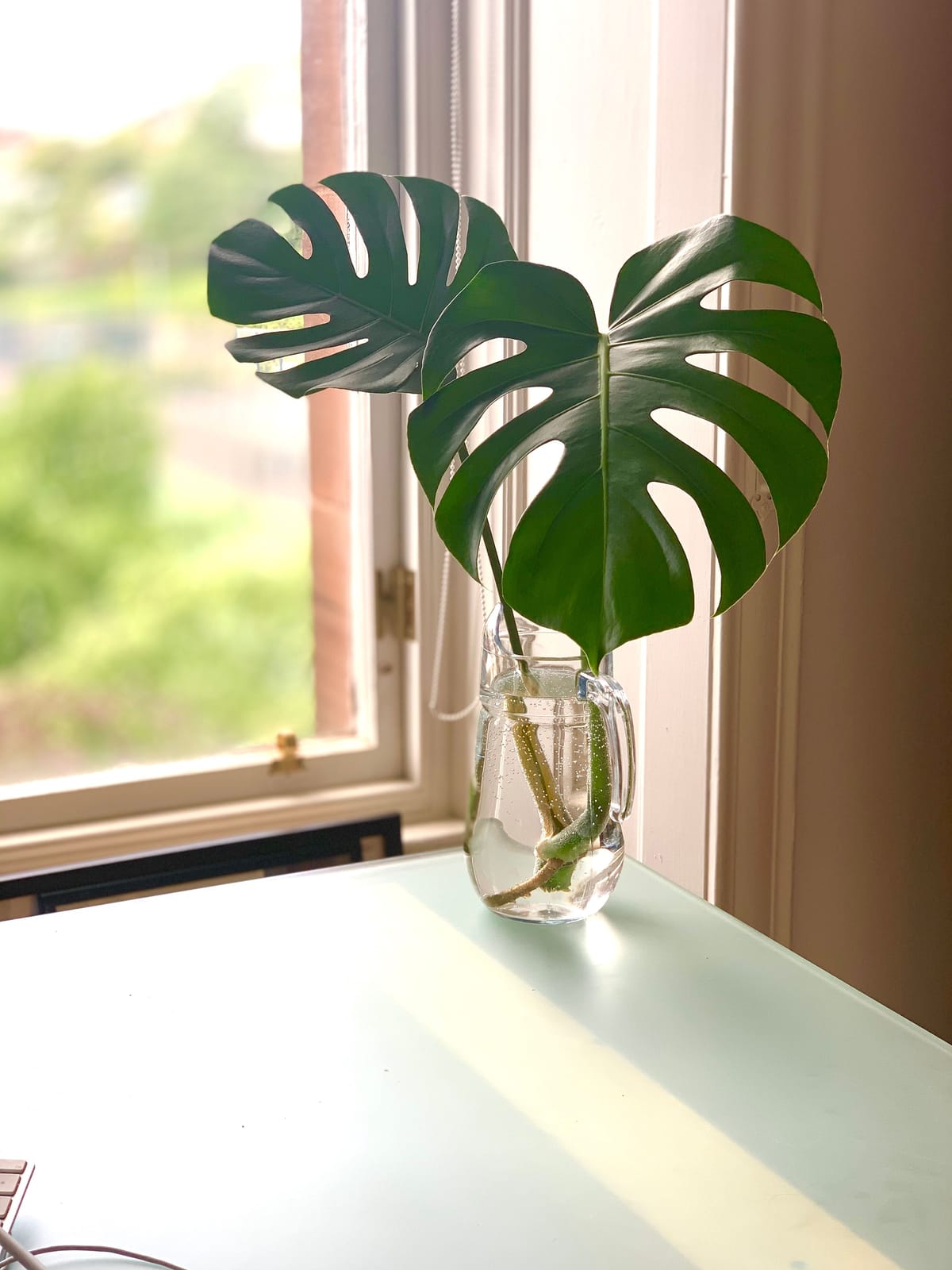
Can a monstera live in water for good?
Read moreShow less
What the trusted sources say. We checked University of Minnesota, Illinois, Iowa State, Maryland, Vermont, Montana State, UW-Madison, Penn State, UConn and NC State Extension, plus the RHS, the New York Botanical Garden and Brooklyn Botanic Garden. Every one that mentions water uses it for rooting cuttings, then potting them up. University of Illinois Extension goes further and doesn't recommend rooting in water at all, because water roots are often weak and adjust to potting mix less easily. Search results from University of Minnesota Extension say a monstera cutting with a node roots in plain water, and that those roots are weaker than roots grown in a solid medium. If you still need a cutting, our monstera propagation guide shows where to cut.
What growers report. Online, the picture looks different. These are personal stories, so treat them as what people say happened to them:
- The YouTube channel Everything Plants shows a large monstera it says has grown only in water for over two years (October 2025). At 1:54 it lifts the plant out of its glass jug of water, roots and all.
- A German grower on YouTube gives an update on a monstera grown in water culture for about three years (June 2024). At 0:31 you can see its glass container of clay pebbles, where she says a third of the roots always sit in water. That setup is water culture with clay pebbles, which works differently from a plain jar of water; our semi-hydroponics guide explains how, so you can compare the two.
- A reader comment on the Old Farmer's Almanac monstera page (December 2023) describes a monstera that spent at least ten years in water, stayed small, then grew large within a few years of moving to soil.
These videos are from independent creators. Grove has no connection to them or the products they link.
So a monstera can clearly hang on in water for a long time. Whether it thrives there is the open question. UW-Madison Extension says a monstera needs a fertile mix and plenty of root room to make bigger leaves, plus a damp support to climb, and a jar offers none of those. If you'd like to keep it out of soil for good, a pot of clay pebbles is another route; our semi-hydroponics guide explains it.
If you want to try keeping it in water, how do you do it?
- Choose a clean, heavy container with a wide base, and pick an opaque or tinted one if you can, since keeping the roots dark slows algae.
- Fill it with room-temperature water.
- Set the cutting so the node and roots sit under the water while the leaves and most of the stem stay above it.
- Place it in bright, indirect light, out of hot direct sun on the glass.
- Change the water once or twice a week, and sooner if it turns cloudy or smells off.
- Rinse the container each time you change the water, and rinse the roots gently under room-temperature water.
- Once the plant is living in water for the long haul, feed it with a hydroponic fertilizer at the label's dilution, and replace all of the water about every two weeks instead of topping it up.
Here's where each step comes from. Montana State University Extension suggests an opaque jar so the roots stay dark, and University of New Hampshire Extension explains that algae thrive on light, moisture and fertilizer. A clear jar is fine too; you'll just see more green. University of Maryland Extension calls for a clean container and changing the water at least twice a week or when it looks cloudy, because fresh water carries oxygen and stale water breeds the bacteria that cause rot. Iowa State University Extension gives once or twice a week. University of Vermont Extension and Maryland both say to use room-temperature water and keep every leaf out of it. The light is the same as on the monstera care card. Rinsing the roots and changing water that smells off come from growers' experience; we found no trusted source that covers them.
The heavy container matters more for a monstera than for most cuttings. Its big leaves make it top heavy, and an expert answering a monstera question for University of Maryland Extension notes a cutting may need anchoring until its roots can hold it upright. A soft tie to a small stake works.
Should I feed a monstera growing in water?
Read moreShow less
Montana State University Extension says to skip fertilizer while a cutting roots, since it runs on the carbohydrates stored in its stem. After that, the jar is the plant's only pantry. In hydroponics, the RHS explains, every nutrient the plant needs is dissolved in the water, from nitrogen, phosphorus and potassium down to small trace elements, which is why a fertilizer labeled for hydroponics fits better than a standard soil feed.
Replace the solution rather than topping it up. As roots drink, the RHS says, the solution gets more concentrated and can turn salty enough to damage roots, so it suggests pouring it out and mixing fresh about every two weeks. That matters for monstera in particular, because UConn's Home and Garden Education Center says it burns easily from high salts.
We found no trusted source with a feeding dose for a monstera in water, so stick to the label and lean light. The doses you'll see for potted monsteras are soil doses: NYBG suggests half-strength houseplant fertilizer every two to four weeks in the growing season. Feed only while it's putting out new leaves. And expect some green in the jar: University of Maryland Extension notes that fertilizer in water feeds algae too.
Why do monstera roots rot in water, and what are the signs?
Read moreShow less
Roots breathe. The RHS says all plant roots need oxygen and that the roots of most plants die in stagnant water, and University of New Hampshire Extension explains that water-grown systems must supply oxygen to the root zone. Fresh water brings oxygen; water left sitting loses it and grows bacteria, which is why University of Maryland Extension ties regular water changes to preventing rot. Search results from University of Minnesota Extension add that bacteria multiply quickly in warm, nutrient-rich water, and the Maryland expert says whether roots stay healthy in water depends partly on the water temperature. So the jar itself is fine; old, warm water is the problem.
Roots that grow in water are built differently. Iowa State calls them coarser, and Illinois calls them weak and slow to adjust to soil. Growers report they also look thicker and more brittle than soil roots.
Signs to watch for:
- Brown or black, soft, mushy roots that pull apart easily. UConn describes rotted monstera roots this way; healthy ones are firm and pale.
- A brown, mushy cut end. The Maryland expert calls this common, a sign the stem is decaying from constant wetness, and notes the roots can look fine meanwhile.
- Cloudy water. Maryland Extension treats it as the cue to change the water.
- A bad smell. Growers report a sour or rotten smell when roots are rotting; we found no trusted source that covers it.
- Yellowing leaves. No trusted source studied monstera in water, so this is growers' experience and what's known for potted plants: NYBG says losing an old leaf now and then is normal, and that many yellow leaves usually mean too much water or too little food. Brooklyn Botanic Garden adds that yellow leaves with green veins point to a nutrient shortage.
What to do: cut away the soft, dark roots and any mushy stem with clean shears, rinse the jar, and start over in fresh, room-temperature water. If roots keep rotting, the Maryland expert's advice is to root the next cutting in soil, or move this one into a pot as soon as it has healthy roots. Our root rot guide and yellow leaves guide go deeper.
How do I move a monstera from water to soil?
Read moreShow less
The general water propagation guide covers root length and why any cutting can droop after the move. For a monstera:
- Pot: one cutting per pot to start, as the Maryland expert suggests, in a pot just big enough for the roots, with a drainage hole. UConn says monsteras handle a snug pot much better than an oversized one.
- Mix: airy, well-draining and rich in organic matter, as UConn and Penn State Extension recommend. Our monstera soil guide explains what goes in it.
- Depth: the node and roots under the mix, no more than about 2 to 3 inches (5 to 7.5 cm) below the first leaf node, with the growing tip above the surface, since UConn says buried tips rot.
- Support: a small stake or moss pole tied on loosely, because the cutting stays top heavy until roots take hold.
- First weeks: water until it drains, empty the saucer, and keep it in bright, indirect light. Minnesota Extension's monstera advice, as shown in search results, is to keep the mix moist for the first one to two weeks and then let the top dry, and Iowa State says a newly potted cutting should settle in within a few weeks.
Water roots are used to being wet all the time, and Illinois Extension says they adapt to potting mix less easily, so a wilted or dropped leaf in the first weeks is normal.
Is a monstera in a jar safe around pets?
Monstera holds calcium oxalate crystals that make a chewing pet's mouth burn, with drooling, vomiting and trouble swallowing, per the ASPCA. NC State Extension rates the severity as low. The sap can also irritate skin, so rinse your hands after handling a cut stem or its roots. A heavy jar on a high shelf also survives a curious cat. If you think a pet chewed some, call your vet or the ASPCA Animal Poison Control Center at (888) 426-4435. The monstera care card has the full safety notes.
Sources
- Propagating Monstera deliciosa : University of Minnesota Extension (seen in search results; the page blocks automated access)
- Houseplants: Propagation : University of Illinois Extension
- How to Propagate Houseplants by Stem Tip Cuttings : Iowa State University Extension and Outreach (last reviewed January 2025)
- Propagating a monstera (Ask Extension) : University of Maryland Extension, Home and Garden Information Center (June 2024)
- Make More Plants From Cuttings: 5 Plants That Root Easily in Water : University of Maryland Extension, Maryland Grows (updated April 2021)
- More, Please: Propagating Houseplants : University of Vermont Extension (December 2022)
- Cloning at Home : Montana State University Extension (Winter 2026)
- Hydroponics : Royal Horticultural Society
- Hydroponics at Home : University of New Hampshire Extension (August 2023)
- Swiss-Cheese Plant, Monstera deliciosa : UW-Madison Extension (revised October 2026)
- Monstera as a Houseplant : Penn State Extension (December 2024)
- Monstera deliciosa : UConn Home and Garden Education Center
- Monstera : New York Botanical Garden
- What's Wrong with My Monstera? : Brooklyn Botanic Garden (May 2021)
- Monstera deliciosa : NC State Extension Gardener Plant Toolbox
- Swiss Cheese Plant : ASPCA Animal Poison Control
Growers' reports (personal experience, cited only as what people report):
- This monstera is the fastest growing plant I have : Everything Plants, YouTube (October 2025)
- Meine Monstera deliciosa: Update nach ca. 3 Jahren : Busruna Vitae, YouTube (June 2024)
- How to Care for Monsteras, reader comments : The Old Farmer's Almanac (comment dated December 2023)