How to propagate a philodendron from cuttings
To propagate a climbing philodendron, cut a 3 to 6 inch (8 to 15 cm) piece of stem just below a node, the joint where a leaf meets the stem, strip the lowest leaves, and root it in water, perlite or a light potting mix. Roots usually show in about 10 days to 6 weeks. Every method our sources describe starts from a node, so a leaf or a bare piece of stem without one won't become a plant.
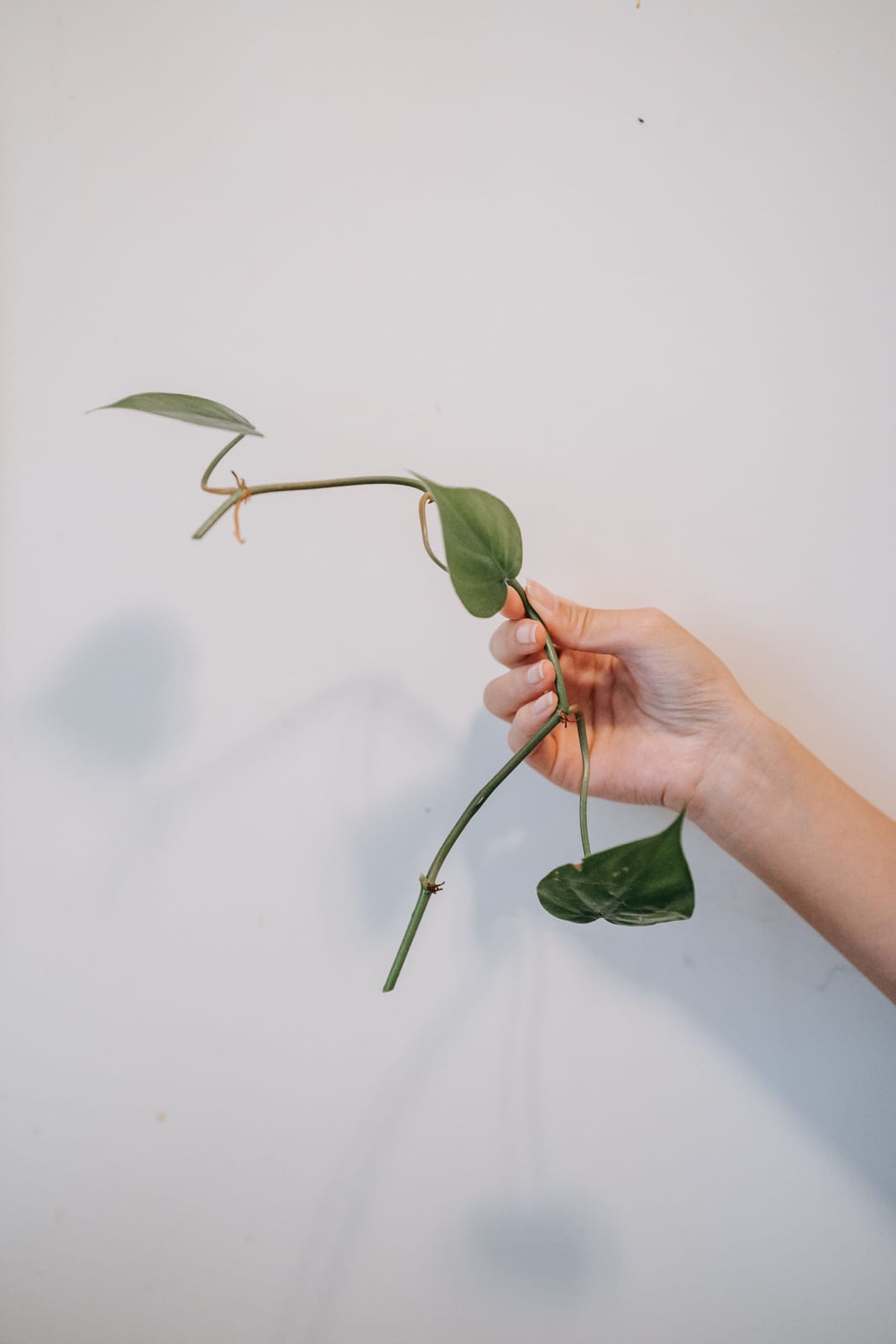
What is a node, and why does a philodendron cutting need one?
Read moreShow less
The NC State Extension Gardener Handbook explains that each node on a stem has a bud tucked where the leaf stalk joins it, and that bud is what grows into the new plant. That's why it says each node can be treated as its own cutting. On a philodendron, nodes are easy to spot: look for the slight bumps along the stem, often with a short brown aerial root or a dry, papery sheath beside them.
How many nodes? Iowa State University Extension says cuttings should have at least two, with at least one in the rooting medium. Commercial growers go smaller: UF/IFAS Extension says heartleaf philodendron is normally propagated from 1 to 1½ inch (2.5 to 4 cm) stem pieces with a single node and an attached leaf. One node works. Two give you a spare.
Can I propagate a philodendron from a leaf or without a node?
Read moreShow less
People search "philodendron propagation from leaf" and "without node" a lot, so here is exactly what the sources say.
- A leaf alone: NC State's handbook says leaf cuttings only work for plants that can grow new buds from a leaf, like African violet or snake plant, and that most other plants grow a few roots or simply rot. Philodendron isn't on its list of plants that grow from a leaf, and none of our sources describe a philodendron leaf growing into a plant.
- A leaf-bud cutting: this is the "leaf" method that does work. NC State lists heartleaf philodendron among plants propagated from leaf-bud cuttings: a leaf, its stalk and a short piece of stem with the bud, set in the mix with the bud covered by up to 1 inch (2.5 cm) and the leaf above. The RHS also lists leaf-bud cuttings for heartleaf.
- A piece of stem with no node: no source we found describes one rooting or growing. Every method ties new growth to the bud at a node, so if your cutting has none, take a new one that does.
Where should I cut a philodendron to propagate it?
The sources agree on cutting just below a node and differ a little on length:
| Advice | Source |
|---|---|
| Cut a piece about 4 inches (10 cm) long, just below a leaf joint, and strip the lower leaves | RHS |
| Take 3 to 4 inches (8 to 10 cm) from the tip, cutting below a node, and strip the lower leaves to expose at least two nodes | University of Nevada, Reno Extension |
| Use stem sections 3 to 6 inches (8 to 15 cm) long with the lower leaves removed | Iowa State |
| For tree philodendron, take a 3 to 4 inch (8 to 10 cm) tip from a low, vigorous stem, cut just below a node with a clean tool | New York Botanical Garden |
Use sharp, clean pruners or a knife. Illinois Extension suggests dipping them in alcohol before and between cuts.
Should I root it in water, soil, perlite or sphagnum moss?
| Method | What the sources say | Source |
|---|---|---|
| Water | Roots in water; change the water often and pot up once roots are several inches long. RHS says it should root within a couple of weeks | Iowa State; RHS; University of Nevada, Reno Extension |
| Perlite | Good drainage and support; rooting hormone can speed rooting in perlite | Iowa State |
| Potting mix | Iowa State's philodendron page suggests well-drained potting soil; its cuttings page says to use soil only as part of a lighter mix. Nevada roots stem cuttings in potting soil under a plastic bag | Iowa State; University of Nevada, Reno Extension |
| Peat and perlite | Used for tree philodendron cuttings, covered with a clear bag | New York Botanical Garden |
| Sphagnum moss | Coarse sphagnum holds water and stays airy, and is hard to rewet once it dries out. Listed for houseplant cuttings in general, with nothing specific to philodendrons | Iowa State (single source) |
| Leaf-bud cutting | One node with its leaf, bud covered in the mix | NC State; RHS |
| Layering | Pin a long stem against the soil until the nodes root, then cut it free. NC State names heartleaf philodendron for this | NC State; University of Nevada, Reno Extension |
| Air layering | Roots a stem while it stays on the plant; useful for a leggy plant | Clemson; UConn; RHS; Illinois |
Water has a catch. Illinois Extension says roots that grow in water are often weak and don't adapt as easily to potting mix, and Iowa State says they're coarser and the cutting may struggle after potting. Iowa State still lists water as fine for trailing philodendrons, so it's a trade: easy to watch now, a little more care later. Our water propagation guide covers that move to soil in detail.
Air layering works the same way on a philodendron as on its cousin, the monstera. Our monstera guide's air layering steps walk through it.
How do I root a philodendron cutting, step by step?
- Wipe a sharp knife or pruners with alcohol so you don't carry disease into the fresh cut.
- Choose a healthy stem tip and cut a piece 3 to 6 inches (8 to 15 cm) long, just below a node.
- Strip the lowest leaves so one or two nodes are bare, and keep a couple of leaves at the top.
- For water: stand the cutting in a glass of clean water with the bare nodes under and the leaves above, and change the water every few days.
- For a medium: fill a small pot with moist perlite or a light potting mix, make a hole, and set the cutting in with at least one node buried and no leaves under the surface. Dust the node with rooting hormone first if you like.
- Cover a potted cutting loosely with a clear plastic bag, propped so it doesn't touch the leaves, to hold in humidity.
- Keep it in bright, indirect light, about 4 to 6 hours a day, and warm air of 65 to 75°F (18 to 24°C).
- When roots are about 1 inch (2.5 cm) long, or several inches long in water, pot the cutting into regular potting mix.
The steps come from Iowa State's two pages on philodendron and stem cuttings (length, nodes, medium, bag, light, warmth, potting up), the RHS and Nevada Extension on where to cut and stripping leaves, Nevada Extension on changing water every 2 to 3 days, and Illinois Extension on cleaning tools. Iowa State warns that too much sun can burn a cutting under a bag, and a heat mat warming the mix to 75 to 80°F (24 to 27°C) helps.
How long does a philodendron cutting take to root?
| What happens | How long | Source |
|---|---|---|
| Roots start in water | About 10 days | University of Nevada, Reno Extension |
| Climbing philodendron roots in water | Within a couple of weeks | RHS |
| Most houseplant stem cuttings root | 3 to 6 weeks | Iowa State |
| Commercial heartleaf cuttings: bud breaks, then roots | Buds in 3 to 5 weeks, roots in 4 to 6 weeks | UF/IFAS |
| Tree philodendron tip cutting roots | About 4 weeks | New York Botanical Garden |
A cutting that looks the same for weeks is often still working underground. As long as the stem stays firm and green, give it time.
When is the best time to propagate a philodendron?
Read moreShow less
Clemson Extension says philodendrons can be propagated in any season, from stem cuttings or by air layering. The RHS suggests spring to late summer for stem cuttings of climbing and trailing types, and Nevada Extension says the right time for houseplants is when they're in full growth. Where it's warm all year, watch for new leaves rather than the calendar. NYBG suggests early summer for tree philodendron tips.
How do I propagate a self-heading philodendron?
Read moreShow less
Self-heading types like 'Birkin', 'Xanadu' and 'Rojo Congo' have short, crowded stems, so the climbing-type method doesn't apply as neatly. Iowa State gives two home options: gently separate offsets from the parent and pot them up, or root stem sections with at least two nodes in water or perlite. It says pieces with aerial roots root more reliably, and rooting hormone speeds things up. Clemson also notes that some philodendrons produce offsets.
For the big tree philodendron, NYBG says seed is the usual method, and a whole leafy top is probably too big for new roots to support. A 3 to 4 inch tip from a low, vigorous stem has a better chance.
UF/IFAS adds a reality check: commercially, most named self-heading hybrids are propagated by tissue culture, a lab method, and seed of tree philodendron needs special equipment. None of our sources gives home steps specific to 'Birkin' or 'Xanadu' beyond Iowa State's offsets and stem cuttings, so try those first.
Why is my philodendron cutting rotting or not rooting?
| What you see | Likely cause | What to try | Source |
|---|---|---|---|
| A leaf in water that never roots | No node | Take a new cutting with a node | NC State |
| Cloudy water around the stem | Water not changed often enough | Change it every 2 to 3 days, or 1 to 2 times a week | University of Nevada, Reno Extension; Iowa State |
| Rotting at the soil line | Leaves buried, or a mix that stays too wet | Keep leaves above the surface; use perlite or a lighter mix | Iowa State |
| No roots after several weeks | Too cool or too dark | Warm it to 65 to 75°F (18 to 24°C) with bright, indirect light | Iowa State |
| Scorched leaves under the bag | Too much sun | Move it out of direct sun | Iowa State |
| Wilting after moving from water to soil | Water roots adjusting | Keep the mix evenly moist for a few weeks | Iowa State; University of Nevada, Reno Extension; Illinois |
If a potted plant's base goes soft, our root rot guide walks through what to check.
Is it safe to take philodendron cuttings around pets and kids?
The ASPCA lists heartleaf philodendron as toxic to cats, dogs and horses. Its insoluble calcium oxalate crystals cause mouth pain and swelling, drooling, vomiting and trouble swallowing if chewed. Clemson says all parts are toxic if eaten. The RHS says philodendron sap can irritate skin and suggests gloves, and NC State lists contact dermatitis. A cutting in a low glass is easy for a cat to reach, so give it a high shelf.
Our philodendron care card has the full safety details. If you think a pet chewed some, call your vet or the ASPCA Animal Poison Control Center at (888) 426-4435 (a fee may apply).
Sources
- Chapter 13: Propagation : NC State Extension Gardener Handbook
- How to Propagate Houseplants by Stem Tip Cuttings : Iowa State University Extension and Outreach (Aaron Steil; last reviewed January 2025)
- How do I propagate philodendron? : Iowa State University Extension and Outreach (Aaron Steil; updated March 2024)
- Growing Philodendrons at Home : Iowa State University Extension and Outreach (last reviewed January 2025)
- Cultural Guidelines for Commercial Production of Interiorscape Philodendron (ENH893) : UF/IFAS Extension (reviewed October 2024)
- How to grow philodendrons : Royal Horticultural Society
- Philodendron hederaceum var. hederaceum : Royal Horticultural Society
- Philodendron (HGIC 1509) : Clemson Cooperative Extension (revised January 2016)
- Philodendron : UConn Home & Garden Education Center
- Propagation : University of Illinois Extension
- La propagación de las plantas de interior (Página de Información 99-60) : University of Nevada, Reno Extension (in Spanish)
- Tree philodendron question : New York Botanical Garden, Plant Information (updated November 2026)
- Philodendron hederaceum : NC State Extension Gardener Plant Toolbox
- Heartleaf Philodendron : ASPCA Animal Poison Control