Philodendron types: climbers, self-headers and how to tell them apart
Philodendrons come in two shapes. Climbing kinds, like heartleaf and its cultivars, send out vines that cling with aerial roots. Self-heading kinds, like the tree philodendron and 'Birkin', grow upright from a short stem. Learn which shape you have, then the leaf, and the name usually follows.
How many types of philodendron are there?
Read moreShow less
The Royal Botanic Gardens, Kew, keeps the World Checklist of Vascular Plants, and its 2026 data release counts 630 accepted Philodendron species. They grow wild from Mexico and the Caribbean to tropical South America. Colombia alone has about 240 native species, more than any other country, followed by Brazil and Ecuador.
Shops sell a small slice of that. University of Florida IFAS Extension notes that philodendrons have been indoor plants since the 1880s, with leaves that range from small hearts to lobed giants more than 4 feet long, and newer cultivars colored anywhere from red-black to light orange.
For care that every philodendron shares, see the philodendron care card.
What is the difference between climbing and self-heading philodendrons?
Read moreShow less
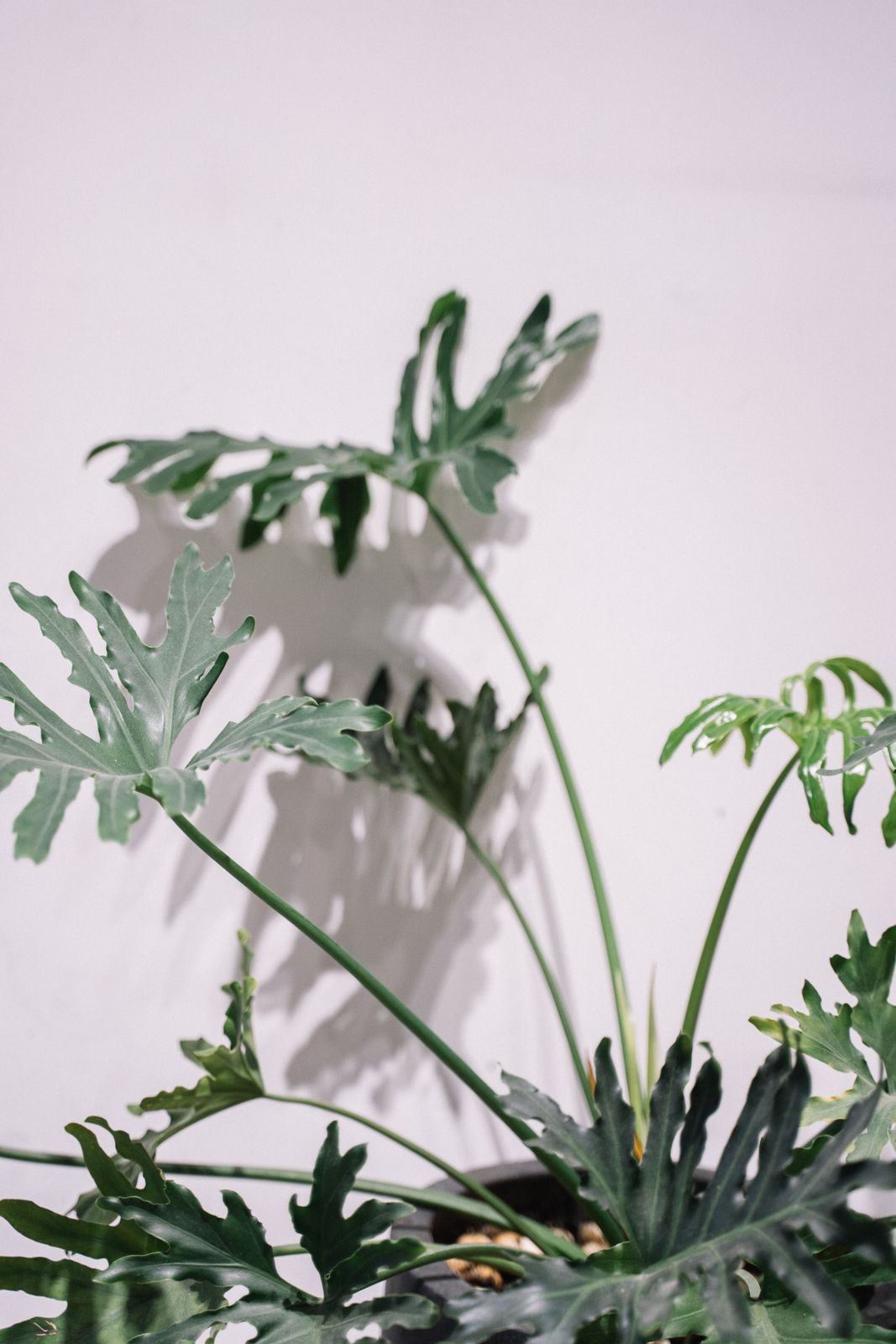
NC State sorts the houseplants into these two groups. Climbing kinds, such as heartleaf (Philodendron hederaceum) and red-leaf philodendron (Philodendron erubescens), hold onto poles or trellises with their aerial roots. Self-heading kinds, such as the tree philodendron and hybrids like 'Birkin' and 'Moonlight', have very short stems and a rosette of large leaves.
Clemson Cooperative Extension adds what that means at home. A climber's height depends on its support and how you prune it. A self-header grows from a dense clump at the base, can get very large and has brittle leaf stalks, so keep it out of busy walkways. Iowa State University Extension warns that some self-heading kinds end up twice as wide as they are tall. UF/IFAS also splits off a third group, the woody, tree-like kinds.
The climbing and support guide covers poles, trellises and baskets.
Which philodendron types will I meet?
Read moreShow less
Heartleaf philodendron (Philodendron hederaceum)
- Habit: climbing or trailing vine.
- How to recognize it: glossy, heart-shaped leaves about 3 to 6 inches long on smooth leaf stalks, and new leaves that come out bronze and turn green quickly, according to the NC State heartleaf page.
- Good to know: UF/IFAS calls it the most common vining philodendron, and Clemson says it tolerates very low light. Older names on labels include Philodendron scandens and Philodendron oxycardium.
- Care card: heartleaf philodendron.
'Brasil'
- Habit: climbing or trailing vine, a cultivar of heartleaf (NC State, Iowa State).
- How to recognize it: heartleaf leaves with a yellow band down the middle of each one, as the UConn Home and Garden Education Center describes it.
- Care card: Philodendron 'Brasil'.
'Lemon Lime'
- Habit: depends on the plant, because two plants share this name.
- How to recognize it: NC State lists 'Lemon Lime' as a heartleaf cultivar with bright yellow to chartreuse leaves. A 2010 US plant patent also names an upright 'Lemon Lime' that came from Philodendron domesticum, with lime-green to golden yellow leaves. A vining 'Lemon Lime' with heart-shaped leaves is the heartleaf one.
- Care card: Philodendron 'Lemon Lime'.
'Micans' (velvet philodendron)
- Habit: small trailing or climbing vine.
- How to recognize it: velvety green leaves with dark copper undersides, according to UF/IFAS, which classes it as a young form of heartleaf that takes less stress than the common one. NC State lists Philodendron micans as a former name of Philodendron hederaceum.
- Care card: Philodendron 'Micans'. The velvet philodendron guide explains which other plants get called velvet philodendron.
Pink Princess (Philodendron erubescens 'Pink Princess')
- Habit: climber.
- How to recognize it: Iowa State lists 'Pink Princess' as a cultivar of red-leaf philodendron, and NC State describes that species as a climber with glossy, heart-shaped leaves tinted red underneath and reddish purple stems. Kew lists Philodendron erubescens as native to Colombia.
- Care card: Pink Princess philodendron.
'Rojo Congo' and the red self-heading hybrids
- Habit: self-heading.
- How to recognize them: UConn groups 'Rojo Congo' with 'Imperial Red', 'Prince of Orange' and 'Autumn' as reddish selections grown in labs. UF/IFAS describes 'Imperial Red' with deep red leaves, 'Black Cardinal' with dark reddish black leaves and 'Prince of Orange' with orange young leaves that need bright light to keep their color, which Clemson confirms.
- Care card: Philodendron 'Rojo Congo'.
'Birkin' and 'Moonlight'
- Habit: compact self-heading hybrids (NC State, Iowa State).
- How to recognize them: 'Birkin' has dark green leaves with creamy white pinstripes, says NC State. 'Moonlight' has light, almost neon green elliptical leaves, UF/IFAS says, which soften to a calmer green with age (NC State).
- Care card: Philodendron 'Birkin'. 'Moonlight' has no card yet; the philodendron care card covers it.
Tree philodendron (Philodendron bipinnatifidum, sold as selloum)
- Habit: self-heading, with a woody stem in time.
- How to recognize it: big, deeply cut leaves, up to about 3 feet long (NC State) or 4 feet (UF/IFAS). NC State gives 12 to 15 feet outdoors.
- Names: Kew accepts Philodendron bipinnatifidum and lists Philodendron selloum and Thaumatophyllum bipinnatifidum as other names for it. Native from eastern Bolivia to southern Brazil and northeastern Argentina.
- Care card: Philodendron selloum (tree philodendron).
Xanadu (Philodendron xanadu)
- Habit: self-heading, a dense, low plant about 2 to 3 feet tall (NC State, UConn).
- How to recognize it: deeply lobed, glossy leaves, like a small tree philodendron, says UF/IFAS. NC State says it takes full or part sun outdoors.
- Names: UF/IFAS called it a patented hybrid from Australia in 2003. Kew now accepts it as a species from southern Brazil to Paraguay, described in 2002, with Thaumatophyllum xanadu as a synonym.
- Care card: Philodendron Xanadu.
Fiddle-leaf philodendron (Philodendron bipennifolium)
- Habit: thick-stemmed climber (UF/IFAS, Clemson, Iowa State).
- How to recognize it: olive green leaves shaped like a fiddle, up to about 1 foot long, often grown on a totem pole (UF/IFAS). Kew treats Philodendron panduriforme as a separate species. It's a different plant from the fiddle-leaf fig.
- Care card: fiddle-leaf philodendron.
Silver sword (Philodendron hastatum)
- Habit: climber.
- How to recognize it: silvery blue to silvery green, sword-shaped leaves, according to NC State. Kew lists it as native to southeastern Brazil.
- Care card: none yet; use the philodendron care card.
Velvet-leaf species: black-gold, verrucosum and gloriosum
- Habit: climbers, per Kew's records.
- How to recognize them: black-gold or velour philodendron (Philodendron melanochrysum) has velvety, heart-shaped leaves up to 3 feet long, blackish green with pale veins, and Clemson says they reach full size only after years trained upright. NC State describes Philodendron verrucosum with velvety leaves, light green veins and burgundy undersides. Philodendron gloriosum, from Colombia, is sold to collectors, and no extension service covers its care.
- Care card: the philodendron care card covers all three.
Burle Marx and Philodendron tortum
- Habit: climbers.
- How to recognize them: the Royal Horticultural Society (RHS) describes Philodendron burle-marxii as a compact climber, about 4 feet (1.2 m), from Colombia, Ecuador and northern Brazil. Philodendron tortum is a climbing species from northern Brazil to Bolivia that Kew records as described in 2001; the RHS notes it is sometimes sold as Philodendron bipinnatifidum 'Tortum'.
- Care card: the philodendron care card covers both.
How do the types compare?
| Type | Botanical name | Habit | Leaves | Care card |
|---|---|---|---|---|
| Heartleaf | Philodendron hederaceum | Climbing or trailing | Glossy hearts, 3 to 6 in | Heartleaf |
| 'Brasil' | P. hederaceum 'Brasil' | Climbing or trailing | Hearts with a yellow center band | 'Brasil' |
| 'Lemon Lime' | P. hederaceum 'Lemon Lime' (also an upright plant) | Climbing, or upright | Yellow to chartreuse | 'Lemon Lime' |
| 'Micans' | P. hederaceum 'Micans' | Small vine | Velvety, copper below | 'Micans' |
| Pink Princess | P. erubescens 'Pink Princess' | Climbing | Hearts, red-tinted below | Pink Princess |
| 'Rojo Congo' group | Hybrids | Self-heading | Red, orange or near black when young | 'Rojo Congo' |
| 'Birkin' | Hybrid | Self-heading, compact | Dark green with cream pinstripes | 'Birkin' |
| Tree philodendron | P. bipinnatifidum | Self-heading, woody | Deeply cut, up to 3 to 4 ft | Selloum |
| Xanadu | P. xanadu | Self-heading, 2 to 3 ft | Lobed, glossy | Xanadu |
| Fiddle-leaf | P. bipennifolium | Climbing | Fiddle-shaped, up to 1 ft | Fiddle-leaf |
| Black-gold | P. melanochrysum | Climbing | Velvety, blackish green, up to 3 ft | Genus card |
Every value comes from the entries above.
How can I tell which philodendron I have?
Read moreShow less
Work through it in this order:
- Habit: vines that climb or trail point to heartleaf, its cultivars, red-leaf or fiddle-leaf philodendron. A short, thick stem with big leaves fanning out points to a self-header (NC State, Clemson).
- Leaf outline: NC State describes philodendron leaves as heart-shaped, arrowhead-shaped or deeply cut. Small hearts suggest heartleaf; a fiddle shape suggests P. bipennifolium; deep lobes suggest tree philodendron or Xanadu.
- Texture: glossy, smooth or velvety, NC State says. Velvet points to 'Micans' on a small vine and to the velvet-leaf species on a big one.
- Color: a yellow center band is 'Brasil'; red, orange or near-black new leaves on a self-header point to the 'Rojo Congo' group (UConn, UF/IFAS).
- Label: a full botanical name, like Philodendron hederaceum 'Brasil', settles most questions. Watch for 'Lemon Lime', which names two different plants.
If none of this fits, it may be a rare species. The philodendron care card covers philodendrons that have no card of their own.
Are monstera and pothos philodendrons?
Read moreShow less
Monsteras are often sold as split-leaf philodendron, and Clemson explains they are close relatives that belong to another genus. Its quick test: holes in the leaf mean monstera. Pothos (Epipremnum aureum) is another genus among the aroids. The philodendron vs pothos guide shows how to tell those two apart, and the monstera care card covers the Swiss cheese plant.
What does Thaumatophyllum mean on a label?
Read moreShow less
Kew's checklist lists Thaumatophyllum as a synonym of Philodendron, and NC State lists it as a former name of the genus. That's why a tree philodendron may carry Philodendron bipinnatifidum, Philodendron selloum or Thaumatophyllum bipinnatifidum on its tag. All three names point to one plant, and the care is the same.
Are all philodendron types toxic to cats and dogs?
Read moreShow less
The ASPCA lists heartleaf philodendron and lacy tree philodendron as toxic to cats, dogs and horses. Chewing causes mouth pain and swelling, drooling, vomiting and trouble swallowing. NC State rates the severity as low and adds that the sap can irritate skin. The RHS lists the rare kinds it covers, such as Philodendron melanochrysum and Philodendron burle-marxii, as harmful to pets.
Keep philodendrons where pets and small children can't chew them: a high shelf, a hanging basket or a room pets don't visit. If your pet chewed one and seems unwell, call your vet.
Sources
- Philodendron species records : World Checklist of Vascular Plants data release (2026-06-04), Royal Botanic Gardens, Kew
- Philodendron and Philodendron hederaceum : North Carolina State Extension Gardener Plant Toolbox
- Philodendron (HGIC 1509) : Clemson Cooperative Extension Home and Garden Information Center
- Growing Philodendrons at Home : Iowa State University Extension and Outreach
- Cultural Guidelines for Commercial Production of Interiorscape Philodendron : University of Florida IFAS Extension
- Philodendron : UConn Home and Garden Education Center
- Philodendron burle-marxii, Philodendron tortum and Philodendron melanochrysum : Royal Horticultural Society
- US Plant Patent PP20,757: Philodendron plant named 'Lemon Lime' : United States Patent and Trademark Office (2010)
- Heartleaf Philodendron and Lacy Tree Philodendron : American Society for the Prevention of Cruelty to Animals