Climbing or self-heading? How to support a philodendron
Most philodendrons are climbing vines that grab onto a support with their aerial roots, so they grow best with a moss pole, a bark-covered board or a trellis. Self-heading types grow from a tight clump at the base and need no support at all, just room to spread. Find out which kind you have first, because the right help for one is the wrong help for the other.
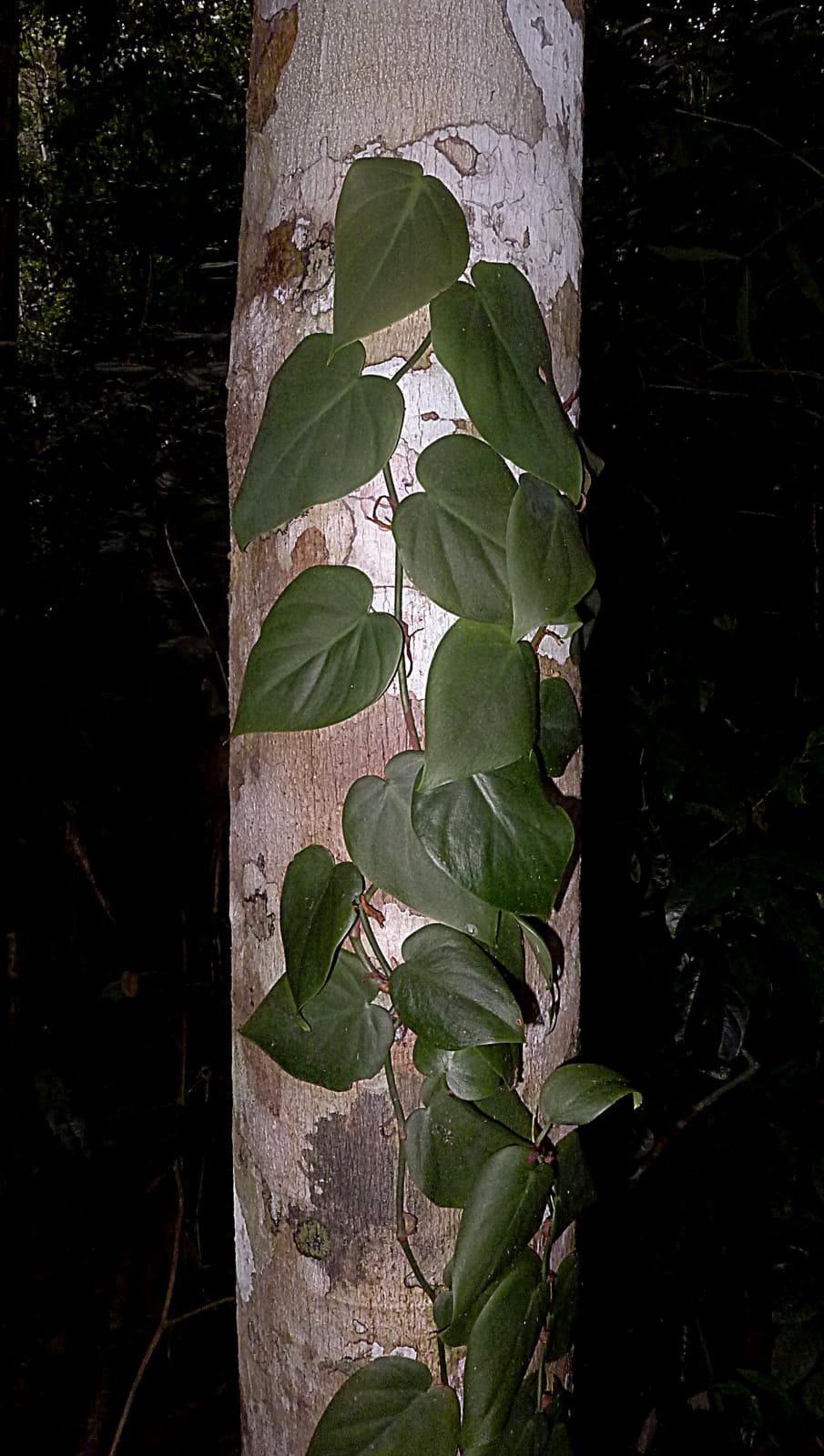
Is my philodendron a climber or self-heading?
Read moreShow less
The name philodendron means "tree lover," and UF/IFAS Extension notes that many species are vines that climb trees. It sorts the genus into three groups: vining, self-heading, and erect or tree-like. NC State Extension describes the difference you can see: climbers have aerial roots that attach to a pole or trellis, while self-heading types grow upright on very short stems with their leaves held in a rosette. Clemson Extension adds that most common philodendrons are vining, and self-headers send their leaves out of a dense clump at the base.
So check two things. Are there long gaps of bare stem between the leaves? Are there short brown roots poking out along the stem? If yes, you have a climber. If every leaf comes from the same crowded spot near the soil, it's self-heading.
Which philodendrons climb, and which stay in a clump?
Here is how our sources group the philodendrons people grow most. Each card has more detail.
| Philodendron | Habit | Sources |
|---|---|---|
| Heartleaf (P. hederaceum), including 'Brasil' and 'Lemon Lime' | Climbs or trails | NC State, Clemson, RHS, Iowa State |
| 'Micans', the velvet form of heartleaf | Thin-stemmed vine | UF/IFAS |
| Black-gold or velour philodendron (P. melanochrysum) | Climber | RHS, Clemson |
| Pink Princess (P. erubescens) | Kew lists the species as a climber; red-leaf philodendron is a climbing type in Iowa State's list | Kew WCVP, Iowa State |
| Fiddle-leaf philodendron (P. bipennifolium) | Sources disagree: a thick-stemmed vine often grown on a totem (UF/IFAS, Iowa State), or self-heading with upright stems (UConn) | UF/IFAS, Iowa State, UConn |
| 'Xanadu' (P. xanadu) | Self-heading, about 2 to 3 feet (60 to 90 cm) tall | UF/IFAS, UConn, Iowa State |
| 'Birkin' and 'Moonlight' | Self-heading | Iowa State, UF/IFAS ('Moonlight') |
| 'Rojo Congo' and related hybrids such as 'Imperial Red', 'Prince of Orange' and 'Black Cardinal' | UF/IFAS lists these hybrids as self-heading | UF/IFAS |
| Tree philodendron, often sold as P. selloum (P. bipinnatifidum) | Erect and tree-like with a woody stem, wider than tall with age | UF/IFAS, NYBG |
| P. gloriosum | Sources disagree; see below | Kew WCVP |
P. gloriosum is the one people ask about most, since "how to support philodendron gloriosum" is a common search. Kew's checklist files it under climbers, while a botanical database description we could only read in a search result describes a creeping stem. No extension service or botanical garden care page we found settles it. If your gloriosum's stem crawls along the soil, it's showing you its habit, and there's no source telling you to force it up a pole. Our velvet philodendron guide has more on this plant.
What does a pole do for a climbing philodendron?
Read moreShow less
In nature, UConn's Home & Garden Education Center explains, philodendrons climb tree trunks and take in the moisture and nutrients trapped in the bark. A pole indoors plays the same part. The RHS says climbers are best tied to a moss pole, and if the pole stays moist, the stems will eventually root into it.
The payoff can be bigger leaves. Clemson says that, as with most philodendrons, the velour philodendron's leaves don't reach full size unless the plant is trained upward for several years. Light still matters: the RHS says too little light makes philodendrons leggy, with fewer and smaller leaves, whatever they're climbing.
Our monstera moss pole guide covers poles in depth for monstera, philodendron's climbing cousin (both are aroids).
Which support should I use?
| Support | What the sources say | Sources |
|---|---|---|
| Moss pole | Climbers are best tied to one; stems root into it if it stays moist | RHS, Iowa State |
| Bark- or moss-covered board, or a totem pole | Heartleaf philodendrons can be trained up one | Clemson, University of Missouri |
| Moisture-holding column | Suggested for heartleaf in a search result from Missouri Botanical Garden's Plant Finder (to be checked by hand) | Missouri Botanical Garden |
| Trellis | Climbing types attach to a pole or trellis; Iowa State lists a trellis as an option | NC State, Iowa State |
| Hanging basket or high shelf | For letting a smaller-leaved climber trail instead | RHS, Iowa State |
| Coir (coconut fiber) pole | Sold widely; none of our sources describe one for philodendrons | none |
The University of Missouri adds that some philodendrons with weak stems are normally attached to a totem so they don't flop.
How do I put a climbing philodendron on a moss pole?
No extension page gives philodendron-specific steps, so these come from what the sources say about philodendron supports plus the staking principles in our monstera moss pole guide.
- Pick a sturdy moss pole or moss-covered board taller than the plant is now, since climbers keep growing.
- If you're repotting anyway, set the pole in the new pot first, deep in the mix, then add the plant beside it so you don't push the pole through the roots.
- Use a pot heavy enough not to tip once the plant gets tall.
- Turn the stem so the side with aerial roots faces the pole.
- Tie the stem to the pole with soft twine or a plant tie, loosely, in a figure eight, so the tie won't cut in as the stem thickens.
- Guide any loose aerial roots onto the pole.
- Wet the moss when you water the plant, so the roots have something damp to root into.
- Keep tying new growth higher as the stem climbs, and check old ties now and then.
Why these steps: the RHS says climbers do best tied to a moss pole that stays moist, and Iowa State says aerial roots can be guided toward a support. UF/IFAS notes that growers add 10 to 20 percent coarse sand to the mix of tall totem plants, 3 feet (90 cm) and up, so they don't tip, which is why a heavy, stable pot matters. Soft, loose figure-eight ties come from the RHS and Penn State Extension's staking advice, which our monstera moss pole guide explains. None of our sources gives a pole height for philodendrons.
What do I do with the aerial roots?
Read moreShow less
Iowa State University Extension says many philodendrons make aerial roots that help them climb. It lists three options: leave them alone, guide them toward a support, or place them in the soil so they root in. If they bother you, it says you can cut them back near the main stem with sharp pruners without harming the plant.
On a climber, guiding them onto a damp pole puts them to work. That is the whole point of the pole, as the RHS describes it.
Do self-heading philodendrons need support?
Read moreShow less
The RHS says bushy philodendrons generally don't need training or support, and UConn says self-heading species need no support. Clemson warns that self-heading types can get very large over time and need plenty of room, and Iowa State says some grow about twice as wide as they are tall.
Clemson also says their leaf stalks are brittle, so keep them out of busy walkways where people brush past. The tree philodendron is the extreme case. UF/IFAS says it can reach 15 feet (4.5 m) with leaves up to 4 feet (1.2 m) long, and the New York Botanical Garden notes that its leaves sprawl until the plant is wider than it is tall. Give it a spot with room to spread instead of a pole.
Can I let a climbing philodendron trail instead?
Read moreShow less
NC State says heartleaf philodendron climbs or trails if given support, and the RHS suggests smaller-leaved trailing forms for high shelves or hanging containers. Iowa State lists a hanging basket alongside a trellis or moss pole for climbing types.
Clemson says a vining philodendron can be kept to the height of its support by training and pruning. When a vine gets too long either way, trim it, and turn the pieces into new plants with our philodendron propagation guide.
Why is my philodendron leggy or flopping over?
Read moreShow less
The RHS says philodendrons get leggy with fewer, smaller leaves when light is too low. UF/IFAS describes the same thing from the nursery side: too little light makes leaf stalks too long and the plant open and floppy, and the fix is more light. A search result from Missouri Botanical Garden's Plant Finder says heartleaf stems get spindly if conditions are too dark.
- Long gaps between small leaves: move it closer to bright, indirect light. Our indoor light guide shows how to judge a spot, and our leggy plants guide covers fixing stretched stems.
- A climber leaning or sprawling: give it a pole or board and tie it on, as above.
- A self-header splitting open: check the light first, then give it more room. Brittle leaf stalks snap if the plant is crowded or bumped.
Wear gloves when you handle the stems: the RHS says philodendron sap can irritate skin, and NC State lists contact dermatitis. All parts are toxic to cats and dogs if chewed, as our philodendron care card explains.
Sources
- Cultural Guidelines for Commercial Production of Interiorscape Philodendron (ENH893) : UF/IFAS Extension (McConnell, Chen, Henny and Everitt; reviewed October 2024)
- Philodendron (HGIC 1509) : Clemson Cooperative Extension, Home & Garden Information Center (revised January 2016)
- Philodendron : NC State Extension Gardener Plant Toolbox
- Philodendron hederaceum : NC State Extension Gardener Plant Toolbox
- Philodendron : UConn Home & Garden Education Center
- Growing Philodendrons at Home : Iowa State University Extension and Outreach (Aaron Steil; last reviewed January 2025)
- How to grow philodendrons : Royal Horticultural Society
- Philodendron melanochrysum : Royal Horticultural Society
- Philodendrons as Interior Plants : University of Missouri (David Trinklein, January 2014)
- Tree philodendron question : New York Botanical Garden, Plant Information (updated November 2026)
- How to tie-in climbers : Royal Horticultural Society
- Supporting Herbaceous Plants in a Flower Garden : Penn State Extension
- World Checklist of Vascular Plants : Royal Botanic Gardens, Kew (data release, 2026-06-04 file)