Douglas fir Christmas tree: what to expect
A Douglas fir is a full, cone-shaped tree with soft, blue-green to dark green needles and one of the best scents on the lot. Its branches are bendier than a true fir's, so it suits lighter ornaments, and it holds its needles well as long as it never runs dry. It's also a bit of an impostor: despite the name, it isn't a true fir.
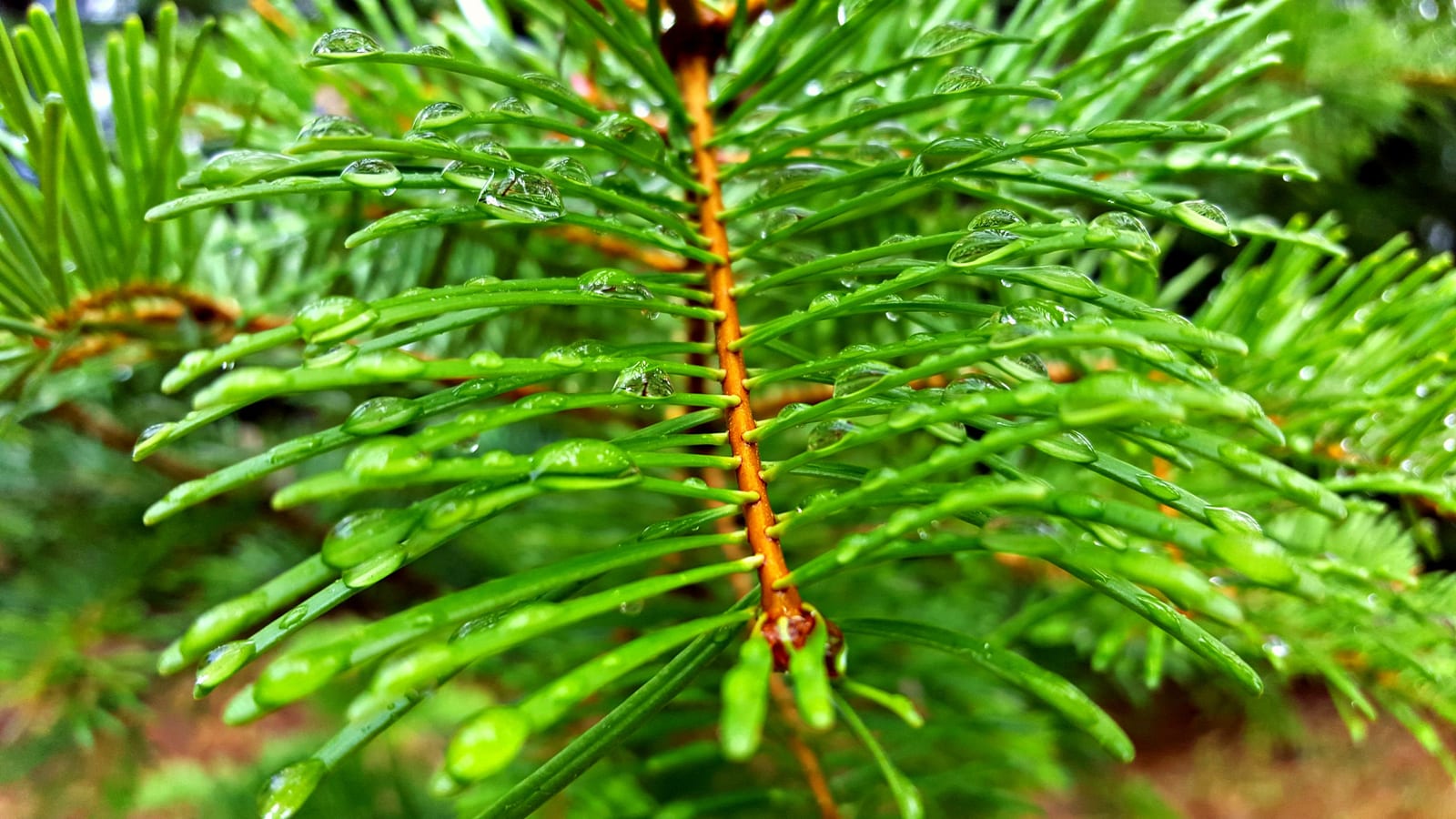
Tree card
Douglas fir · Pseudotsuga menziesii · Not a true fir
Also called: Oregon pine, Douglas spruce, red fir
Native to: Western North America, from British Columbia to Mexico
- Needle retentionGood
- FragranceStrong
- BranchesFlexible to medium (sources disagree)
- NeedlesSoft
Color: Blue-green to dark green · Shape: Full and naturally cone shaped
Grown in: Oregon and Washington; also British Columbia, North Carolina mountains
Sources: canr.msu.edu · extension.psu.edu · yardandgarden.extension.iastate.edu · hort.extension.wisc.edu · extension.illinois.edu · mortonarb.org · plants.ces.ncsu.edu
How long does a Douglas fir Christmas tree last?
Read moreShow less
Michigan State University's species guide rates Douglas fir good to excellent for needle holding in water. Penn State says good and Iowa State says very good. The catch is drying: Michigan State drops it to fair to good once it dries, while Fraser fir keeps a good rating. A Cornell Cooperative Extension guide sums it up: buy it fresh and keep it watered for the best needle holding.
For how many weeks a cut tree lasts in general, and how to tell when it's done, see our Christmas tree care guide.
Why is my Douglas fir losing needles?
Read moreShow less
Start with the stand. If the water dropped below the base of the trunk, our care guide explains why the tree stops drinking and how to fix it. Michigan State's ratings explain why a Douglas fir shows it sooner than a Fraser or noble fir: it holds its needles less well once dry.
Sometimes the tree arrived weak. Washington State University found that Douglas firs with Swiss needle cast, a fungal disease of the needles, dried about twice as fast on display. A fresh tree from a nearby farm, watered from day one, is your best bet.
What does a Douglas fir smell like?
Read moreShow less
Illinois Extension says its crushed needles give off one of the best aromas of any Christmas tree, and Iowa State calls the scent very good. Sources describe it differently: Penn State hears sweet and citrusy, while the Morton Arboretum says the crushed needles smell like camphor. Crush a few needles on the lot and decide for yourself.
Can a Douglas fir hold heavy ornaments?
Read moreShow less
UW-Madison suggests lighter ornaments because the branches are less stiff, and Iowa State says they can bend under heavy ones. Penn State rates them moderately stiff and says they may struggle with the very heaviest pieces. If you hang a lot of heavy glass, a stiffer tree such as a noble fir or Fraser fir is the safer pick. Penn State adds that a Douglas fir is naturally full and symmetrical.
Douglas fir vs noble fir: which is better?
Read moreShow less
- Needles that stay on: Iowa State rates noble fir excellent, and Washington State University says a watered noble fir can last about eight weeks. Douglas fir rates good.
- Branches: Illinois says noble fir's short, stiff branches suit heavier ornaments. Douglas fir's bend.
- Scent: Douglas fir has the stronger reputation. Iowa State calls both very good, and few other sources mention noble fir's scent at all.
- Needles: Douglas fir's are soft. Cornell says noble fir's aren't too sharp.
- Where they grow: both are native to the Pacific Northwest, and Oregon State University says they're the two most popular species on Oregon and Washington farms.
More on the other side: noble fir.
How does a Douglas fir compare with a Fraser fir?
Read moreShow less
Most sources rate Fraser fir's needle holding excellent and Douglas fir's good, and Michigan State's dry ratings widen the gap. Fraser's branches are strong or stiff in most sources, while Douglas fir's bend. Both are full and cone shaped. The USDA Economic Research Service says Oregon and North Carolina together grew more than half of US Christmas trees in 2022. Douglas fir is one of Oregon's two main trees, per Oregon State University, and Fraser fir is North Carolina's, per NC State. More: Fraser fir, or compare all 16 trees.
Is a Douglas fir a true fir?
Read moreShow less
The Morton Arboretum, Michigan State, Cornell and UW-Madison all point out that it isn't a true fir. NC State explains the name: Pseudotsuga joins the Greek for "false" with tsuga, the Japanese word for hemlock. People also call it Oregon pine, Douglas spruce and red fir, per NC State and the USDA Forest Service, so it gets mistaken for almost everything.
Can you plant a Douglas fir?
Read moreShow less
It's native to western North America, from British Columbia and Alberta south through the Rockies and Pacific states to Mexico, per the USDA Forest Service and NC State. The Morton Arboretum says it wants moist, well-drained, neutral to acid soil and dislikes hot, dry sites. NC State says it can't take heat and humidity and fails in North Carolina's Piedmont and Coastal Plain, though it grows well in the state's mountains.
A cut tree can't be planted. If you want one to plant after Christmas, read our potted vs cut Christmas tree guide first.
Is a Douglas fir safe for cats and dogs?
An ASPCA holiday release says Christmas trees aren't particularly toxic, and UConn's Home and Garden Education Center says fir, pine and spruce aren't known to be toxic if eaten. Swallowed needles can still cause vomiting or diarrhea, per UConn and UF/IFAS Extension, and the ASPCA's holiday tips warn that stand water grows bacteria that can upset a pet's stomach. Douglas fir's soft needles are kinder to small hands and paws than a sharp-needled Colorado blue spruce, which UW-Madison and Penn State suggest keeping away from small children. More in our guide to Christmas plants and pets. If your pet ate a lot of needles or seems unwell, call your vet; the ASPCA's poison line is (888) 426-4435 and may charge a fee.
Frequently asked questions (FAQ)
How do I keep a Douglas fir fresh?
A fresh cut, a big stand and plain water every day, kept above the base of the trunk. Penn State's holiday pets guide says plain fresh water with no additives, and UF/IFAS says additives aren't needed. The full routine is in our Christmas tree care guide.
Where are Douglas fir Christmas trees grown?
Mostly in western Oregon and Washington, per Oregon State University Extension, and NC State says it grows well in the North Carolina mountains too. In its native range it's grown as a Christmas tree in 4 to 7 years, per the USDA Forest Service. In Mexico, CONAFOR says about 8% of Christmas tree plantations grow it.
Is a Douglas fir a good Christmas tree?
Yes, if you love scent and a soft, full look and you'll keep the stand full. If you hang a lot of heavy ornaments, a noble or Fraser fir has stiffer branches, and if you tend to forget the water, a Fraser fir is more forgiving. Compare all 16 trees to see the trade-offs.
Sources
- Christmas Tree Species Guide : Michigan State University Extension (ratings from USDA ARS Agriculture Handbook 66, revised 2016)
- Selection and Care of Cut Christmas Trees : Penn State Extension (updated November 2026)
- Tips for Selection and Care of Cut Christmas Trees : Penn State Extension (updated September 2025)
- Holiday Plants and Pets : Penn State Extension (updated November 2025)
- What types of Christmas trees are available? : Iowa State University Extension and Outreach (updated December 2024)
- Tree Species : University of Illinois Extension
- Choosing the right Christmas tree : University of Wisconsin-Madison Extension, L. Jull (December 2024)
- Christmas Tree Guide 2024 : Cornell Cooperative Extension Monroe County
- Douglas-fir : The Morton Arboretum
- Christmas Tree Species : NC State Extension (revised January 2019)
- Pseudotsuga menziesii : NC State Extension Gardener Plant Toolbox
- Pseudotsuga menziesii var. menziesii : USDA Forest Service, Fire Effects Information System (1991)
- Douglas-fir : USDA Forest Service, Silvics of North America (1990)
- Ask Mr. Christmas Tree : Washington State Magazine, Washington State University (October 2013)
- OSU research keeps Oregon Christmas tree industry No. 1 in the nation : Oregon State University Extension (March 2025)
- Christmas tree nutrient management guide for Western Oregon and Washington : Oregon State University Extension, EM 8856 (revised January 2019)
- 2022 Census of Agriculture: U.S. tree farms cut more than 14.5 million Christmas trees : USDA Economic Research Service (December 2024)
- Árboles de Navidad naturales y mexicanos, ¿por qué elegirlos? : Comisión Nacional Forestal, CONAFOR (November 2022)
- How to Care for a Fresh Christmas Tree : UF/IFAS Extension Hillsborough County (December 2025)
- Plant Hazards to Avoid this Holiday Season : UConn Home and Garden Education Center (December 2024)
- ASPCA Offers Pet Safety Tips for the Holiday Season : ASPCA (November 2013)
- Holiday Safety Tips : ASPCA