Fraser fir Christmas tree: what to expect
A Fraser fir is the tree people pick when they want needles that stay put. It has soft, dark green needles with a silvery underside, a spicy fir scent and sturdy branches with room between them for ornaments. Most extension services rate its needle holding as excellent, and it ships well because it keeps its needles even after a long trip from the farm.
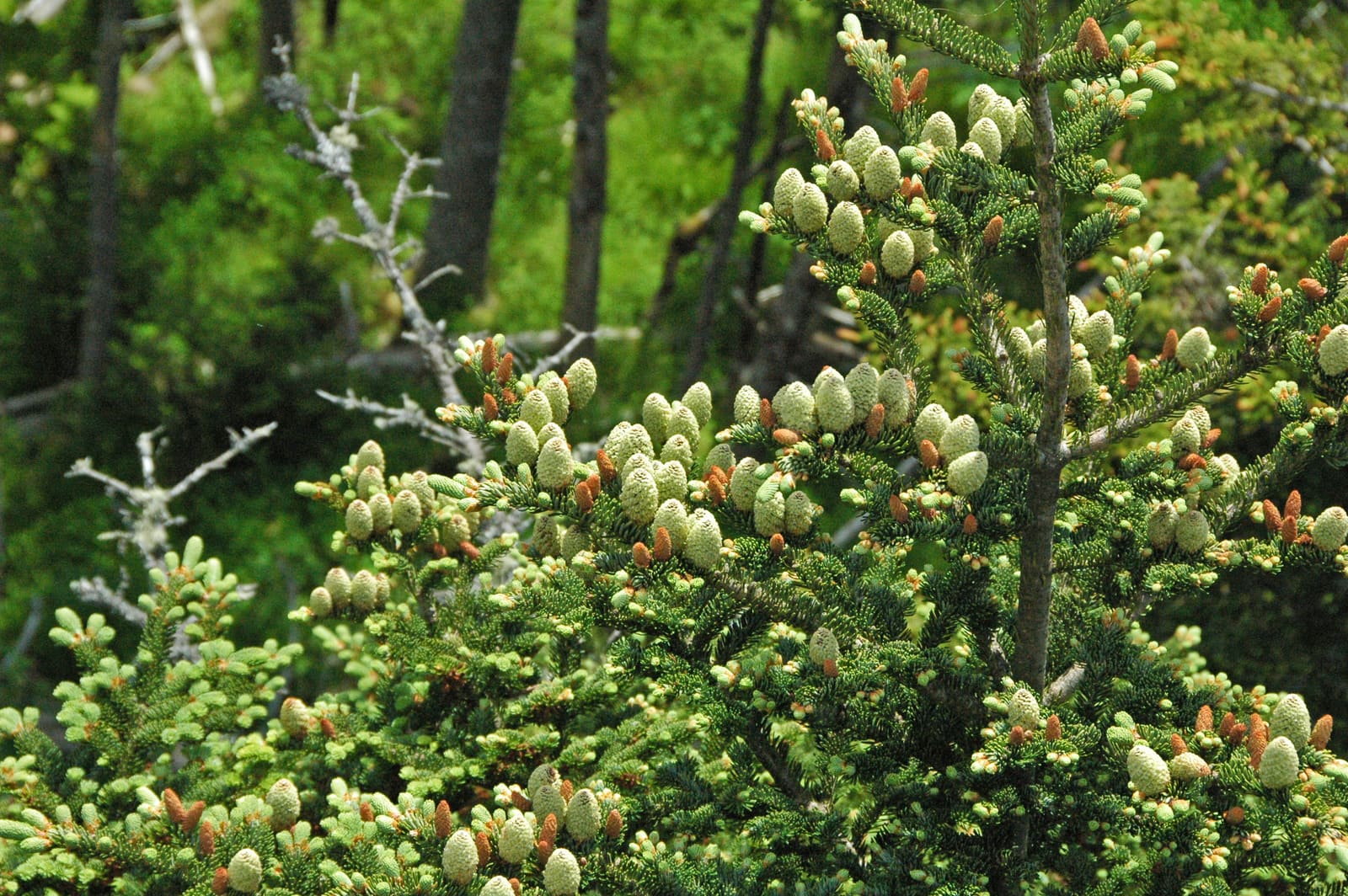
Tree card
Fraser fir · Abies fraseri
Also called: southern balsam fir, she-balsam
Native to: High peaks of the southern Appalachians (Virginia, North Carolina, Tennessee)
- Needle retentionGood to excellent (sources disagree)
- FragranceStrong
- BranchesMedium to stiff (sources disagree)
- NeedlesSoft
Color: Dark green, silvery underneath · Shape: Conical, with room between branches for ornaments
Grown in: North Carolina mountains; also Michigan, Wisconsin, Quebec
Keeping it fresh: Drinks more water than most trees in the first days; holds its needles well even when it dries a little.
Sources: canr.msu.edu · content.ces.ncsu.edu · hgic.clemson.edu · extension.psu.edu · hort.extension.wisc.edu · plants.ces.ncsu.edu
How long does a Fraser fir Christmas tree last?
Read moreShow less
Michigan State University's species guide rates Fraser fir excellent for needle holding in water. NC State Extension, Clemson and Iowa State say excellent too, and UW-Madison puts it among the best. Penn State and Illinois Extension rate it good. Every source puts it at good or better.
It also forgives a little neglect. Michigan State gives it a good rating even when it dries out, the best of the firs in its guide. NC State adds that it ships long distances well.
For how many weeks a well-watered cut tree lasts in general, and how to tell when it's done, see our Christmas tree care guide.
Does a Fraser fir smell good?
Read moreShow less
Clemson goes furthest, calling the fragrance exceptional and saying it lasts. Penn State describes it as spicy and resinous, Iowa State calls it very good, and NC State and Illinois call it pleasing or pleasant. If you want the strongest scent of all, balsam fir is the usual rival (see the comparison below).
Can a Fraser fir hold heavy ornaments?
Read moreShow less
NC State says the branches are strong enough for heavy ornaments, UW-Madison says they're stiff enough for heavier ones, and Clemson calls the limbs sturdy. Penn State is the cautious voice: moderately stiff, so the very heaviest pieces may be a stretch. A Cornell Cooperative Extension guide adds that the open spacing between branches makes it easy to decorate.
How do you keep a Fraser fir fresh?
Read moreShow less
Penn State notes that Fraser and Canaan fir can take up even more water than other species at first, so a stand that looked full at breakfast can be low by dinner. Use plain water: Penn State's holiday pets guide says plain fresh water with no additives, and UF/IFAS Extension says additives aren't needed. The full routine, from the fresh cut to fire safety, is in our Christmas tree care guide.
Fraser fir vs balsam fir: which should you get?
Read moreShow less
They're close cousins, and both are true firs. Here's how the sources split them:
- Needles that stay on: In water, Michigan State rates Fraser excellent and balsam good to excellent. Once they dry, Fraser still rates good and balsam drops to fair, so Fraser forgives a missed watering better.
- Scent: both smell like Christmas. Michigan State says balsam is picked for its strong scent, and UW-Madison calls it the most aromatic of the firs it lists.
- Branches: Fraser's are stiffer. Cornell says balsam's branches are flexible and may not hold heavier ornaments.
- Shape: Cornell calls balsam narrower than average, good for small rooms.
- Where it grows: balsam is native to the northeastern US and most of Canada; Fraser comes from the high peaks of the southern Appalachians.
More on the other side: balsam fir.
How does a Fraser fir compare with noble and Douglas fir?
Read moreShow less
- Noble fir: Iowa State rates its needle holding excellent, and Illinois says its short, stiff branches suit heavier ornaments. Fewer sources say much about its scent. It's grown mostly in western Oregon and Washington, so in the East it travels farther. See noble fir.
- Douglas fir: Penn State and Iowa State rate its needle holding good to very good, a step below Fraser in most sources. UW-Madison and Iowa State say its branches are less stiff and can bend under heavy ornaments. Its scent is a highlight, and it isn't a true fir at all. See Douglas fir.
Want the whole lineup side by side? Compare all 16 trees.
Can you plant a Fraser fir?
Read moreShow less
In the wild it grows only on the high peaks of the southern Appalachians, at about 4,500 to 6,700 feet (1,370 to 2,040 m), in southwest Virginia, western North Carolina and eastern Tennessee, per the USDA Forest Service and NC State. NC State's Plant Toolbox lists it for zones 4a to 7a in full sun to part shade and acid soil below pH 6.0. Michigan State says it needs acid soil and good drainage and is very prone to root rot in wet ground. Clemson notes it isn't grown in South Carolina because it needs cool summers.
A cut tree can't be planted. If you want one to plant after Christmas, read our potted vs cut Christmas tree guide first.
Is a Fraser fir safe for cats and dogs?
An ASPCA holiday release says Christmas trees aren't particularly toxic, and UConn's Home and Garden Education Center says fir, pine and spruce aren't known to be toxic if eaten. Swallowed needles can still cause vomiting or diarrhea, per UConn and UF/IFAS, and the ASPCA's holiday tips warn that stand water grows bacteria that can upset a pet's stomach. Fraser's soft needles are kinder to small hands and paws than a sharp-needled Colorado blue spruce, which UW-Madison and Penn State suggest keeping away from small children. More in our guide to Christmas plants and pets. If your pet ate a lot of needles or seems unwell, call your vet; the ASPCA's poison line is (888) 426-4435 and may charge a fee.
Frequently asked questions (FAQ)
Is a Fraser fir a true fir?
Yes. Its botanical name is Abies fraseri, and Abies is the true fir genus, per the USDA PLANTS Database and the USDA Forest Service. Other names include southern balsam fir and she-balsam.
Where are Fraser fir Christmas trees grown?
Mostly in the North Carolina mountains, per NC State. The USDA Economic Research Service says Oregon and North Carolina together grew more than half of the 14.5 million trees US farms cut in 2022. UW-Madison lists Fraser among Wisconsin's trees, and the Quebec government says it's Quebec's second most grown tree after balsam fir.
Is a Fraser fir a good Christmas tree?
For most homes, yes: soft needles, strong scent, sturdy branches and needle holding that most sources call excellent. If you want the very strongest scent, look at balsam fir; if you live in the West, noble fir is grown closer to home. Compare all 16 trees to see the trade-offs.
Sources
- Christmas Tree Species Guide : Michigan State University Extension (ratings from USDA ARS Agriculture Handbook 66, revised 2016)
- Christmas Tree Species : NC State Extension (revised January 2019)
- Abies fraseri : NC State Extension Gardener Plant Toolbox
- Selecting a Christmas Tree : Clemson Cooperative Extension, Home and Garden Information Center (revised November 2019)
- What types of Christmas trees are available? : Iowa State University Extension and Outreach (updated December 2024)
- Choosing the right Christmas tree : University of Wisconsin-Madison Extension, L. Jull (December 2024)
- Selection and Care of Cut Christmas Trees : Penn State Extension (updated November 2026)
- Tips for Selection and Care of Cut Christmas Trees : Penn State Extension (updated September 2025)
- Holiday Plants and Pets : Penn State Extension (updated November 2025)
- Tree Species : University of Illinois Extension
- Christmas Tree Guide 2024 : Cornell Cooperative Extension Monroe County
- Abies fraseri : USDA Forest Service, Fire Effects Information System (1993)
- Abies fraseri plant profile : USDA NRCS PLANTS Database
- 2022 Census of Agriculture: U.S. tree farms cut more than 14.5 million Christmas trees : USDA Economic Research Service (December 2024)
- Culture des arbres de Noël : Gouvernement du Québec (updated March 2026)
- How to Care for a Fresh Christmas Tree : UF/IFAS Extension Hillsborough County (December 2025)
- Plant Hazards to Avoid this Holiday Season : UConn Home and Garden Education Center (December 2024)
- ASPCA Offers Pet Safety Tips for the Holiday Season : ASPCA (November 2013)
- Holiday Safety Tips : ASPCA