Potted Christmas tree vs cut: an honest side by side
A cut tree is the easy choice: it can stay up for three to five weeks with daily water, then it gets recycled. A potted tree, with its roots in a pot or a burlap-wrapped ball, can go on to grow in your yard, but it can only spend about a week indoors, it's heavy, and it needs a plan for planting day. Which one is better depends on your climate, your yard and how much work you want in late December.
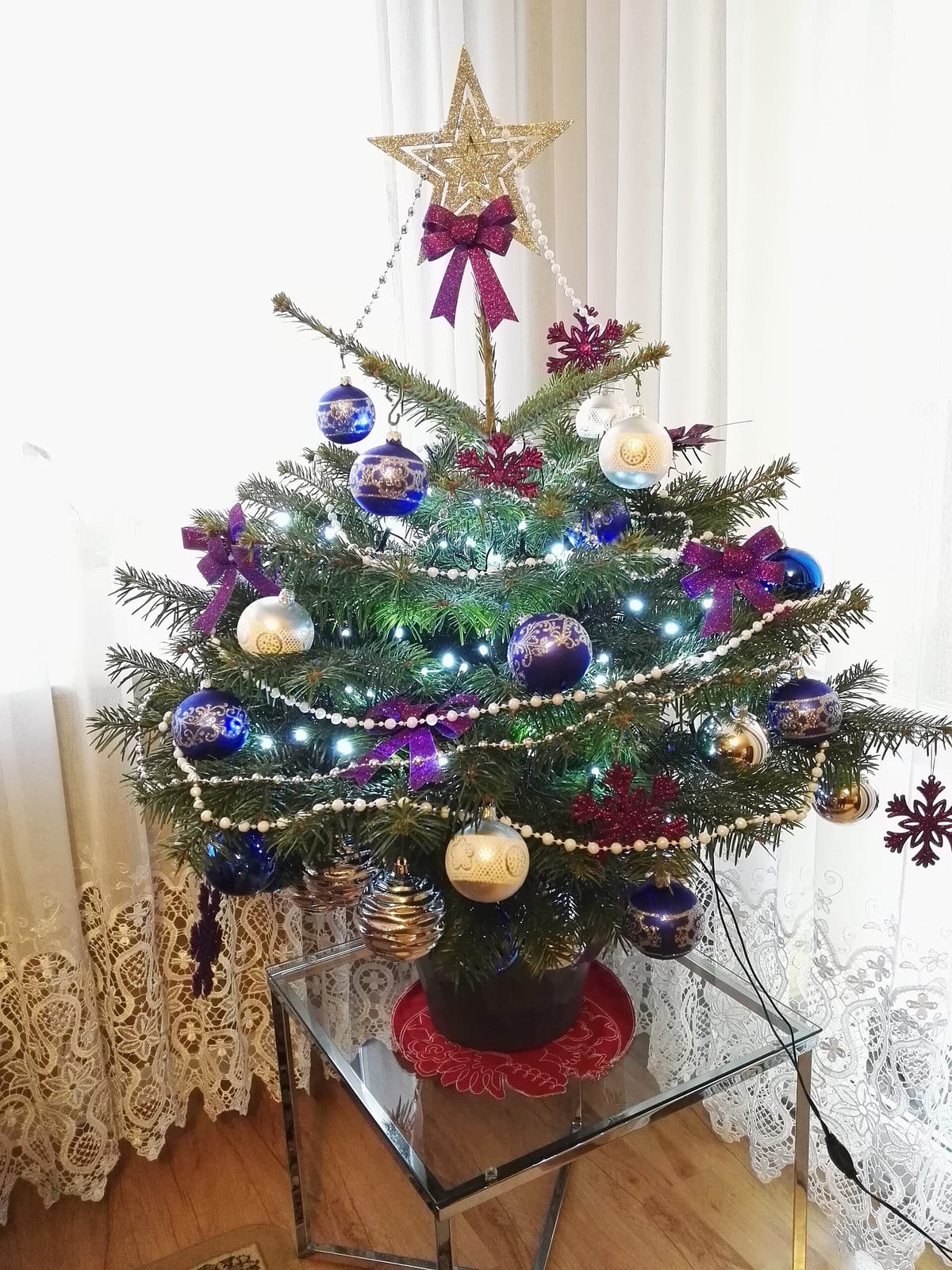
Is a cut or potted Christmas tree better?
| Cut tree | Potted tree (container or balled and burlapped) | |
|---|---|---|
| Time indoors | About 3 to 5 weeks with daily water | About 4 days to 10 days, depending on the source |
| Daily care | Keep the stand full of plain water | Keep the root ball evenly moist, never flooded |
| Extra work | A fresh cut at the base | Acclimate it before and after, dig the hole early, plant it, water it for a year or two |
| Size and weight | Any size; the stand holds it | Smaller, and the root ball is very heavy |
| Mess | Falling needles, stand water | Falling needles, plus soil and a watertight tub under the root ball |
| Fire safety | Safe while watered; take it down when dry | The same tips apply; a dried root ball also stresses the tree |
| Afterward | Recycled into mulch or used in the yard | Planted in the yard, or kept in a pot for a few years |
Time indoors. Cut trees last about three to five weeks with care, per University of Illinois Extension, another Illinois page and the RHS. Potted trees get days: the next section explains why.
Effort and weight. Penn State Extension says a damp burlap root ball adds so much weight that you should choose a smaller tree than you would cut, and Clemson Extension calls these trees very heavy. Penn State and Illinois Extension both suggest setting a short tree on blocks or a stand to make it look taller. Utah State University Extension adds that a living tree costs more than a cut one and should be carried by the pot or ball, never by the trunk.
Fire safety. No source we found says either kind is safer. The U.S. Fire Administration rules apply to both: keep any real tree watered, at least 3 feet from heat and out of exits. A cut tree is the bigger worry once it dries, and NC State Extension says a potted tree that dries out indoors even once may be stressed beyond recovery. Our real tree care guide has the full fire safety list.
Success isn't guaranteed. NC State is frank: many living trees don't survive or grow well after the holidays, usually because of the wrong species for the area, a tree that's too big, drying out, or too many days indoors. Smaller trees handle the move better.
How long can a live Christmas tree stay indoors?
Read moreShow less
Here is what each source says:
- Illinois Extension: 4 to 5 days in total.
- Penn State: 4 to 5 days is ideal, a week at most.
- Utah State: about a week.
- NC State: about a week to 10 days at most.
- Clemson and UF/IFAS Extension (Florida): 7 to 10 days, and Clemson warns that longer can kill the tree.
- The RHS (UK): no more than 12 days, and move it back outside sooner if it looks unhappy.
The reason is dormancy. Illinois Extension explains that a tree kept inside longer may break its winter rest and start growing, and NC State adds that a tree that has woken up can be injured or die when it goes back into the cold, while trying to re-harden it works only a little. So bring it in as late as you can (the RHS suggests the weekend before Christmas) and take it out soon after.
How do you care for a potted Christmas tree indoors?
Read moreShow less
- Before it comes in: Penn State suggests one to two weeks in a garage, shed or sheltered spot outside so the tree adjusts gradually. UF/IFAS suggests a shady spot outdoors first.
- Where to put it: a cool spot away from heat sources and direct sun, per Penn State, NC State and Clemson. NC State says lowering the thermostat a few degrees slows drying.
- Water: check the root ball every day. Keep it evenly moist and never flooded (Clemson, NC State). UF/IFAS calls overwatering a common problem and suggests the finger test: if the soil is moist to your first knuckle, wait. NC State says a full-size tree can use up to a gallon a day, and both Clemson and NC State suggest scattering crushed ice over the root ball as a slow way to water.
- Protect the floor: set a burlap-wrapped ball in a watertight tub with a layer of stones or gravel in the bottom so the roots don't sit in water (Penn State, Clemson).
- Lights: LED or other low-heat lights only (Penn State, NC State, Clemson).
Can you plant a potted Christmas tree after Christmas?
Read moreShow less
Pick the right tree for your zone. Penn State says some small container trees can be planted out and others have to stay in pots, so check the tag for winter hardiness. NC State says the same about tabletop trees and warns that greenhouse-grown plants may not be hardy. Look up your zone on the USDA Plant Hardiness Zone Map and compare it with the tag.
Some favorites are poor choices outside their home turf. NC State says Fraser fir, the classic cut tree, grows naturally at high elevations and usually lives only a few years when planted lower. For the Piedmont and Coastal Plain of the Southeast it suggests eastern redcedar, Leyland cypress, Virginia pine and Arizona cypress instead. Clemson lists similar trees for South Carolina, plus southern red cedar for the coast.
Plan for the grown-up size. Many of these become big trees. Clemson lists Leyland cypress at 60 to 70 feet tall, Virginia pine at 60 to 65 feet and eastern white pine at 50 to 100 feet, and Illinois Extension says many will spread 12 to 15 feet wide at the base. Pick a spot with room for its full size, or choose a dwarf conifer (the RHS suggests dwarf spruces for pots and small gardens).
Or keep it in a pot. The RHS says you can keep it in a container, moving it to a slightly bigger pot each year until it reaches about 18 inches (45 cm) across and deep. It also warns that most conifers aren't suited to life in a pot and may last only a few years that way.
How do you plant a potted Christmas tree after the holidays?
- In late fall, before the ground freezes, dig the hole: about as deep as the root ball, or a little shallower, and two to three times as wide.
- After Christmas, move the tree to an unheated garage or sheltered spot for several days so it adjusts to the cold.
- Plant it as soon as you can. Remove the pot, plus any wire, twine and synthetic burlap; natural burlap can stay on the sides.
- Loosen any roots circling the outside of the root ball.
- Set the tree so the root flare (where the trunk widens into roots) sits level with the ground or slightly above it.
- Refill the hole, water thoroughly, and spread 2 to 3 inches of mulch over the area, keeping it off the trunk.
- Stake it only in a windy spot, and hold off on fertilizer until growth starts in spring.
- Keep watering through dry spells for the first year or two while the roots settle in.
Where each step comes from: Penn State, Utah State and Illinois Extension all say to dig the hole before the ground freezes. Clemson says the hole should match the root ball's depth and be at least twice as wide, Utah State says about three times as wide, and NC State says the same width as the root ball, slightly shallower, inside a much bigger loosened area. Penn State, Clemson and NC State all call for a few days of adjusting before planting. Clemson, NC State and Penn State cover removing synthetic burlap and wire, and Clemson and NC State cover loosening circling roots and the 2 to 3 inches of mulch. The root flare depth is from Penn State and Illinois. Staking only in wind and waiting on fertilizer are from NC State and Clemson; Utah State suggests staking for the first year either way. The RHS says newly planted conifers need regular water for their first two years, and UF/IFAS says at least two years in Florida.
If the ground is already frozen, Penn State and NC State say to keep the tree in an unheated, wind-sheltered place like a garage, keep the root ball watered, and plant it in spring. Clemson, writing for South Carolina's mild winters, says to plant right after the holidays and not wait for spring.
What about warm climates and the Southern Hemisphere?
Read moreShow less
Mild US winters. UF/IFAS lists red cedar, Arizona cypress, Leyland cypress, Torulosa juniper and sand pine as living Christmas trees for Florida, and warns that trees sold locally don't always grow well there. It says to keep the tree inside no more than about 10 days and to water it until established, at least two years. Clemson and NC State lists (above) cover the rest of the Southeast. Norfolk Island pine also suits South Florida per UF/IFAS, but that's a houseplant-style tree: see living Christmas trees.
Summer Christmas. In Argentina, Chile, Uruguay, southern Brazil, Australia and South Africa, Christmas comes in summer. We found no extension or botanical garden guide written for a summer Christmas tree, so here is what the general sources say. Heat dries trees fast, which is why every source asks for a cool room away from sun and heat. And the RHS conifer guide says a container-grown conifer can be planted any time of year, but to avoid hot, dry weather unless you can water well, with fall to early spring as the easy window. Where Christmas is in summer, that window is autumn, roughly March to May. Until then, keep it in its pot and water it regularly; the RHS says conifers in containers need regular watering.
Which is better for the environment?
Read moreShow less
What the sources do say:
- Both come from farms. Utah State says most trees sold on lots in Utah are grown on farms in Oregon and Washington. NC State says farm-raised trees are completely recyclable.
- A growing tree stores carbon. The RHS says real trees support wildlife and absorb carbon while they grow, and suggests buying a locally grown tree.
- A planted tree can last. Clemson describes living trees going on to become landscape trees, including one planted as a screen along a road that was 25 years old. NC State warns many don't survive, so the benefit depends on success.
- Renting is an option. The RHS mentions renting a potted tree that goes back to the grower after the holidays.
We didn't find a source we trust that says one choice is clearly greener, so we won't claim one.
Frequently asked questions (FAQ)
What does "balled and burlapped" mean?
A tree dug from the field with its roots in a ball of soil wrapped in burlap or fabric. Penn State says these must be planted outdoors afterward. Container trees grow in a pot and are usually smaller, tabletop size.
Can you replant a cut Christmas tree?
No. A cut tree has no roots left. Clemson Extension notes that a tree without roots can still shelter wildlife in the yard, but it won't grow. Our real tree care guide covers recycling it.
Can a potted Christmas tree stay in its pot all year?
Some can for a few years. The RHS suggests moving it to a slightly bigger pot each year until it's about 18 inches (45 cm) across, and warns that most conifers don't do well in a pot for long. Dwarf conifers are better suited to it.
Does a potted tree need water every day?
Check it every day. Penn State says container trees dry out fast indoors. UF/IFAS suggests the finger test: if the soil is moist to your first knuckle, wait. Never leave it standing in water.
Are Christmas trees safe for pets?
Needles and the water in the stand have their own answers in our guide to holiday plants and pets.
Is a Norfolk Island pine a potted Christmas tree?
It's a houseplant you can decorate and keep inside all year; the RHS says it isn't fully hardy outdoors. That's a different choice, covered in our living Christmas trees guide. For more gift ideas, see our Christmas gift plants guide.
Sources
- Caring for a Living Christmas Tree : Penn State Extension (updated November 2023)
- Selection and Care of Living Christmas Trees : NC State Extension (revised February 2019)
- Selection and Care of Christmas Trees : NC State Extension (revised February 2019)
- Living Christmas Trees : Clemson Cooperative Extension, Home and Garden Information Center (updated November 2023)
- Repurposing Christmas Trees to Benefit Wildlife : Clemson Cooperative Extension (updated November 2023)
- How to care for a living Christmas tree : University of Illinois Extension (December 2020)
- Caring for Live Christmas Trees and Caring for Christmas Trees : University of Illinois Extension
- Christmas Tree Selection and Care : Utah State University Extension (November 2019)
- Living Christmas Trees : UF/IFAS Extension Gardening Solutions
- Christmas trees: types and care : Royal Horticultural Society
- How to grow conifers : Royal Horticultural Society
- Holiday Fire Safety : U.S. Fire Administration
- USDA Plant Hardiness Zone Map : U.S. Department of Agriculture (2023)