Living Christmas trees: a Norfolk pine or rosemary you keep all year
Yes, a houseplant can be your Christmas tree, and the two classics are the Norfolk Island pine and rosemary trimmed into a little cone. A Norfolk pine wants a bright window and holds small ornaments; a rosemary tree wants real sun and a cool room, and you can snip it for cooking. Decorate either one lightly, and after the holidays both keep going as plants you can enjoy for years.
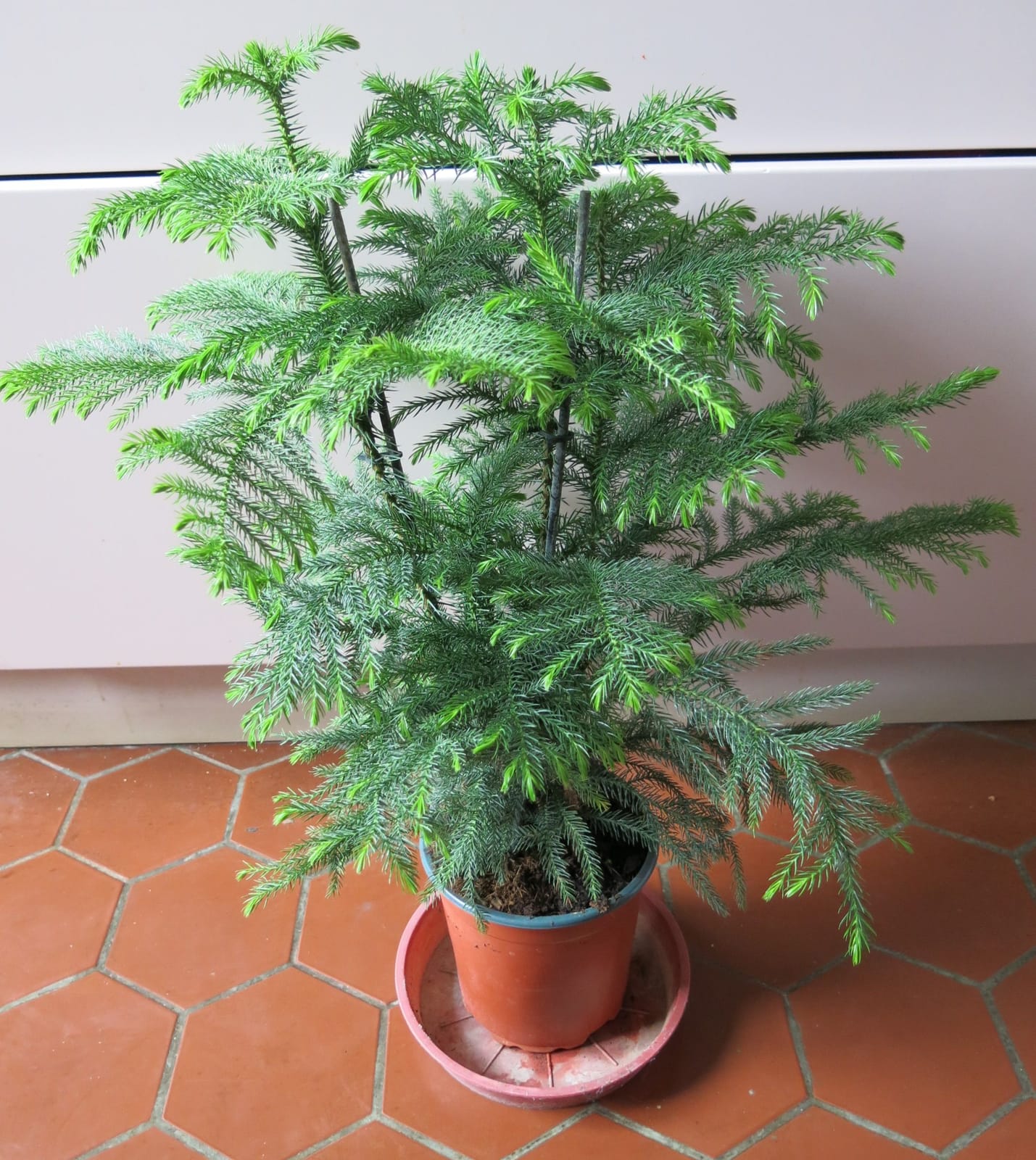
Can a houseplant be my Christmas tree?
Illinois Extension calls the Norfolk Island pine a living Christmas tree, and NC State Extension even lists "living Christmas tree" among its common names. Iowa State Extension puts it on its list of alternative Christmas trees, along with rosemary pruned into a small topiary tree. Rosemary trees show up in shops every December: UW-Madison Extension notes that rosemary is often sold for the holidays as a decorated topiary, and UF/IFAS says those topiaries are pruned into a festive tree shape.
| Norfolk Island pine | Rosemary tree | |
|---|---|---|
| Light | Bright light near a window; a little sun helps | About 6 hours of direct sun, or a grow light |
| Water | When the top inch is dry | When the top inch is dry; never soggy |
| Room | 55 to 70°F (13 to 21°C), humid | Cool: 45 to 65°F (7 to 18°C) |
| Care rating | Easy to moderate | Moderate |
| Pets | Non-toxic to cats, dogs and horses | Non-toxic to cats, dogs and horses |
| After Christmas | A houseplant for years | A sunny-window herb you can cook with |
| Outdoors all year | USDA zones 10 to 11 | USDA zones 8 to 10 |
Every value comes from the Norfolk Island pine care card and the rosemary care card, where each one links its sources.
Shopping for a spruce or fir in a pot that you plan to plant outside after the holidays? That's a different kind of living tree, with its own rules on how long it can stay indoors. Our cut or potted Christmas tree guide covers it.
Other options. Iowa State and Mississippi State Extension also name the dwarf Alberta spruce, the Italian stone pine and the lemon cypress as small holiday trees. All three are outdoor conifers, so treat them as short visitors indoors: Iowa State suggests keeping a hardy one like the spruce inside for only 7 to 10 days, and says the stone pine and lemon cypress can't take a cold winter outdoors, so most people enjoy them for the season. We didn't find any of the three on the ASPCA's plant list, so we don't call them pet safe; for needles and pets, see Christmas plants and pets.
How do you care for a Norfolk pine Christmas tree?
Read moreShow less
Think of me as a tree from a small island in the South Pacific: I like bright light, cool rooms and a bit of humidity. Iowa State Extension suggests a spot near an east, west or south window, and Purdue and the New York Botanical Garden say a couple of hours of direct sun is fine, as long as it isn't harsh midday sun.
- Water. Check the soil instead of watering on a schedule. When the top inch is dry, water until it runs out the bottom, then empty the saucer. Soil that dries out browns the lower branches, and soggy roots rot.
- Humidity. Purdue says it thrives around 50% humidity, and heated homes can fall far below that. A humidifier or a tray of pebbles and water helps, says Iowa State.
- Temperature. 55 to 70°F (13 to 21°C) is ideal; keep it above 50°F (10°C) and away from heat vents, radiators and cold drafts.
- A few dropped needles are normal. University of Missouri Extension says a new tree often drops some needles while it adjusts to less light than it had at the greenhouse, and NYBG says a few brown needles on the oldest, lowest branches are just aging. Iowa State adds a plus: it sheds whole branches instead of loose needles, so there's less sweeping than with a cut tree.
The Norfolk Island pine care card has the full care, including why lower branches brown and why you shouldn't cut the top off.
How do you keep a rosemary Christmas tree alive?
Read moreShow less
Rosemary comes from sunny Mediterranean hillsides, so I'm happiest with about 6 hours of direct sun a day. Iowa State and Penn State Extension ask for at least that much, and UF/IFAS says full sun; a grow light works when no window gets it. Turn the pot every week so each side gets sun.
- Foil off. The decorative foil traps water around the roots. UW-Madison Extension says to remove it and use a drip tray, and UF/IFAS suggests swapping it for a bow. Iowa State's rule: never let water sit in the sleeve or the tray.
- Water on the dry side. Check once or twice a week with a finger about an inch deep, and water thoroughly when it's dry. Too much water is the most common way rosemary dies.
- Keep it cool. A room around 45 to 65°F (7 to 18°C) suits it, and it needs to stay above freezing. Hot, dry air from a heater shrivels the leaves.
- Let the air move. Still, humid air brings powdery mildew, a white dust on the leaves, according to NC State. Iowa State suggests checking often for spider mites too.
The tree shape won't stay perfect, and that's fine. UF/IFAS says new growth and the sprigs you snip for cooking will change it over time. To keep the cone, Iowa State suggests pruning in late spring and midsummer, plus light trims as it grows.
The rosemary care card covers the rest, from grow lights to the white powder on leaves.
Can you put lights and ornaments on a living Christmas tree?
Read moreShow less
On a Norfolk pine. Its soft branches can hold ornaments, says Purdue, and UConn suggests ornaments and miniature lights. University of Missouri Extension adds two warnings: heavy ornaments can bend branches down for good, and lights that give off heat can damage the needles, so choose LED lights. One more thing to check when you buy it: Illinois Extension notes that many holiday trees are sold sprayed with green paint, which blocks light, so wipe off as much as you can.
On a rosemary tree. None of the extension guides we read gives rules for lights or ornaments on rosemary. The safe choice is to keep it simple: a ribbon or a bow on the pot instead of foil, as UF/IFAS suggests, and no reason to move it out of its sunny window or closer to a heater for the holidays.
Whatever you hang, take it off after the holidays so every branch gets light again.
What do you do with a living Christmas tree after Christmas?
Read moreShow less
Norfolk pine. Illinois Extension says many get thrown out after the holidays, even though they can be living trees for years. Iowa State says you can bring it back out every December until it outgrows its space, which takes many years. Give it your brightest window, keep it cool and away from heaters, raise the humidity in winter and start feeding again in spring. If it starts to lean or dries out fast, repot it one size up in spring. Don't cut the top to keep it short: the RHS and NYBG say that spoils its shape for good. A smaller pot keeps it smaller instead.
Rosemary tree. Keep it in full sun, cool and on the dry side through winter, with no fertilizer until late spring. In spring, after frost, UW-Madison Extension suggests repotting it in fresh mix and moving it outside. Snip it for the kitchen whenever you like.
Can a living Christmas tree grow outdoors?
Read moreShow less
Norfolk pine. It grows outdoors all year in USDA zones 10 to 11, where the coldest winter nights average 30°F (−1°C) or warmer; NC State rates it to zone 9. Plan for a giant: UF/IFAS says 60 to 80 feet tall. In colder places, it can spend summer outside once nights stay above 50°F (10°C) and frost is over, in bright shade out of afternoon sun. Move it out gradually so it doesn't scorch, and bring it back in before nights drop below 60°F (16°C).
Rosemary. It grows outdoors all year in USDA zones 8 to 10, where the coldest winter nights average 10°F (−12°C) or warmer. UF/IFAS says a holiday rosemary can go in the ground after Christmas in Florida, in full sun with good drainage. In colder places, keep it in its pot: UW-Madison Extension suggests sinking the pot to its rim in a sunny bed for summer, then bringing it in before the first fall frost. Rosemary dug out of the ground and potted in fall often doesn't survive the move.
Frequently asked questions (FAQ)
Is a Norfolk Island pine safe for cats and dogs?
The ASPCA lists the Norfolk Island pine as non-toxic to cats, dogs and horses, and NC State agrees. A UC Master Gardeners column notes that some vets report stomach upset when pets chew the needles, so keep curious pets from snacking on it. For the whole holiday picture, including ornaments and other seasonal plants, see our guide to Christmas plants and pets.
Is rosemary safe for cats and dogs?
Yes. The ASPCA lists rosemary as non-toxic to cats, dogs and horses, and NC State agrees. Eating a lot of any plant can still upset a pet's stomach.
Is a Norfolk Island pine a real pine?
No. Illinois Extension and UF/IFAS explain that it's a conifer from the Araucariaceae group, apart from the true pines. In the wild it comes from Norfolk Island, in the South Pacific between Australia, New Zealand and New Caledonia.
Can I cook with my rosemary Christmas tree?
Yes. It's the same culinary herb, and Iowa State and UF/IFAS both mention snipping it for the kitchen. Trimming for cooking changes the shape a little, which UF/IFAS calls natural.
What about a potted spruce or fir?
Those are hardy trees meant for the garden, and they can only stay indoors for a short time. Our cut or potted Christmas tree guide explains how to keep one alive and plant it out. For a cut tree, see how to keep a Christmas tree fresh.
What other plants make good Christmas gifts?
Our Christmas gift plants guide matches plants to the person, and Christmas plants other than poinsettia lists holiday bloomers that keep going long after New Year.
Sources
- Araucaria heterophylla and Salvia rosmarinus : NC State Extension Gardener Plant Toolbox
- Alternative Christmas Trees and How do I care for a Norfolk Island Pine? : Iowa State University Extension and Outreach
- Grow a living Christmas tree with Norfolk Island Pine, Norfolk Island Pines and Norfolk Island pine (The Garden Scoop) : University of Illinois Extension
- A Christmas tree from the South Pacific : University of Missouri Extension
- Norfolk Island Pine Needs TLC : Purdue University Consumer Horticulture
- Norfolk Island Pine : UConn Home and Garden Education Center
- Why is my potted Norfolk pine leaning and its needles browning? and Can I prune a Norfolk Island pine houseplant? : New York Botanical Garden
- Araucaria heterophylla : Royal Horticultural Society
- Araucaria heterophylla: Norfolk Island-Pine and Rosemary Topiaries : UF/IFAS Extension
- Holiday Houseplants (P2309) : Mississippi State University Extension
- Holiday Plants Toxic to Pets : UC Master Gardeners of Fresno County, UC Agriculture and Natural Resources
- Holiday Rosemary and Rosemary : University of Wisconsin-Madison Extension
- Growing Herbs Indoors : Penn State Extension
- Houseplant Winter Care Q&A : UNH Extension
- Australian Pine and Rosemary : ASPCA Animal Poison Control